

Liquid AI
A non-transformer model provider that replaces standard attention mechanisms with dynamical systems to deliver massive memory savings for edge devices and high-throughput enterprise applications.
Excellent for developers needing on-device AI or low-latency inference, weaker for users requiring the broad reasoning ecosystem of GPT-4 or Claude.
Analysis based on product data, pricing structure, traffic signals, and public user sentiment.
Who Should Use Liquid AI?
Typical users
Machine learning engineers, robotics developers, and enterprise architects building high-scale or hardware-constrained AI applications.
Maturity fit
advanced
Choose this if…
- You need to run large context windows on consumer-grade hardware without linear memory growth.
- Your priority is sub-20ms inference latency for real-time applications like search or recommendations.
- You are deploying AI on edge devices like smartphones, drones, or automotive head units.
Skip this if…
- You require a fully open-source ecosystem with extensive community fine-tunes.
- Your primary need is top-tier creative writing or highly nuanced human-like reasoning.
- You rely on a massive library of pre-built third-party plugins and integrations.
About Liquid AI
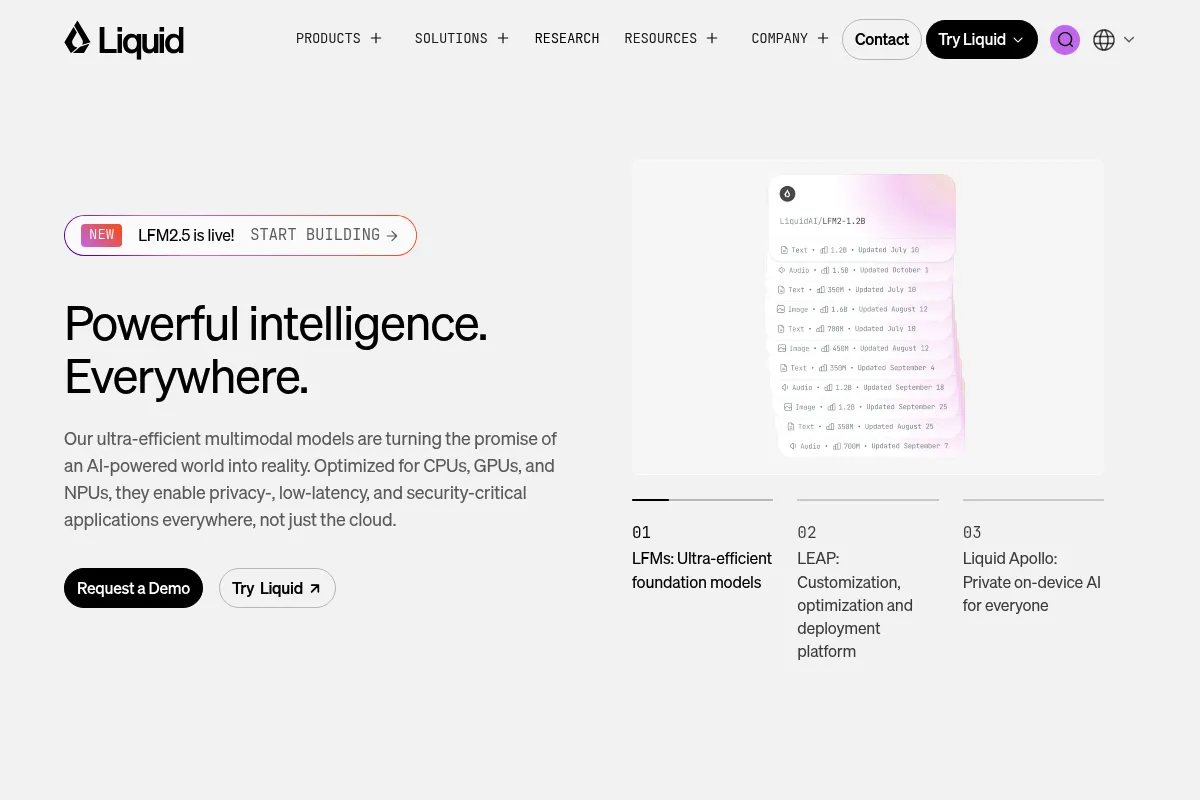
Liquid AI is an MIT spinoff developing Liquid Foundation Models (LFMs). It moves away from the standard Transformer architecture in favor of Liquid Neural Networks, which are designed to be more computationally efficient and adaptable to sequential data.
Official profiles
What it actually does
It provides a suite of foundation models (LFM-1.3B, 3B, and 40B) that process text, audio, and video with a fixed memory footprint. Users can access these models via API, download them for local deployment, or use the LEAP platform for custom fine-tuning.
What makes it different
Unlike Transformers, which suffer from a 'KV cache' that grows with every token, LFMs use a dynamical system architecture that maintains constant-time inference. This allows for massive context handling and high throughput without the exponential hardware costs typical of standard LLMs.
Key Features
LFM-40B MoE
High-throughput model with 12B active parameters for enterprise workloads.
LFM-1.3B Edge
Optimized for mobile and IoT hardware with minimal RAM requirements.
Liquid Playground
Web interface for immediate model testing and comparison.
LEAP Platform
Tools for customizing and deploying models to specific hardware targets.
Liquid Apollo
A mobile application for testing model performance directly on smartphones.
Sub-20ms Latency
Engineered for real-time commerce and search experiences.
Hardware-Aware Search (STAR)
Optimizes model architecture for specific silicon targets during training.
Pricing
Community / Startup
- Free for organizations with <$10M annual revenue
- Access to Playground
- Downloadable small models (Hugging Face)
- Community support
LFM-40B API
- 131K context window
- Sub-20ms inference capability
- Multimodal support
- Usage-based billing ($0.20/1M output)
Enterprise
- Full LEAP platform access
- Hardware-specific optimization
- Dedicated support
- On-premise deployment options
Pricing checked 6 months ago
Pricing guidance
- When your organization exceeds $10M in annual revenue
- When you need hardware-specific optimization via the LEAP platform
- When you require private, on-premise deployment for sensitive data
- Commercial use for larger enterprises requires direct sales contact
- Rate limits apply to the free Playground
- Full multimodal features may be restricted to enterprise tiers
Aggressive pricing for small players to build ecosystem, with premium enterprise licensing for high-scale commercial use.
Pros & Cons
Strengths
-
Extreme memory efficiency
By eliminating the linear growth of the KV cache, these models can handle long conversations on hardware that would crash standard Transformers.
-
Predictable performance
Constant-time inference means the model doesn't slow down as the input length increases, which is critical for real-time systems.
-
Low operational costs
Higher throughput per GPU allows enterprises to serve more users with fewer compute resources compared to traditional LLMs.
Weaknesses
-
Early-stage reasoning gaps
Users have reported occasional logic loops and 'GPT-2 level' responses on unconventional or highly complex reasoning tasks.
Affects: Developers building complex logic-heavy agents
-
Limited ecosystem
Lacks the massive community support, documentation, and third-party tooling available for Llama or OpenAI models.
Affects: Small teams needing plug-and-play solutions
-
Closed weights for flagship models
While some models are downloadable, the most advanced versions are often restricted to API or enterprise licensing.
Affects: Open-source purists and researchers
Real User Sentiment
Technically impressed but cautious. Users praise the architectural novelty and efficiency but remain skeptical of reasoning benchmarks compared to frontier models.
Users tend to like
- Memory efficiency on long context
- Speed of inference on local hardware
- MIT research pedigree
- Potential for robotics and IoT
Users commonly complain about
- Occasional repetitive loops in output
- Benchmark performance doesn't always translate to real-world reasoning
- Limited availability of weights for the largest models
Recurring tradeoffs
- Trading off the 'proven' reliability of Transformers for significant gains in throughput and memory.
Happiest users
Edge developers and enterprise architects managing high-volume, low-latency search or recommendation engines.
Often frustrated
General users expecting a ChatGPT-like experience with high creative reasoning and broad plugin support.
Use Cases
On-device Translation
Running language models on smartphones without draining battery or requiring cloud access.
Real-time E-commerce Search
Powering sub-20ms product recommendations for high-traffic platforms like Shopify.
Automotive Voice Assistants
Deploying low-latency, private voice control directly on vehicle hardware.
Robotics Control
Using liquid neural networks for adaptive movement and sensor processing in dynamic environments.
Long Document Analysis
Summarizing massive legal or technical files on local workstations without high VRAM GPUs.
Frequently Asked Questions
Is Liquid AI free to use?
Yes, for organizations with less than $10M in annual revenue. Larger companies must contact sales for commercial licensing. Small models are also available for free download on Hugging Face.
How does Liquid AI compare to Llama 3?
While Llama 3 is a standard Transformer, Liquid AI uses a non-transformer architecture. Liquid models are significantly more memory-efficient for long context and offer faster inference, though Llama 3 currently has a larger ecosystem of tools and fine-tunes.
What are the main limitations of Liquid Foundation Models?
The primary limitations are their early-stage reasoning capabilities, which can sometimes result in loops or lower-quality logic compared to top-tier models like GPT-4o. They also have a smaller community and fewer pre-integrated tools.
Does Liquid AI support multimodal inputs?
Yes, the LFM family is designed to handle text, audio, and video sequentially, making it suitable for vision-language tasks and real-time sensor data.
Can I run Liquid AI models locally?
Yes, the LFM-1.3B and LFM-3B models are specifically optimized for local execution on CPUs, GPUs, and NPUs, including Apple Silicon and mobile processors.
What is the maximum context window?
The LFM-40B model supports a context window of up to 131K tokens, while smaller models like the 1.3B version are optimized for 32K token context on edge devices.
Why trust this page?
This evaluation combines product positioning, pricing analysis, traffic and market signals, and public user sentiment into a single decision-support page. Content is generated editorially — not copied from the vendor's website.
Funding & Company
Founded
2023
Stage
Series a
Total Raised
$287.6M
Latest Round
Series A (Dec 2024)
Notable Investors
Liquid AI has raised a total of $287.6M across two rounds, including a substantial $250M Series A in late 2024 led by strategic partner AMD. This significant early-stage funding highlights strong investor confidence in its novel 'liquid' neural network technology and provides a long runway for product development and market expansion.
Market Signals & Traffic
Estimated visits, global rank, geography, traffic sources, monthly visit trends, and organic search keywords (Similarweb)—on a dedicated page built for depth and search.
- Estimated visits
- 154,775
- Global rank
- #273,115
- Snapshot
- Apr 2026
- Traffic trend
- Steady
Estimated monthly visits
Alternatives to Liquid AI
View all alternativesClaude
AI Assistant

A conversational AI assistant for writing, analysis, coding, and more.
Cohere
Developer Tools, Automation & Agents

Enterprise large language models for search, discovery, and generation.
AI21 Labs
Developer Tools, AI Assistant, Content Creation

Foundation models and developer tools for building language-based applications.
Similar Tools
Tenstorrent
Developer Tools, Research

RISC-V based hardware and software for scalable AI computing.
Rain AI
Developer Tools, Research

Energy-efficient hardware for on-device AI and edge computing.
TruLens
Developer Tools, Research

Evaluation and monitoring for large language model applications.
CVAT
Developer Tools, Research

Collaborative image and video annotation platform for computer vision
Context
Developer Tools, Research

Product analytics and observability for LLM applications and chatbots.
Label Studio
Developer Tools, Research
Open-source data labeling platform for training machine learning models.