

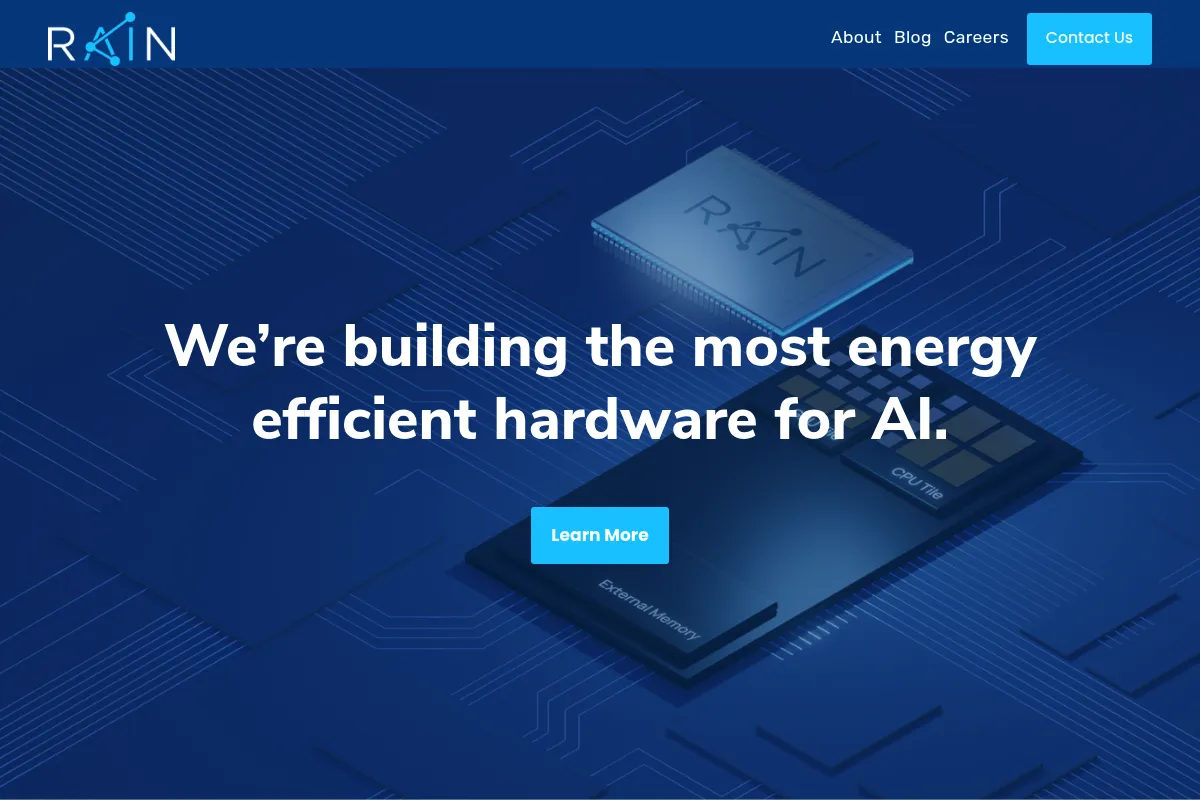
Rain AI is a hardware designer building specialized NPUs that use digital in-memory computing to run large-scale AI models on edge devices with minimal power draw.
Excellent for high-density edge inference and robotics, weaker for teams requiring the mature software ecosystem of NVIDIA CUDA.
Analysis based on product data, pricing structure, traffic signals, and public user sentiment.
Who Should Use Rain AI?
Typical users
Hardware architects, robotics engineers, and R&D leads at enterprise firms building autonomous systems or on-device LLM applications.
Maturity fit
advanced
Choose this if…
- Your priority is energy efficiency over raw peak FLOPS.
- You need to run LLMs or complex neural networks on battery-powered edge devices.
- You want to avoid the 'memory wall' bottleneck inherent in traditional GPU architectures.
Skip this if…
- You need off-the-shelf hardware available for immediate retail purchase.
- Your software stack is strictly dependent on proprietary NVIDIA libraries.
- You are looking for a general-purpose cloud training solution rather than an inference-focused NPU.
About Rain AI
Rain AI is a semiconductor company developing Neural Processing Units (NPUs) based on a digital in-memory computing architecture. The company aims to solve the energy efficiency crisis in AI by co-locating processing and memory, specifically targeting the needs of generative AI at the edge.
Official profiles
What it actually does
The company designs hardware IP and chips that execute AI inference tasks with significantly lower power consumption than traditional architectures. Their technology allows devices like drones, robots, and wearables to process advanced models locally without relying on cloud connectivity or massive cooling systems.
What makes it different
Rain AI utilizes Digital In-Memory Computing (DIMC), which eliminates the energy-heavy process of moving data between a separate processor and memory unit. By using a RISC-V based architecture, they offer a more customizable and open alternative to the closed ecosystems of established chipmakers.
Ratings across the web

Ratings aggregated from independent review platforms.
Key Features
Digital In-Memory Computing
Minimizes data movement to reduce power consumption by orders of magnitude.
RISC-V Core Integration
Uses an open-standard architecture to allow for better hardware-software co-design.
Sparsity Optimization
Skips unnecessary calculations in neural networks to speed up processing.
Quantization Support
Optimized for running compressed models without significant accuracy loss.
Tile-based Scaling
Allows the NPU to be configured for different power envelopes, from wearables to edge servers.
End-to-end Toolchain
Provides software to compile standard models (PyTorch/TensorFlow) for their specific NPU architecture.
Pricing
Enterprise / OEM
- NPU IP licensing
- Custom chip design services
- Early access to hardware samples
- Dedicated technical support
- Full software toolchain access
Pricing checked 5 months ago
Pricing guidance
- When moving from software simulation to hardware prototyping
- When requiring custom NPU configurations for specific hardware form factors
- Minimum order quantities for physical chips
- Licensing restrictions on IP usage
- Hardware-specific model optimization requirements
Premium enterprise positioning focused on high-value hardware partnerships.
Pros & Cons
Strengths
-
Extreme energy efficiency
By reducing data movement, Rain AI chips can run models that would typically drain a battery in minutes for much longer periods.
-
Reduced heat signature
Lower power consumption leads to less heat, which is critical for fanless designs in robotics and mobile devices.
-
Privacy-first inference
Enables sophisticated AI to run entirely on-device, removing the need to send sensitive data to the cloud.
-
Strategic RISC-V foundation
The use of RISC-V provides a hedge against proprietary licensing shifts and allows for deeper architectural customization.
Weaknesses
-
Immature software ecosystem
Unlike NVIDIA's decades-old CUDA platform, Rain's toolchain is new and likely requires more manual optimization from developers.
Affects: Software engineers and ML researchers
-
Limited availability
As an early-stage hardware company, their chips are not yet available for mass-market purchase or easy cloud testing.
Affects: Small startups and individual developers
-
Niche focus
The hardware is highly optimized for inference; it is not a replacement for the high-end GPUs used in massive model training.
Affects: Enterprise AI labs
Real User Sentiment
The technical community is cautiously optimistic about the DIMC approach but remains skeptical until mass production benchmarks are public.
Users tend to like
- Focus on energy efficiency
- Use of RISC-V
- Potential for truly autonomous edge AI
- Strong backing from high-profile AI investors
Users commonly complain about
- Lack of public benchmarks
- Difficulty in accessing hardware
- Steep competition from established players like NVIDIA and ARM
Recurring tradeoffs
- Users trade the convenience of the CUDA ecosystem for significantly better power performance.
Happiest users
Robotics researchers and hardware engineers at large tech firms looking for the next generation of edge compute.
Often frustrated
General software developers who want a 'plug and play' experience similar to cloud GPUs.
Use Cases
Autonomous Drones
Running real-time object detection and pathfinding without heavy batteries.
Industrial Robotics
Enabling low-latency decision making on the factory floor without cloud lag.
Smart Wearables
Powering voice assistants and health monitoring with multi-day battery life.
Edge Servers
Reducing the electricity and cooling costs of local AI inference in branch offices.
Automotive AI
Handling cabin monitoring and localized ADAS features with minimal thermal impact.
Frequently Asked Questions
How much does Rain AI hardware cost?
Rain AI does not publish a standard price list. As a semiconductor startup, they primarily engage in IP licensing and enterprise partnerships. Costs are determined by the scale of the deployment and the specific hardware configuration required.
How does Rain AI compare to NVIDIA Jetson?
NVIDIA Jetson is a mature, widely available platform with a massive software library (CUDA). Rain AI targets higher energy efficiency through its Digital In-Memory Computing architecture, making it potentially better for battery-constrained devices, though it lacks NVIDIA's software maturity.
What is Digital In-Memory Computing (DIMC)?
DIMC is an architectural choice where the processing happens directly inside the memory array. This eliminates the 'von Neumann bottleneck'—the energy-intensive process of moving data back and forth between the CPU and RAM—which is the primary source of power waste in AI.
Does Rain AI support PyTorch and TensorFlow?
Yes, Rain AI is developing a software toolchain designed to compile models from standard frameworks like PyTorch and TensorFlow into instructions optimized for their NPU architecture.
Is Rain AI related to Sam Altman?
Sam Altman was an early personal investor in Rain AI. While he is a high-profile backer, the company operates independently of OpenAI, focusing specifically on the hardware layer of the AI stack.
Can I buy a Rain AI chip today?
Currently, Rain AI is in the development and sampling phase. It is not available for individual consumer purchase on sites like Digikey or Mouser; interested enterprises must contact them directly for partnership opportunities.
Why trust this page?
This evaluation combines product positioning, pricing analysis, traffic and market signals, and public user sentiment into a single decision-support page. Content is generated editorially — not copied from the vendor's website.
Funding & Company
Founded
2017
Stage
Series a
Total Raised
$38.1M
Latest Round
Series A (May 2024)
Notable Investors
Rain AI has raised over $38 million to develop energy-efficient AI hardware. The company is backed by prominent investors like Sam Altman, but a failed Series B funding round in late 2024 has created uncertainty about its long-term stability.
Market Signals & Traffic
Estimated visits, global rank, geography, traffic sources, monthly visit trends, and organic search keywords (Similarweb)—on a dedicated page built for depth and search.
- Estimated visits
- 5,013
- Global rank
- #3,440,460
- Snapshot
- Apr 2026
- Traffic trend
- Falling
Estimated monthly visits
Similar Tools
Liquid AI
Developer Tools, Research

High-performance foundation models for long-context data and edge computing
Unsloth
Developer Tools, Research

Lightweight framework for faster and memory-efficient LLM fine-tuning.
Nous Research
Developer Tools, Research

Open-source research collective developing high-performance large language models.
Label Studio
Developer Tools, Research
Open-source data labeling platform for training machine learning models.
Bittensor
Developer Tools, Research

Decentralized marketplace for peer-to-peer machine intelligence and model training.
Weights & Biases (W&B)
Developer Tools, Research

Developer platform for tracking, visualizing, and managing machine learning experiments.