

Unsloth
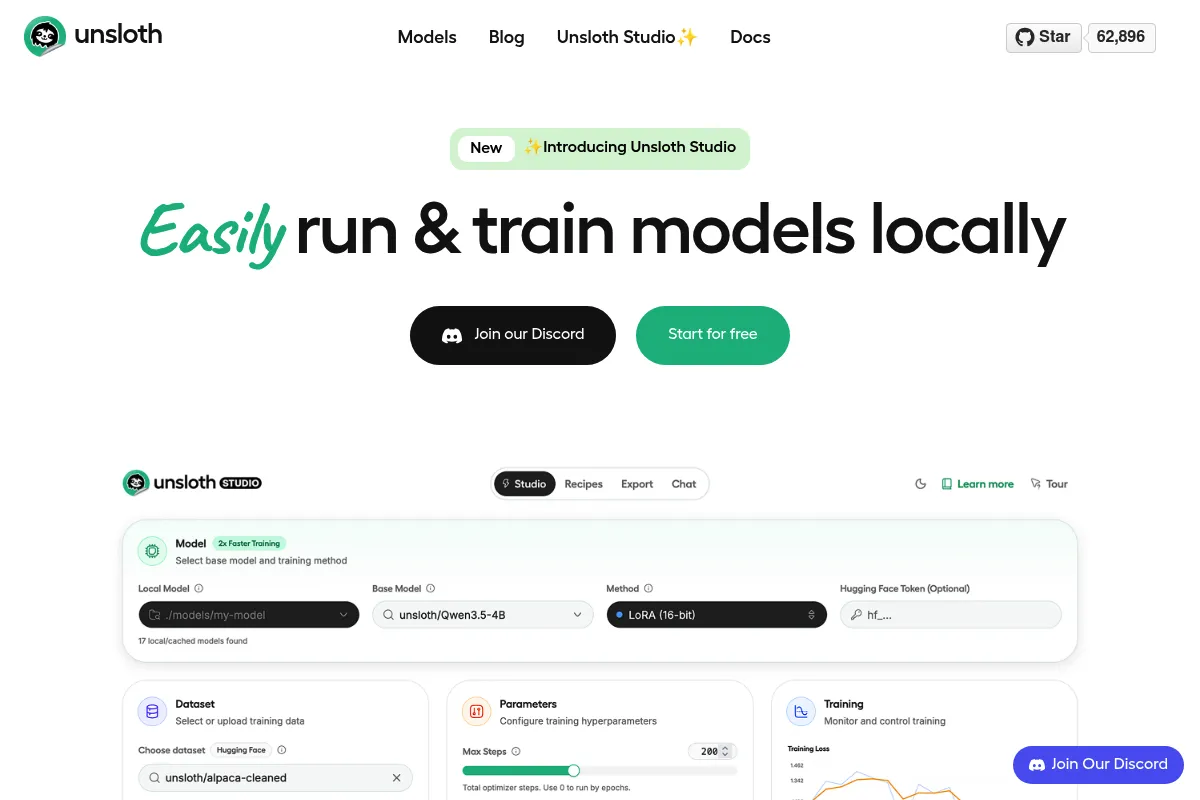
A specialized optimization library that makes LLM fine-tuning significantly faster and less resource-intensive, enabling high-performance training on consumer-grade hardware.
Excellent for developers fine-tuning Llama, Mistral, or Phi models on single GPUs, but limited for those using non-NVIDIA hardware or unsupported model architectures.
Analysis based on product data, pricing structure, traffic signals, and public user sentiment.
Who Should Use Unsloth?
Typical users
Machine learning engineers, independent AI researchers, and developers at startups who need to fine-tune models without massive cloud compute budgets.
Maturity fit
beginner to advanced
Choose this if…
- You need to fit larger models like Llama 3 70B into limited VRAM
- Your priority is reducing training time and cloud GPU costs
- You are already using Hugging Face TRL or PEFT and want a drop-in speed boost
- You want to fine-tune on a single consumer GPU like an RTX 3090 or 4090
Skip this if…
- You are using AMD or Apple Silicon GPUs, as it requires NVIDIA/CUDA
- Your workflow relies on niche or highly customized model architectures not yet supported
- You require a no-code GUI for fine-tuning
About Unsloth
Unsloth is an open-source framework built to optimize the fine-tuning process of Large Language Models. It rewrites core PyTorch kernels using OpenAI's Triton language to bypass the inefficiencies of standard autograd systems.
Official profiles
What it actually does
It provides a set of optimized model loaders and training patches that reduce memory overhead by up to 70% and increase training speed by 2x. It integrates directly with the Hugging Face ecosystem, allowing users to swap standard model classes for Unsloth-optimized versions with minimal code changes.
What makes it different
Unlike general-purpose libraries, Unsloth uses manual backpropagation and custom Triton kernels specifically tuned for the attention mechanisms of popular models. This architectural focus allows it to achieve performance gains that generic frameworks like standard PyTorch cannot match without manual optimization.
Key Features
Custom Triton Kernels
Replaces slow PyTorch operations with hand-optimized GPU code for faster execution.
Manual Backpropagation
Reduces memory usage by calculating gradients more efficiently than standard automated systems.
4-bit Quantization
Allows large models to be loaded and trained on GPUs with as little as 16GB of VRAM.
One-click Colab Notebooks
Provides pre-configured environments for immediate testing on free cloud hardware.
GGUF Export
Enables immediate deployment of fine-tuned models to local inference engines like llama.cpp.
Dynamic Padding
Minimizes wasted computation on shorter sequences during batch training.
Support for Long Context
Optimizes memory to handle larger context windows during the fine-tuning phase.
Pricing
Open Source
- Support for Llama 3, Mistral, Gemma
- 2x faster training
- 70% less memory usage
- Export to GGUF/AWQ
Unsloth Pro
- Early access to new model support
- Priority bug fixes
- Advanced optimization features
- Private Discord access
Unsloth Enterprise
- Custom model architecture support
- Dedicated engineering support
- On-premise deployment assistance
- SLA guarantees
Pricing checked 5 months ago
Pricing guidance
- When you need immediate support for a brand-new model architecture
- When you require direct technical assistance from the core developers
- When your organization needs enterprise-grade support and SLAs
- Pro features are often experimental before trickling down to the open-source version
- Cloud-based training (Unsloth Cloud) is a separate upcoming cost
Extremely developer-friendly with a generous open-source core and a low-cost tier for individual supporters.
Pros & Cons
Strengths
-
Drastic VRAM savings
By reducing memory consumption by up to 70%, users can fine-tune 7B parameter models on 8GB GPUs or 70B models on a single A100.
-
Significant speed improvements
The 2x speed increase directly translates to lower compute costs when renting GPUs on platforms like Lambda Labs or RunPod.
-
Low migration friction
It maintains compatibility with the Hugging Face ecosystem, meaning existing training scripts usually require fewer than 10 lines of code changes.
-
Active open-source maintenance
The maintainers frequently release updates for new models (like Llama 3.1) within hours of their public release.
Weaknesses
-
NVIDIA-only dependency
The reliance on Triton and CUDA kernels means it does not work on AMD, Intel, or Mac hardware.
Affects: Developers using non-NVIDIA local setups or specific cloud providers.
-
Limited model variety
While it covers the most popular models, it doesn't support every architecture available on Hugging Face.
Affects: Researchers working with experimental or less common model structures.
-
Multi-GPU limitations
While it supports multi-GPU via DDP, some of its most aggressive optimizations are best suited for single-GPU setups.
Affects: Enterprise teams running massive distributed training jobs across clusters.
Real User Sentiment
Users are overwhelmingly positive, often expressing surprise at how much faster it is compared to standard Hugging Face implementations.
Users tend to like
- The ability to run Llama 3 on free Google Colab instances
- The simplicity of the provided Jupyter notebooks
- Frequent updates that keep pace with the fast-moving LLM space
- Significant reduction in 'Out of Memory' (OOM) errors
Users commonly complain about
- Lack of support for Windows without WSL2
- Occasional breaking changes during rapid updates
- Limited documentation for complex multi-GPU configurations
Recurring tradeoffs
- Users trade broad model compatibility for extreme performance on a specific subset of models.
Happiest users
Individual developers and small AI startups working with consumer-grade GPUs.
Often frustrated
Enterprise engineers trying to use it with highly customized, non-standard model architectures.
Use Cases
Cost Reduction
Reducing the hourly cost of fine-tuning by finishing jobs in half the time.
Local Development
Fine-tuning a 7B model on a local RTX 3060 or 4060 laptop GPU.
Edge Deployment
Training a model and exporting it directly to GGUF for use in local apps.
Research Prototyping
Quickly testing multiple fine-tuning hyperparameters without waiting hours for results.
Dataset Testing
Running small-scale fine-tuning runs to evaluate the quality of a new training dataset.
Frequently Asked Questions
Is Unsloth actually free?
Yes, the core Unsloth library is open-source and free to use under the Apache 2.0 license. There is a Pro version for $15/month that offers early access to features and a Discord community, but the performance gains are available in the free version.
How does Unsloth compare to Axolotl?
Axolotl is a configuration-based wrapper that supports many backends, while Unsloth is a specific optimization backend. You can actually use Unsloth inside Axolotl. Unsloth is generally faster and more memory-efficient for the models it supports, whereas Axolotl supports a wider range of models and datasets.
Does Unsloth work on Mac M1/M2/M3 chips?
No, Unsloth currently requires NVIDIA GPUs and CUDA. It uses Triton kernels which are specifically designed for NVIDIA hardware. For Mac users, MLX is the recommended alternative for efficient fine-tuning.
Can I use Unsloth for full parameter fine-tuning?
Unsloth is primarily optimized for LoRA and QLoRA (Parameter-Efficient Fine-Tuning). While it can handle some aspects of full fine-tuning, its main benefits—like the 70% memory reduction—are most prominent when using LoRA.
Do I need to change my whole codebase to use it?
No. If you are using Hugging Face's `SFTTrainer` or `Trainer`, you typically only need to change the model loading step. Unsloth provides a `FastLanguageModel` class that replaces the standard `AutoModelForCausalLM`.
What models are currently supported?
Unsloth supports most popular decoder-only models including Llama 3.1, Llama 3, Mistral, Mixtral, Gemma, Gemma 2, Phi-3, and Qwen. It does not support encoder-decoder models like T5 or older architectures like GPT-2.
Why trust this page?
This evaluation combines product positioning, pricing analysis, traffic and market signals, and public user sentiment into a single decision-support page. Content is generated editorially — not copied from the vendor's website.
Funding & Company
Founded
2023
Stage
Seed
Total Raised
$540K
Latest Round
Seed (Sep 2024)
Notable Investors
Unsloth has raised a total of $540K in Seed funding, primarily from a round in late 2024. The company is backed by premier accelerator Y Combinator and strategic investors M12 (Microsoft's venture fund) and the GitHub Fund, signaling strong technical validation and providing a solid foundation for an early-stage company.
Market Signals & Traffic
Estimated visits, global rank, geography, traffic sources, monthly visit trends, and organic search keywords (Similarweb)—on a dedicated page built for depth and search.
- Estimated visits
- 1,569,058
- Global rank
- #36,477
- Snapshot
- Apr 2026
- Traffic trend
- Surging
Estimated monthly visits
Alternatives to Unsloth
View all alternatives
Similar Tools
Bittensor
Developer Tools, Research

Decentralized marketplace for peer-to-peer machine intelligence and model training.
Etched
Developer Tools, Research

Specialized ASIC hardware for accelerating Transformer model inference and throughput.
Inception
Developer Tools, Research

Specialized large language models and sovereign infrastructure for enterprises.
Weights & Biases (W&B)
Developer Tools, Research

Developer platform for tracking, visualizing, and managing machine learning experiments.
Cleanlab
Developer Tools, Research
Automated data curation to find and fix dataset errors.
TruLens
Developer Tools, Research

Evaluation and monitoring for large language model applications.