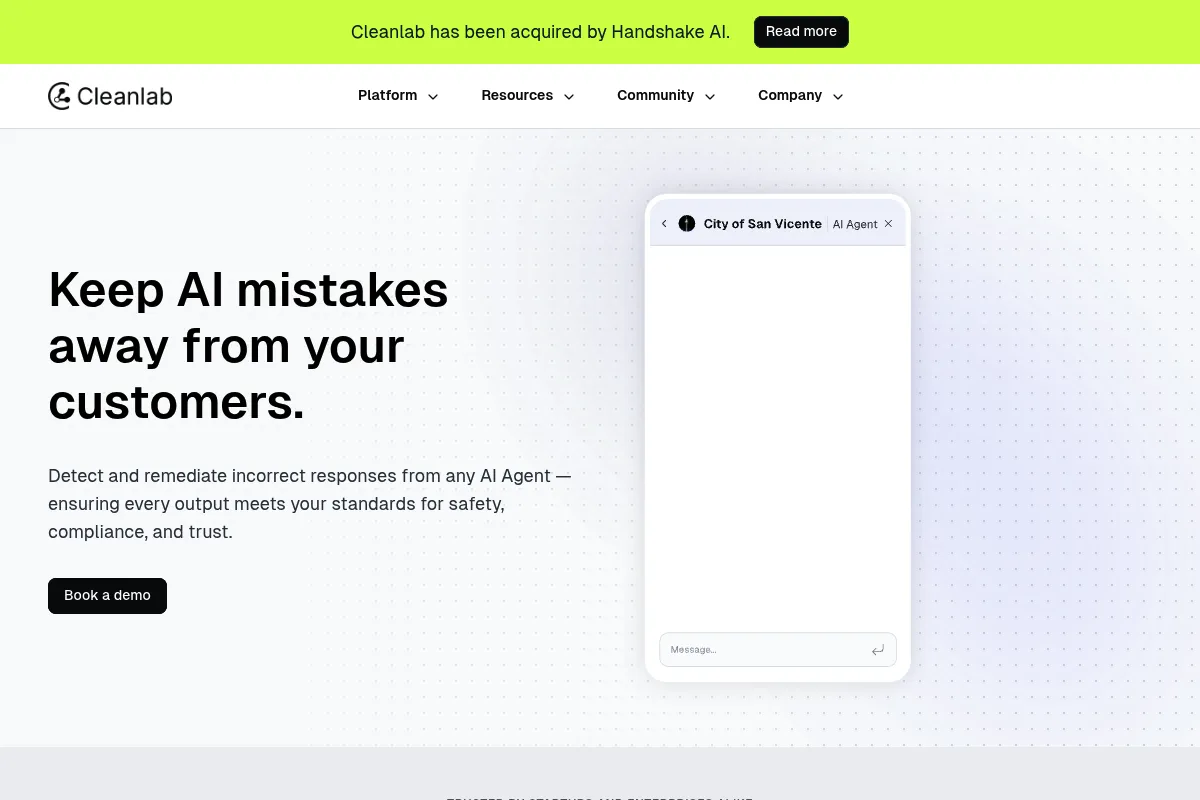
A data-centric AI platform that automates the detection and correction of label errors, outliers, and duplicates across text, image, and tabular datasets.
Excellent for ML teams needing to clean noisy training data at scale, weaker for teams requiring complex manual annotation workflows.
Analysis based on product data, pricing structure, traffic signals, and public user sentiment.
Who Should Use Cleanlab?
Typical users
Data scientists and ML engineers managing large, noisy datasets or fine-tuning LLMs.
Maturity fit
scaling to advanced
Choose this if…
- Your training data has a high rate of label noise or human error
- You want to automate data cleaning without writing custom heuristic scripts
- You are fine-tuning LLMs and need to prune low-quality instruction pairs
- Your priority is improving model performance through data quality rather than architecture tuning
Skip this if…
- You need a platform for manual, first-pass human labeling from scratch
- Your datasets are small enough for manual inspection in Excel or basic notebooks
- You require specialized support for video or 3D point cloud data in non-enterprise tiers
About Cleanlab
Cleanlab provides tools to improve dataset quality by identifying semantic errors that standard data validation tools miss. It was founded by the creators of Confident Learning at MIT and exists to solve the 'garbage in, garbage out' problem in machine learning. The platform offers both a programmatic Python library and a no-code web interface for data curation.
Official profiles
What it actually does
It analyzes the relationship between data features and their labels to find inconsistencies, such as an image of a 'cat' labeled as a 'dog.' It generates 'cleanliness' scores for every data point, flags outliers, and suggests corrected labels. For LLMs, it provides a 'Trustworthy Language Model' (TLM) that scores the reliability of generated responses to detect hallucinations.
What makes it different
Unlike traditional data quality tools that focus on schema errors or null values, Cleanlab uses 'Confident Learning' to find semantic errors in the labels themselves. It is model-agnostic, meaning it can work with any ML model (PyTorch, XGBoost, OpenAI) to evaluate the data that model was trained on.
Ratings across the web
Ratings aggregated from independent review platforms.
Key Features
Confident Learning
The core algorithmic framework that mathematically identifies label noise.
Cleanlab Studio
A web-based UI for visual data inspection and one-click error correction.
Trustworthy Language Model (TLM)
Provides a 0-1 reliability score for LLM outputs to catch hallucinations.
Multi-annotator Analysis
Aggregates labels from multiple humans to identify who is underperforming.
Auto-labeling
Uses high-confidence predictions to label large unlabelled subsets automatically.
Python API
Allows for integration into existing MLOps pipelines and CI/CD workflows.
Cross-modal Support
Handles tabular, text, and image data within the same platform logic.
Cleanset Export
Generates a cleaned version of your dataset ready for immediate retraining.
Pricing
Open Source
- Python library (MIT License)
- Basic label error detection
- Outlier detection
- Community support
Free (Studio)
- 1,000 credits per month
- No-code web interface
- Basic AutoML
- Standard data types
Personal
- 1,000 credits included
- Pay-as-you-go additional credits
- Full web interface access
- Python API access
Team
- 5,000 credits included
- Shared workspaces
- Priority support
- Advanced analytics
Enterprise
- Unlimited credits/volume discounts
- VPC/On-prem deployment
- Support for Audio/Video
- Custom ML task support (Object Detection)
Pricing checked 4 months ago
Pricing guidance
- When your dataset exceeds 1,000 rows per month
- When you need to collaborate with other team members in a shared workspace
- When you need to process unstructured data like video or audio
- Credits are consumed per row/task, and LLM tasks (TLM) consume credits much faster than tabular tasks
- The open-source library lacks the 'Auto-fix' UI and AutoML features found in Studio
Premium positioning for the Studio platform, justified by the significant manual labor costs it offsets for enterprise ML teams.
Pros & Cons
Strengths
-
Theoretically grounded error detection
Based on peer-reviewed MIT research, the algorithms provide provable guarantees for finding label errors under certain conditions.
-
Significant reduction in manual QA
Users report reducing manual data review time by up to 80% by focusing only on the samples Cleanlab flags as low-confidence.
-
Model-agnostic flexibility
It works with any model that outputs predicted probabilities, allowing teams to keep their existing ML stack.
-
Effective LLM hallucination detection
The TLM feature provides a concrete metric for RAG reliability, which is often a 'black box' for developers.
Weaknesses
-
Credit-based pricing can be opaque
The Studio platform uses a credit system that can become expensive and difficult to budget for when processing millions of rows.
Affects: Teams with massive datasets
-
Computational overhead
Running advanced cleaning algorithms on very large datasets can be resource-intensive and slow in the open-source version.
Affects: Individual developers with limited compute
-
Limited support for complex ML tasks
While expanding, support for tasks like object detection or sequence-to-sequence is often restricted to Enterprise tiers.
Affects: Computer vision and advanced NLP teams
Real User Sentiment
Highly positive among technical users who value the algorithmic rigor, though some find the SaaS pricing steep for large-scale data.
Users tend to like
- The 'one line of code' simplicity of the Python library
- The ability to find errors in famous benchmark datasets (like ImageNet)
- The no-code interface for non-technical stakeholders to review data
- The effectiveness of the Trustworthy Language Model for RAG
Users commonly complain about
- Studio credit costs can scale quickly
- Occasional dependency conflicts in the Python package
- The UI can be sluggish when handling very large files (>1GB)
Recurring tradeoffs
- Users often choose between the free but 'manual' open-source library and the expensive but 'automated' Studio platform.
Happiest users
ML Engineers at mid-to-large enterprises who are tired of manually cleaning messy, human-labeled datasets.
Often frustrated
Budget-constrained startups with massive datasets that exceed the Personal/Team credit limits.
Use Cases
E-commerce
Cleaning a product catalog where thousands of items have been miscategorized by vendors.
LLM Fine-tuning
Identifying and removing low-quality or toxic instruction pairs from a training set.
Medical Imaging
Flagging potential misdiagnoses in labeled X-ray or MRI datasets for expert re-review.
Customer Support
Detecting hallucinations in a RAG-based chatbot before they reach the customer.
Financial Services
Improving the accuracy of fraud detection models by removing outliers from historical transaction data.
Frequently Asked Questions
Is there a free version of Cleanlab?
Yes, Cleanlab offers a fully free, open-source Python library (available via pip install cleanlab). Additionally, Cleanlab Studio has a free tier that provides 1,000 credits per month for the no-code web interface.
How does Cleanlab compare to Snorkel AI?
Snorkel AI focuses on 'weak supervision'—helping you create labels from scratch using programmatic rules. Cleanlab focuses on 'data-centric cleaning'—finding and fixing errors in labels you already have. They are often used together in the same pipeline.
What are the main limitations of Cleanlab?
The primary limitation is that it requires a model to generate predicted probabilities; if your model is very poor, the error detection will be less accurate. Also, advanced tasks like Object Detection and Video analysis are currently restricted to Enterprise plans.
Does Cleanlab work with Snowflake or Databricks?
Yes, Cleanlab Studio has native integrations and tutorials for both Snowflake and Databricks, allowing you to clean data directly from your warehouse and export the 'cleanset' back.
Can Cleanlab fix my data automatically?
Yes, the 'Auto-fix' feature in Cleanlab Studio can automatically update labels to the suggested correct value for high-confidence errors, though manual review is recommended for critical data.
What data types are supported?
Cleanlab supports tabular (CSV, Excel, SQL), text (JSON, TXT), and image data. Support for audio and video is available for Enterprise customers.
Why trust this page?
This evaluation combines product positioning, pricing analysis, traffic and market signals, and public user sentiment into a single decision-support page. Content is generated editorially — not copied from the vendor's website.
Funding & Company
Founded
2021
Stage
Acquired
Total Raised
$30M
Latest Round
Series A (Oct 2023)
Notable Investors
Cleanlab raised a total of $30M across two quick succession rounds in 2023, a $5M Seed and a $25M Series A, from notable investors including Menlo Ventures, Bain Capital Ventures, and Databricks Ventures. The company was subsequently acquired by Handshake in January 2026, shifting its stability and future development under the umbrella of its new parent company.
Market Signals & Traffic
Estimated visits, global rank, geography, traffic sources, monthly visit trends, and organic search keywords (Similarweb)—on a dedicated page built for depth and search.
- Estimated visits
- 27,176
- Global rank
- #1,031,199
- Snapshot
- Apr 2026
- Traffic trend
- Surging
Estimated monthly visits
Alternatives to Cleanlab
View all alternativesSuperAnnotate
Developer Tools, Research, Automation

Platform for data labeling, management, and high-quality dataset curation.
Labelbox
Developer Tools, Research, Automation

Platform for data labeling, management, and model evaluation workflows.
Scale
Developer Tools, Research, Automation

Data infrastructure for training, labeling, and evaluating machine learning models.
Similar Tools
CVAT
Developer Tools, Research

Collaborative image and video annotation platform for computer vision
Akash Network
Developer Tools, Research

Decentralized cloud marketplace for high-performance GPU and compute resources.
FluidStack
Developer Tools, Research

Global GPU cloud platform for AI training and inference.
Etched
Developer Tools, Research

Specialized ASIC hardware for accelerating Transformer model inference and throughput.
Inception
Developer Tools, Research

Specialized large language models and sovereign infrastructure for enterprises.
Weights & Biases (W&B)
Developer Tools, Research

Developer platform for tracking, visualizing, and managing machine learning experiments.