

The industry-standard data engine for high-stakes AI development, providing managed human-in-the-loop pipelines for RLHF, model evaluation, and complex multimodal labeling.
Excellent for enterprise-scale LLM fine-tuning and autonomous systems, weaker for teams requiring transparent, low-cost labeling workflows.
Analysis based on product data, pricing structure, traffic signals, and public user sentiment.
Who Should Use Scale?
Typical users
Enterprise AI researchers, machine learning engineers at frontier labs, and government defense analysts.
Maturity fit
scaling to advanced
Choose this if…
- You are training foundational models and need high-quality RLHF (Reinforcement Learning from Human Feedback).
- Your project involves complex multimodal data like LiDAR, 3D point clouds, or high-resolution video.
- You need a fully managed workforce to handle massive labeling volumes without internal management overhead.
Skip this if…
- You have a limited budget and can achieve similar results using LLM-based auto-labeling.
- You require direct oversight and communication with individual annotators.
- Your data is highly sensitive and cannot be processed by a third-party crowdsourced workforce.
About Scale
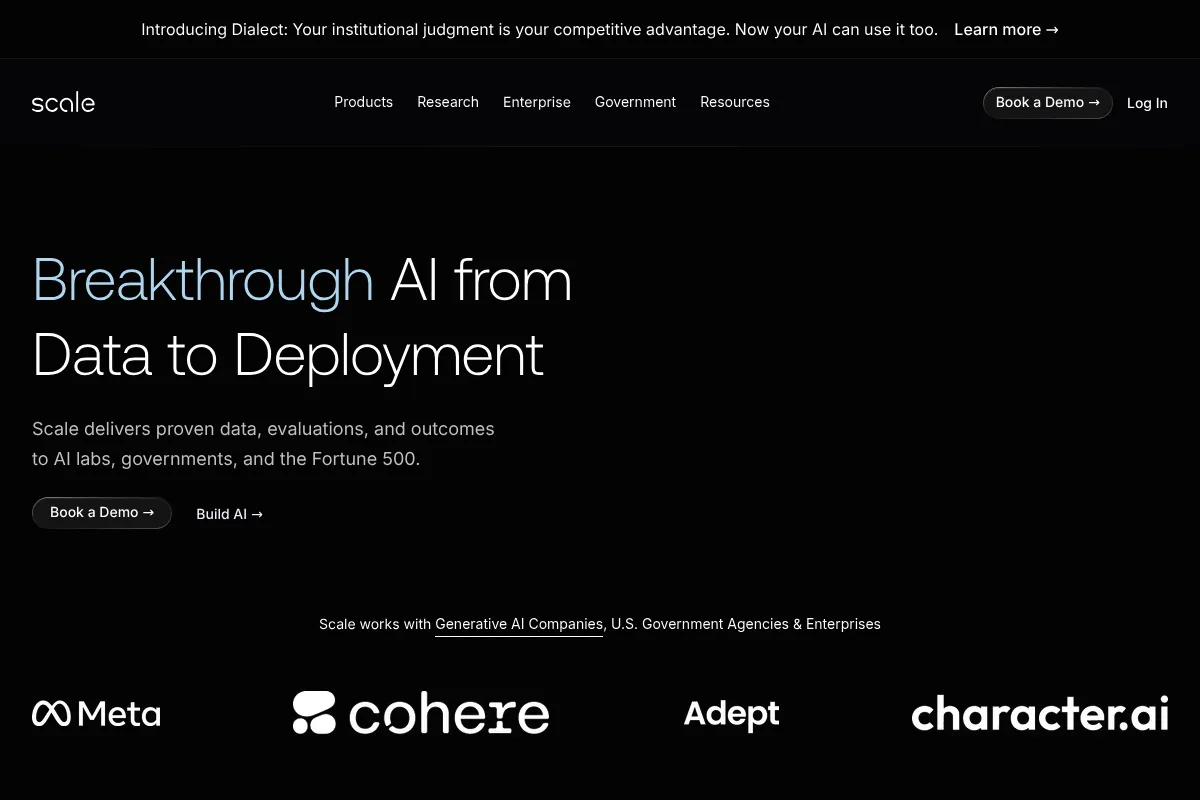
Scale AI provides the data infrastructure required to train and evaluate artificial intelligence. It combines machine learning automation with a massive global workforce to turn raw, unstructured data into high-quality training sets for autonomous vehicles, LLMs, and government applications.
Official profiles
What it actually does
The system ingests raw data—text, images, video, or sensor data—and applies a multi-stage labeling process involving AI pre-labeling and human verification. It provides specialized environments for fine-tuning models, evaluating model safety, and managing large-scale datasets through a centralized dashboard.
What makes it different
Unlike software-only labeling tools, Scale provides a vertically integrated service including the workforce. Its 'Donovan' platform is specifically built for classified defense environments, and its role as the primary data partner for OpenAI and Meta gives it a unique advantage in RLHF methodology that competitors struggle to replicate.
Ratings across the web

Ratings aggregated from independent review platforms.
Key Features
Scale Data Engine
Managed pipeline for collecting, curating, and labeling data for production ML.
Scale GenAI Platform
Specialized environment for fine-tuning and testing large language models.
Scale Nucleus
A data management tool to visualize datasets and identify model failure cases.
Scale Rapid
An on-demand service for smaller batches with faster turnaround times.
Scale Donovan
A decision-support system for defense that processes unstructured intelligence data.
Scale Studio
A platform for teams who want to use Scale’s software with their own internal labelers.
Expert RLHF
Access to domain experts (coders, lawyers, doctors) for specialized model training.
Pricing
Scale Rapid (Self-Serve)
- 200 free labeling units per month
- $0.05 per additional labeling unit
- Standard image, video, and text tasks
- Credit card billing
Enterprise
- Full access to Data Engine and GenAI Platform
- Dedicated project management
- SLA-backed quality and throughput
- Custom workforce sourcing (e.g., PhDs, lawyers)
- Advanced security and compliance
Pricing checked 5 months ago
Pricing guidance
- When moving from a research prototype to a production model
- When requiring specialized RLHF or red-teaming
- When data volume exceeds the limits of self-serve management
- Rapid pricing varies based on 'multipliers' for task complexity
- Minimum contract values for Enterprise are reportedly high (avg. $93k+)
- Data storage and egress fees may apply for large datasets
Premium enterprise positioning with high barriers to entry for smaller teams.
Pros & Cons
Strengths
-
Unmatched RLHF quality
The company has refined the process of human feedback for LLMs, making it the preferred choice for labs building frontier models.
-
Comprehensive multimodal support
Handles complex data types like LiDAR and 4D video better than almost any other platform in the market.
-
Enterprise-grade security
Offers deployments in secure, classified environments (IL4, IL5, JWICS), which is a requirement for government and defense contracts.
-
Reduced management overhead
The managed service model means teams don't have to hire, train, or manage thousands of individual annotators.
Weaknesses
-
Opaque and high pricing
Enterprise contracts often reach six or seven figures, and the self-serve 'Rapid' tier can become unpredictable as task complexity increases.
Affects: Startups and mid-market companies
-
Black-box workforce management
Users have limited visibility into who is labeling their data or the specific expertise of the annotators assigned to their project.
Affects: Teams requiring high transparency or auditability
-
Neutrality concerns
Following Meta's significant investment in the company, some competitors are wary of sharing proprietary data with a vendor partially controlled by a rival.
Affects: Big Tech AI labs
Real User Sentiment
Users generally view Scale as the high-cost, high-quality option, though there is significant criticism regarding its workforce treatment and pricing transparency.
Users tend to like
- Superior quality for complex 3D and video tasks
- Speed of scaling up large projects
- Deep expertise in LLM fine-tuning and RLHF
- Reliable API and integration with cloud providers
Users commonly complain about
- Extremely expensive compared to competitors like Labelbox
- Lack of transparency in the labeling process
- Inconsistent quality in the lower-cost 'Rapid' tier
- Difficult sales process for non-enterprise customers
Recurring tradeoffs
- You trade cost and transparency for speed and managed scale.
Happiest users
Fortune 500 AI teams and autonomous vehicle companies with massive budgets and complex data needs.
Often frustrated
Early-stage startups and academic researchers who find the pricing prohibitive and the self-serve tools limited.
Use Cases
Autonomous Vehicle Training
Labeling LiDAR and video data for object detection and path planning.
LLM Fine-Tuning
Using RLHF to align model responses with human intent and safety guidelines.
Defense Intelligence
Using Scale Donovan to analyze satellite imagery and unstructured field reports.
E-commerce Search
Categorizing millions of product images and improving search relevance.
Medical AI
Annotating specialized imaging data (MRI, CT scans) using domain experts.
Content Moderation
Training models to identify and filter harmful content at scale.
Frequently Asked Questions
How much does Scale AI actually cost?
For most users, Scale AI is an enterprise-only service with custom pricing. While the 'Rapid' tier offers a pay-as-you-go model starting at $0.05 per unit, enterprise contracts typically average around $93,000 annually and can exceed $400,000 depending on data volume and task complexity.
How does Scale AI compare to Labelbox?
Labelbox is primarily a software platform where you bring your own labelers or use their marketplace; it offers more transparency and lower entry costs. Scale AI is a managed service that provides both the software and the workforce, making it more expensive but easier to scale for massive projects.
What is the difference between Scale Rapid and Scale Studio?
Scale Rapid is an on-demand service where Scale's workforce labels your data. Scale Studio is a software-only offering that allows you to use Scale's advanced labeling tools with your own internal or third-party team of annotators.
Does Scale AI support HIPAA or SOC2 compliance?
Yes, Scale AI is SOC2 Type II compliant and offers HIPAA-compliant data processing for healthcare and medical AI use cases, though these features are typically reserved for Enterprise-tier customers.
Can I use Scale AI for small projects?
Technically yes, via Scale Rapid, which has no minimum data requirements. However, the platform is optimized for high-volume enterprise work, and small-scale users may find the support and quality-control features lacking compared to the Enterprise tier.
What integrations does Scale AI support?
Scale integrates with major cloud storage providers including AWS S3, Google Cloud Storage, and Azure Blob Storage. It also offers a robust API for programmatically sending data and receiving labels into your ML pipeline.
Why trust this page?
This evaluation combines product positioning, pricing analysis, traffic and market signals, and public user sentiment into a single decision-support page. Content is generated editorially — not copied from the vendor's website.
Funding & Company
Founded
2016
Stage
Late stage
Total Raised
$15.9B
Latest Round
Undisclosed (Jun 2025)
Notable Investors
Scale AI has raised approximately $15.9 billion, with a landmark $14.3 billion strategic investment from Meta in June 2025 making up the vast majority of its capital. This massive influx of capital from a strategic partner, following a consistent track record of raising from top-tier VCs, provides exceptional financial stability. The funding solidifies Scale's position as a critical infrastructure provider for the AI industry.
Market Signals & Traffic
Estimated visits, global rank, geography, traffic sources, monthly visit trends, and organic search keywords (Similarweb)—on a dedicated page built for depth and search.
- Estimated visits
- 0
- Global rank
- —
- Snapshot
- May 2026
- Traffic trend
- —
Alternatives to Scale
View all alternativesLabelbox
Developer Tools, Research, Automation

Platform for data labeling, management, and model evaluation workflows.
V7
Developer Tools, Automation, Workflow

Data platform for computer vision and automated image labeling
Similar Tools
Alpha Drive AI
Developer Tools, Research, Automation

Cloud-based testing and validation platform for autonomous driving algorithms.
DSPy
Developer Tools, Research, Automation

Framework for programming and optimizing language model pipelines.
SuperAnnotate
Developer Tools, Research, Automation

Platform for data labeling, management, and high-quality dataset curation.
Labelbox
Developer Tools, Research, Automation
Platform for data labeling, management, and model evaluation workflows.
Ragas
Developer Tools, Research, Automation

Evaluation framework for Retrieval Augmented Generation (RAG) pipelines
Argilla
Developer Tools, Research, Automation

Open-source data curation platform for building high-quality language models.