

TruLens
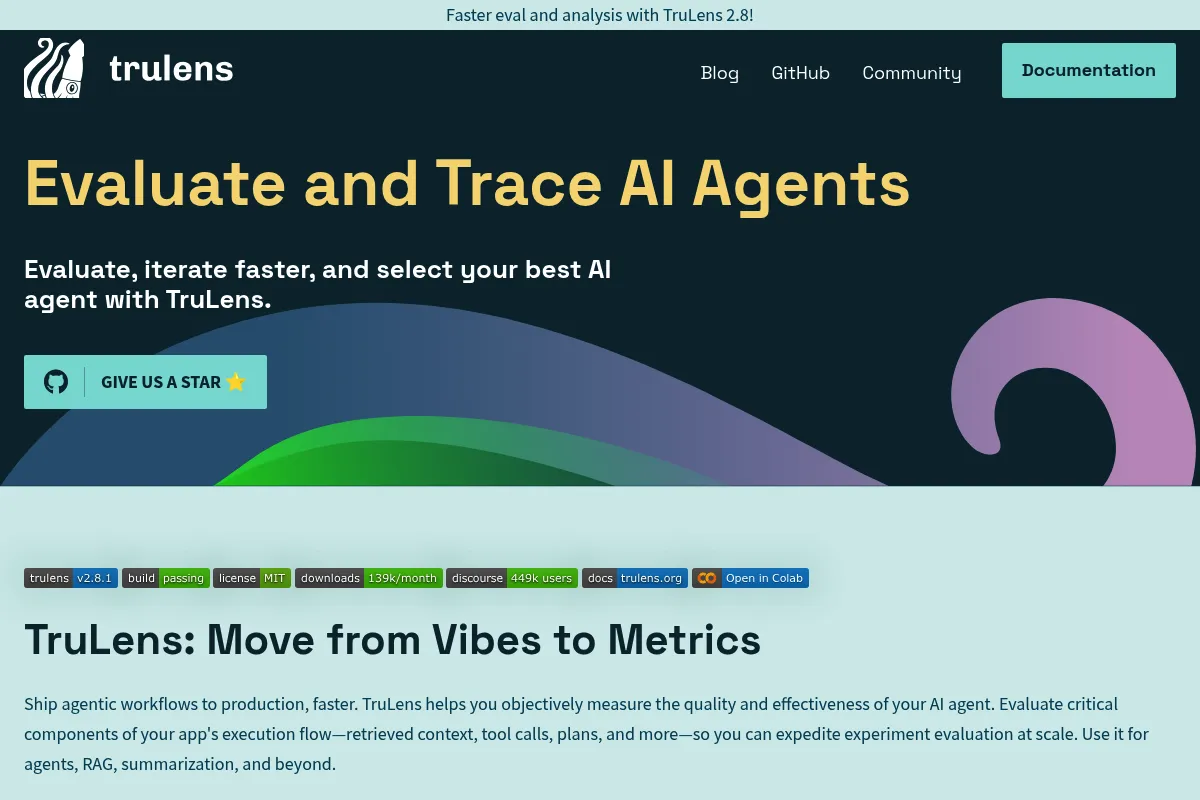
An open-source evaluation library that uses the 'RAG Triad' framework to quantify hallucination risks and response quality in LLM applications.
Excellent for developers building RAG pipelines who need programmatic quality scores, weaker for teams requiring a polished, collaborative SaaS UI.
Analysis based on product data, pricing structure, traffic signals, and public user sentiment.
Who Should Use TruLens?
Typical users
ML engineers and Python developers building Retrieval Augmented Generation (RAG) systems.
Maturity fit
beginner to scaling
Choose this if…
- You need to measure groundedness and context relevance in RAG pipelines
- Your priority is open-source flexibility over a managed service
- You want to run evaluations locally to maintain data privacy
Skip this if…
- You require a zero-code evaluation interface for non-technical stakeholders
- Your workflow is strictly non-Python
- You need advanced enterprise features like SOC2 compliance out of the box without a custom contract
About TruLens
TruLens is an open-source library developed by TruEra for evaluating and tracking LLM application performance. It provides a systematic way to move beyond vibes-based testing by using LLMs to programmatically score other LLMs.
Official profiles
What it actually does
It instruments LLM applications to record inputs, outputs, and intermediate steps like retrieval results. It then applies 'Feedback Functions' to score these interactions based on specific criteria like factual accuracy, relevance, and safety.
What makes it different
It popularized the 'RAG Triad'—a specific evaluation methodology that isolates failures into context relevance, groundedness, and answer relevance. This architectural choice helps developers pinpoint exactly whether a failure happened in the retrieval step or the generation step.
Key Features
RAG Triad
Breaks down evaluation into three distinct metrics to identify if the retriever or the generator is failing.
Feedback Functions
Uses LLM-as-a-judge to automate the scoring of thousands of records without manual human review.
TruLens Dashboard
A local UI for visualizing experiment results, comparing model versions, and inspecting individual traces.
Instrumentation
Wraps existing Python code to capture internal state and metadata without requiring a total rewrite.
Groundedness Provider
Specifically checks if the LLM response is supported by the retrieved source documents to prevent hallucinations.
Framework Agnostic
Works with any LLM provider (OpenAI, Anthropic, local models) and major orchestration frameworks.
Customizable Thresholds
Allows developers to set pass/fail criteria for different deployment stages.
Pricing
Open Source
- Core Python library
- RAG Triad feedback functions
- Local Streamlit dashboard
- Community support
TruEra Enterprise
- Managed hosting
- Team collaboration tools
- Enterprise-grade security and RBAC
- Dedicated support
Pricing checked 4 months ago
Pricing guidance
- When you need a centralized, managed dashboard for a large team
- When you require enterprise security features like SSO
- When you need professional support and SLAs
- Evaluation costs are separate (you pay your own LLM provider)
- Local dashboard performance can lag with very large datasets
Primarily an open-source tool with a high-end enterprise upsell for managed observability.
Pros & Cons
Strengths
-
Diagnostic precision for RAG
By separating retrieval quality from generation quality, it saves developers hours of manual debugging when a model provides a wrong answer.
-
Open-source and local-first
Teams can run the entire evaluation suite on their own infrastructure, which is critical for projects with strict data residency requirements.
-
Extensible feedback logic
Developers can write custom Python functions to evaluate niche requirements specific to their industry, such as PII detection or specific brand tone.
Weaknesses
-
Documentation gaps
Advanced configurations and troubleshooting for specific edge cases are often missing from the official docs, forcing users to dig through GitHub issues.
Affects: Developers implementing complex or non-standard architectures
-
UI is developer-centric
The Streamlit dashboard is functional but lacks the collaboration, tagging, and reporting features found in dedicated SaaS observability platforms.
Affects: Product managers and non-technical stakeholders
-
High evaluation costs
Running LLM-based feedback functions on large datasets can significantly increase OpenAI or Anthropic API bills if not monitored.
Affects: Teams running high-volume automated testing
Real User Sentiment
Generally positive among engineers who value the structured approach to RAG evaluation, though some find the setup and documentation slightly unpolished.
Users tend to like
- The RAG Triad methodology
- Ease of integration with LlamaIndex
- Ability to run locally
- Transparency of the feedback functions
Users commonly complain about
- Inconsistent documentation
- Occasional bugs in the Streamlit UI
- Steep learning curve for custom feedback functions
Recurring tradeoffs
- Users trade a polished UI for the flexibility and privacy of an open-source library.
Happiest users
Python developers who want to programmatically validate their RAG pipelines before moving to production.
Often frustrated
Non-technical users or teams looking for a 'plug-and-play' SaaS experience with no coding required.
Use Cases
RAG Debugging
Identifying if a wrong answer is due to poor document retrieval or a hallucinating model.
Model Comparison
Running the same test set against GPT-4 and Claude 3 to see which performs better for a specific task.
Regression Testing
Ensuring that updates to the prompt or vector database don't degrade the quality of responses.
Hallucination Monitoring
Automatically flagging responses that contain information not found in the source context.
Cost Optimization
Testing if a smaller, cheaper model can achieve similar quality scores as a larger model.
Frequently Asked Questions
Is TruLens free to use?
Yes, the core TruLens-Eval library is open-source and free. However, you will still need to pay for the LLM API calls (like OpenAI) used by the feedback functions to evaluate your application.
How does TruLens compare to Ragas?
Both are popular for RAG evaluation. TruLens is often preferred for its 'RAG Triad' framework and its built-in Streamlit dashboard, while Ragas is sometimes seen as having a slightly simpler API for generating synthetic test datasets.
Can I use TruLens with local models like Llama 3?
Yes, TruLens is model-agnostic. You can use it with local models via providers like Ollama or LiteLLM, which is a common choice for teams concerned about data privacy.
Does TruLens support non-RAG applications?
While it is heavily optimized for RAG, you can use its feedback functions for general LLM tasks like summarization, sentiment analysis, or custom classification by defining your own scoring logic.
What is the RAG Triad?
It is a framework consisting of three metrics: Context Relevance (did we find the right docs?), Groundedness (is the answer based only on those docs?), and Answer Relevance (does the answer actually address the user's query?).
Do I need to use LangChain to use TruLens?
No. While TruLens has specific integrations for LangChain and LlamaIndex, it can instrument any standard Python code using its 'TruCustomApp' wrapper.
Why trust this page?
This evaluation combines product positioning, pricing analysis, traffic and market signals, and public user sentiment into a single decision-support page. Content is generated editorially — not copied from the vendor's website.
Funding & Company
Founded
2019
Stage
Acquired
Total Raised
$42.3M
Latest Round
Series B (Mar 2022)
Notable Investors
TruEra, the company behind the open-source TruLens project, raised a total of $42.3 million across three funding rounds before being acquired by Snowflake in May 2024. The funding, led by notable investors like Menlo Ventures and Greylock, supported its development of AI quality and observability tools. The acquisition by Snowflake provides significant long-term stability for the continued development of the TruLens open-source project.
Market Signals & Traffic
Estimated visits, global rank, geography, traffic sources, monthly visit trends, and organic search keywords (Similarweb)—on a dedicated page built for depth and search.
- Estimated visits
- 12,258
- Global rank
- #1,802,365
- Snapshot
- Apr 2026
- Traffic trend
- Falling
Estimated monthly visits
Alternatives to TruLens
View all alternatives
Similar Tools
Context
Developer Tools, Research

Product analytics and observability for LLM applications and chatbots.
CVAT
Developer Tools, Research
Collaborative image and video annotation platform for computer vision
Nous Research
Developer Tools, Research

Open-source research collective developing high-performance large language models.
Rain AI
Developer Tools, Research
Energy-efficient hardware for on-device AI and edge computing.
Akash Network
Developer Tools, Research

Decentralized cloud marketplace for high-performance GPU and compute resources.
Unsloth
Developer Tools, Research

Lightweight framework for faster and memory-efficient LLM fine-tuning.