

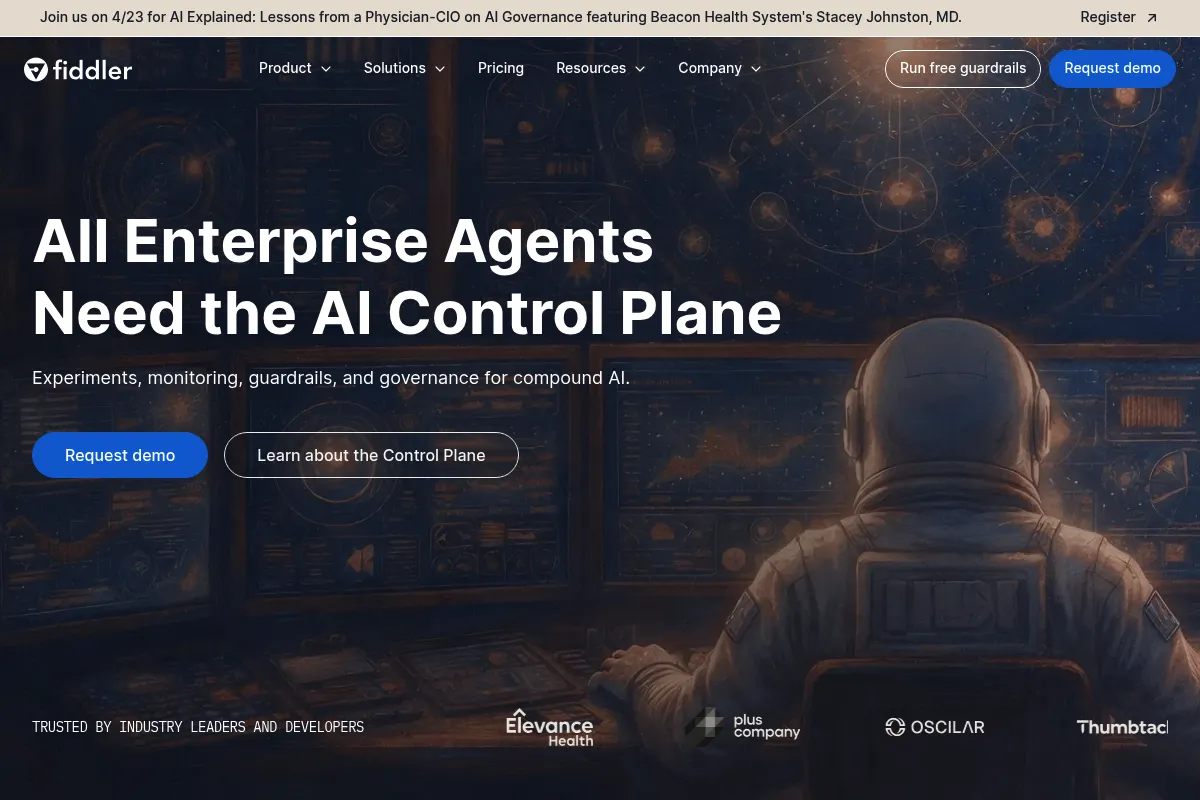
An enterprise-grade model monitoring and explainability platform that prioritizes AI governance and bias detection for both predictive and generative models.
Best fit for organizations in regulated industries that require deep explainability and compliance auditing for their AI deployments.
Analysis based on product data, pricing structure, traffic signals, and public user sentiment.
Who Should Use Fiddler?
Typical users
Data scientists, ML engineers, and compliance officers at mid-to-large enterprises managing production-grade AI.
Maturity fit
scaling to advanced
Choose this if…
- Your priority is explaining model decisions to regulators or stakeholders over simple uptime monitoring.
- You need to detect and mitigate bias across specific protected groups in your training and production data.
- You are moving LLM applications into production and need to monitor for hallucinations and PII leakage.
Skip this if…
- You only have one or two simple models and don't require formal governance.
- You need a lightweight, open-source tool you can self-host for free forever.
- Your primary requirement is experiment tracking during the training phase rather than production monitoring.
About Fiddler
Fiddler is a Model Performance Management (MPM) platform designed to provide visibility into how AI models behave in the real world. It addresses the 'black box' problem by providing tools to monitor, explain, and analyze model outputs for drift and bias. The platform serves as a centralized hub for both technical teams and compliance stakeholders to ensure AI reliability.
Official profiles
What it actually does
Fiddler connects to your model pipelines to track performance metrics, data drift, and prediction integrity in real-time. It uses advanced explainability techniques to show which features are driving specific model outcomes. For generative AI, it provides a specialized environment to evaluate LLM prompts and responses for safety and accuracy.
What makes it different
Unlike many competitors that focus strictly on operational metrics like latency, Fiddler was built with 'Explainable AI' (XAI) as its core. It offers deeper feature-level attribution and fairness auditing tools than general-purpose monitoring stacks. Their proprietary 'Fiddler Auditor' specifically targets the unique risks of LLMs, such as prompt injection and toxicity.
Ratings across the web

Ratings aggregated from independent review platforms.
Key Features
Explainable AI (XAI)
Uses SHAP and Integrated Gradients to provide clear reasons for every model prediction.
Drift Analytics
Visualizes how production data distributions deviate from training data to prevent model decay.
Fairness Indicators
Measures disparate impact and equal opportunity metrics to ensure ethical AI usage.
LLM Evaluation
Scores generative AI responses for correctness, toxicity, and PII exposure.
Model Directory
Provides a centralized catalog for all production models and their associated metadata.
Custom Alerts
Notifies teams via Slack or PagerDuty when performance or drift thresholds are breached.
Fiddler Auditor
An open-source library for red-teaming and evaluating LLM robustness before deployment.
Pricing
Free Trial
- Access to core monitoring features
- Limited data ingestion
- Standard explainability tools
- Evaluation of LLM prompts
Enterprise
- Unlimited model monitoring
- Full bias and fairness suite
- Advanced LLM safety guardrails
- VPC or On-prem deployment options
- Dedicated support and SLA
Pricing checked 5 months ago
Pricing guidance
- Moving a model from staging to production
- Requiring SOC2 or HIPAA compliant data handling
- Needing to monitor more than two models simultaneously
- Data retention limits vary by contract
- Explainability calculations can be computationally expensive and may impact costs
- On-prem deployment requires significant internal infrastructure
Premium enterprise positioning with high-touch sales and custom pricing.
Pros & Cons
Strengths
-
Deep explainability for complex models
It handles high-dimensional data well, allowing users to see exactly which features (like age or credit score) influenced a specific outcome.
-
Strong compliance and governance focus
The platform generates reports that are useful for internal audits and meeting regulatory requirements in finance and healthcare.
-
Unified view for Predictive and Generative AI
Teams can manage traditional ML models and new LLM applications within a single interface, reducing tool sprawl.
Weaknesses
-
High barrier to entry for small teams
The lack of transparent, self-serve pricing makes it difficult for small startups or individual developers to adopt.
Affects: Early-stage startups and solo developers
-
Complex initial integration
Mapping custom model schemas and uploading baseline datasets can be time-consuming compared to more automated 'plug-and-play' monitors.
Affects: Teams with limited MLOps engineering resources
-
Documentation can be dense
The technical depth of the platform means the documentation is often academic, requiring a solid grasp of data science theory to navigate.
Affects: Junior data scientists and non-technical managers
Real User Sentiment
Generally positive, especially among enterprise users who value the depth of the explainability and the professional UI.
Users tend to like
- The granularity of the drift detection
- The ability to slice and dice data to find bias
- Clean and intuitive dashboard design
- Responsive customer success team
Users commonly complain about
- Lack of transparent pricing
- Complexity of setting up custom explainers for non-standard models
- Resource intensive for very large datasets
Recurring tradeoffs
- Users trade ease of setup for much deeper analytical capabilities compared to basic monitors.
Happiest users
ML Engineers in banking or insurance who need to justify model decisions to non-technical stakeholders.
Often frustrated
Developers looking for a quick, cheap way to monitor a side project or a single simple model.
Use Cases
Credit Scoring
Explaining why a loan was denied to ensure compliance with fair lending laws.
Fraud Detection
Identifying when a model's accuracy drops because fraudsters have changed their tactics (drift).
Healthcare Diagnostics
Auditing models for bias to ensure equal performance across different patient demographics.
Customer Support Bots
Monitoring LLM responses for toxicity or 'hallucinated' company policies.
E-commerce Recommendations
Analyzing which product features are most influential in driving click-through rates.
Frequently Asked Questions
How much does Fiddler cost?
Fiddler does not publish its pricing. It is an enterprise-focused tool that requires a custom quote based on the number of models, data volume, and deployment requirements. Most contracts are annual.
How does Fiddler compare to Arize AI?
While both offer model monitoring, Fiddler places a much heavier emphasis on 'Explainable AI' (XAI) and bias detection. Arize is often praised for its troubleshooting and root-cause analysis workflows, whereas Fiddler is the preferred choice for governance and regulatory compliance.
Can Fiddler be deployed on-premise?
Yes, Fiddler offers flexible deployment options including SaaS, Virtual Private Cloud (VPC), and on-premise installations to meet strict data privacy requirements.
Does Fiddler support LLMs and Generative AI?
Yes, Fiddler has expanded its platform to include LLM observability, allowing users to monitor for hallucinations, safety violations, and prompt effectiveness using their 'Fiddler Auditor' tool.
What are the main limitations of Fiddler?
The main limitations are the high cost for smaller teams and the complexity of the initial setup. It requires a structured approach to data logging, which can be a hurdle for teams with messy or unorganized data pipelines.
Does Fiddler integrate with AWS SageMaker or Google Vertex AI?
Yes, Fiddler integrates with major cloud ML platforms including AWS SageMaker, Azure ML, and Google Vertex AI, allowing you to monitor models regardless of where they are hosted.
Why trust this page?
This evaluation combines product positioning, pricing analysis, traffic and market signals, and public user sentiment into a single decision-support page. Content is generated editorially — not copied from the vendor's website.
Funding & Company
Founded
2018
Stage
Series c
Total Raised
$97.2M
Latest Round
Series C (Jan 2026)
Notable Investors
Fiddler AI has raised a total of $97.2 million across five funding rounds, including a recent $30 million Series C in January 2026. This consistent and substantial backing from high-quality investors like Insight Partners, Lightspeed, and RPS Ventures signals strong market confidence and provides a solid financial runway for product development and expansion.
Market Signals & Traffic
Estimated visits, global rank, geography, traffic sources, monthly visit trends, and organic search keywords (Similarweb)—on a dedicated page built for depth and search.
- Estimated visits
- 64,490
- Global rank
- #553,648
- Snapshot
- Apr 2026
- Traffic trend
- Cooling
Estimated monthly visits
Alternatives to Fiddler
View all alternativesWhyLabs
Developer Tools, Workflow
Observability platform for monitoring data health and model performance.
Weights & Biases (W&B)
Developer Tools, Research

Developer platform for tracking, visualizing, and managing machine learning experiments.
Similar Tools
Wordware
Developer Tools, Automation & Agents, Workflow

IDE for building and deploying complex LLM applications
Weights & Biases (W&B)
Developer Tools, Research
Developer platform for tracking, visualizing, and managing machine learning experiments.
NoimosAI
Marketing Automation, Automation & Agents, SEO

Autonomous marketing platform for research, strategy, and campaign execution.
Predibase
Developer Tools

Fine-tune and serve custom large language models at scale.
Sarvam AI
Developer Tools, Communication, AI Assistant

Multilingual platform for Indian languages and voice-first enterprise applications.
OpenManus
Automation & Agents, Developer Tools, AI Assistant

Open-source framework for building and deploying autonomous general-purpose agents