

Vayu Robotics
Vayu Robotics provides a vision-first autonomous delivery system that prioritizes hardware cost reduction by replacing expensive LiDAR with a transformer-based AI model and passive sensors.
Excellent for logistics providers needing to scale delivery fleets at lower unit costs, weaker for operations requiring active depth sensing in low-visibility environments.
Analysis based on product data, pricing structure, traffic signals, and public user sentiment.
Who Should Use Vayu Robotics?
Typical users
Logistics managers at large e-commerce firms, third-party delivery operators, and retail chains managing last-mile fulfillment.
Maturity fit
scaling
Choose this if…
- Your primary goal is reducing the CAPEX of autonomous delivery fleets
- You want a vision-based navigation system similar to modern automotive AI
- You operate in urban or suburban environments with clear visual markers
- You are moving from small-scale pilots to thousands of deployed units
Skip this if…
- Your delivery routes frequently involve heavy fog, total darkness, or extreme weather where cameras fail
- You require immediate, off-the-shelf consumer availability for a single unit
- Your workflow demands high-precision LiDAR for centimeter-level obstacle mapping
About Vayu Robotics
Vayu Robotics is an automation company focused on last-mile logistics. It was founded by former leaders from Velodyne and Apple to solve the high cost of autonomous hardware. The company develops both the physical delivery robots and the underlying AI models that allow them to navigate without expensive sensors.
What it actually does
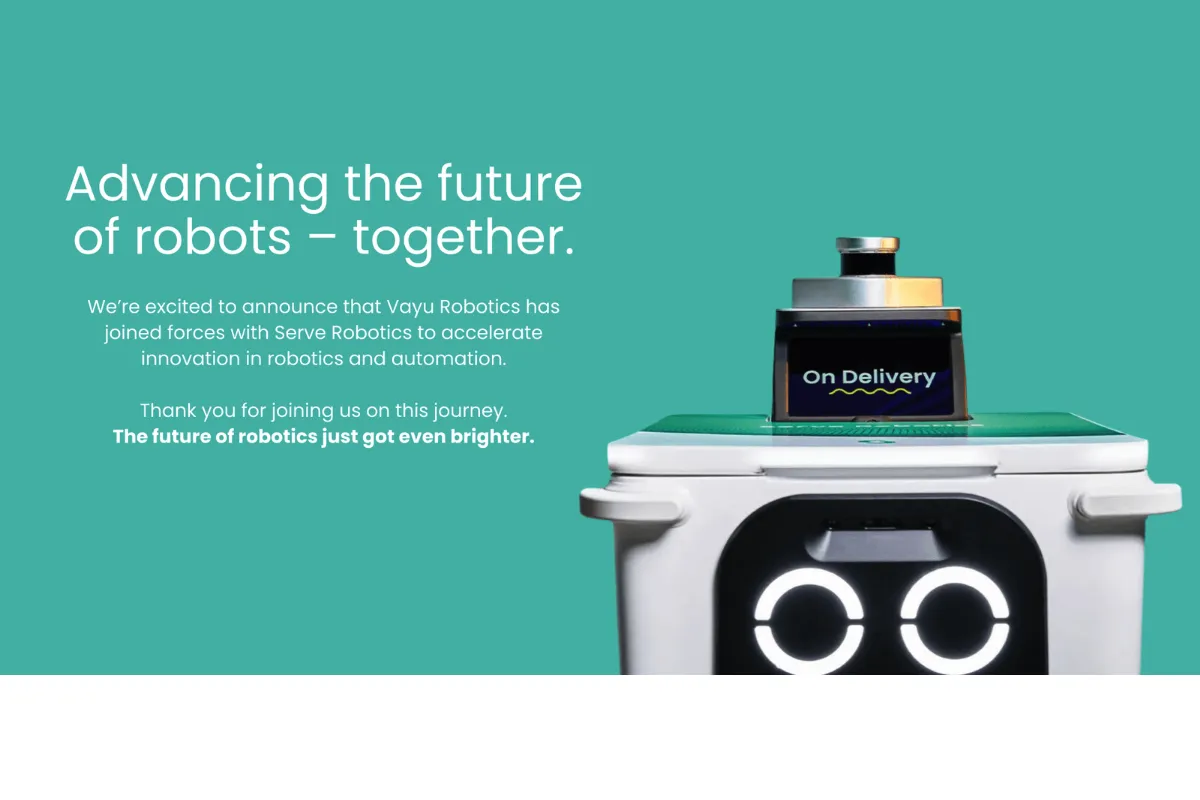
The company provides the Vayu One delivery robot, which can carry up to 100lbs of goods at speeds up to 20mph. It uses a proprietary 'Vayu Drive' foundation model to process visual data from cameras, enabling the robot to navigate sidewalks and roads autonomously from a hub to a customer's door.
What makes it different
Unlike competitors like Nuro or Starship that rely on LiDAR for spatial awareness, Vayu uses a transformer-based mobility model and passive sensors. This architectural choice mimics human vision and significantly lowers the manufacturing cost per robot, making large-scale fleet deployment economically viable.
Key Features
Vayu Drive
A foundation model trained on massive datasets to handle navigation as a unified AI task.
Passive Sensor Suite
High-resolution cameras replace $10,000+ LiDAR units to lower hardware costs.
Vayu One Robot
A purpose-built delivery vehicle designed for durability and urban maneuverability.
Form-factor Agnostic AI
The software can be integrated into different robotic designs beyond the Vayu One.
Cloud Fleet Management
Centralized dashboard for tracking delivery status and robot health.
Low-Latency Connectivity
Ensures remote operators can take control if the AI encounters an edge case.
Pricing
Enterprise Fleet
- Vayu One robot hardware
- Vayu Drive software licensing
- Fleet management dashboard
- Maintenance and support
- Custom integration services
Pricing checked 5 months ago
Pricing guidance
- Moving from pilot to full commercial rollout
- Expanding delivery zones
- Increasing payload requirements
- Minimum order quantities likely apply
- Maintenance costs vary by geographic density
- Connectivity fees for remote monitoring
Aggressive pricing aimed at undercutting LiDAR-based competitors on total cost of ownership.
Pros & Cons
Strengths
-
Significant unit cost reduction
By removing LiDAR, Vayu can produce robots at a fraction of the cost of traditional autonomous vehicles, shortening the path to ROI for logistics firms.
-
Scalable AI architecture
The transformer-based model generalizes better to new environments than traditional rule-based systems, reducing the need for manual mapping.
-
High payload efficiency
The Vayu One is designed to carry substantial weight, making it practical for grocery and retail delivery rather than just small food orders.
Weaknesses
-
Vision system vulnerability
Passive sensors are susceptible to environmental factors like glare, heavy rain, or low light that active LiDAR systems handle more reliably.
Affects: Operators in regions with frequent inclement weather
-
Early-stage deployment data
While the tech is promising, there is less public long-term reliability data compared to established players like Starship.
Affects: Risk-averse enterprise buyers
-
Regulatory uncertainty
Autonomous sidewalk robots face a patchwork of local regulations that can change or ban operations with little notice.
Affects: Expansion teams in new geographic markets
Real User Sentiment
The sentiment among industry analysts is cautiously optimistic, focusing on the potential for Vayu to finally make last-mile delivery profitable through cost reduction.
Users tend to like
- The bold move to ditch LiDAR
- The pedigree of the founding team
- The focus on manufacturing scalability
- The use of modern transformer models
Users commonly complain about
- Lack of public performance benchmarks
- Concerns about safety in complex urban edge cases
- Limited availability for smaller operators
Recurring tradeoffs
- Users trade the high-fidelity depth data of LiDAR for a significantly lower price point and simpler hardware stack.
Happiest users
Large-scale retailers looking for a way to automate deliveries without the massive upfront costs of traditional AVs.
Often frustrated
Small business owners or researchers looking for a single, low-cost autonomous platform for experimentation.
Use Cases
Grocery Delivery
Transporting weekly shopping orders from local stores to residential doorsteps.
E-commerce Fulfillment
Moving packages from micro-fulfillment centers to customers in urban areas.
Pharmacy Delivery
Securely transporting prescriptions to patients with real-time tracking.
Campus Logistics
Moving mail or supplies between buildings in a corporate or university setting.
Retail Returns
Picking up return items from customers to bring back to a central hub.
Frequently Asked Questions
How does Vayu navigate without LiDAR?
Vayu uses a 'Vayu Drive' foundation model, which is a transformer-based AI trained on visual data. It processes images from multiple cameras to understand depth, distance, and object classification, similar to how the human brain processes vision to navigate.
What is the payload capacity of the Vayu One?
The Vayu One is designed to carry over 100 pounds (approx. 45kg) of cargo, making it suitable for larger grocery orders or multiple e-commerce packages in a single trip.
How much does a Vayu robot cost?
Vayu does not publish a list price. However, their stated mission is to produce robots at a significantly lower cost than LiDAR-equipped competitors, which typically cost tens of thousands of dollars per unit.
How does Vayu compare to Starship Technologies?
While Starship is a pioneer in the space with millions of deliveries, Vayu focuses on a more advanced AI architecture (transformers) and a vision-only sensor suite to drive down costs. Vayu's robots are also generally larger and faster than the standard Starship model.
Can Vayu robots operate in the rain?
Yes, the hardware is weather-sealed for standard outdoor operation. However, like all vision-based systems, extremely heavy rain or snow that obscures camera lenses can degrade autonomous performance.
Does Vayu offer a free trial?
No, Vayu operates on a B2B partnership model. Potential customers typically engage in a paid pilot program to test the technology in their specific operational environment before committing to a full fleet.
Why trust this page?
This evaluation combines product positioning, pricing analysis, traffic and market signals, and public user sentiment into a single decision-support page. Content is generated editorially — not copied from the vendor's website.
Market Signals & Traffic
Estimated visits, global rank, geography, traffic sources, monthly visit trends, and organic search keywords (Similarweb)—on a dedicated page built for depth and search.
- Estimated visits
- 3,079
- Global rank
- #4,993,722
- Snapshot
- Apr 2026
- Traffic trend
- Falling
Estimated monthly visits
Similar Tools
Deepchecks
Developer Tools, Automation, Workflow

Testing and monitoring platform for machine learning and LLM applications.
Parea
Developer Tools, Automation, Workflow

Platform for evaluating, testing, and monitoring LLM applications.
Extropic
Developer Tools, Research

Thermodynamic computing platform for high-performance and energy-efficient generative models.
Reka
Developer Tools, AI Assistant

Multimodal language models for text, image, video, and audio.
Lightning AI
Developer Tools, Automation, Research

Cloud platform for building, training, and deploying machine learning models
Physical Intelligence
Automation & Agents, Developer Tools, Research

Universal foundation models for robotic control and physical interaction.