

Parea
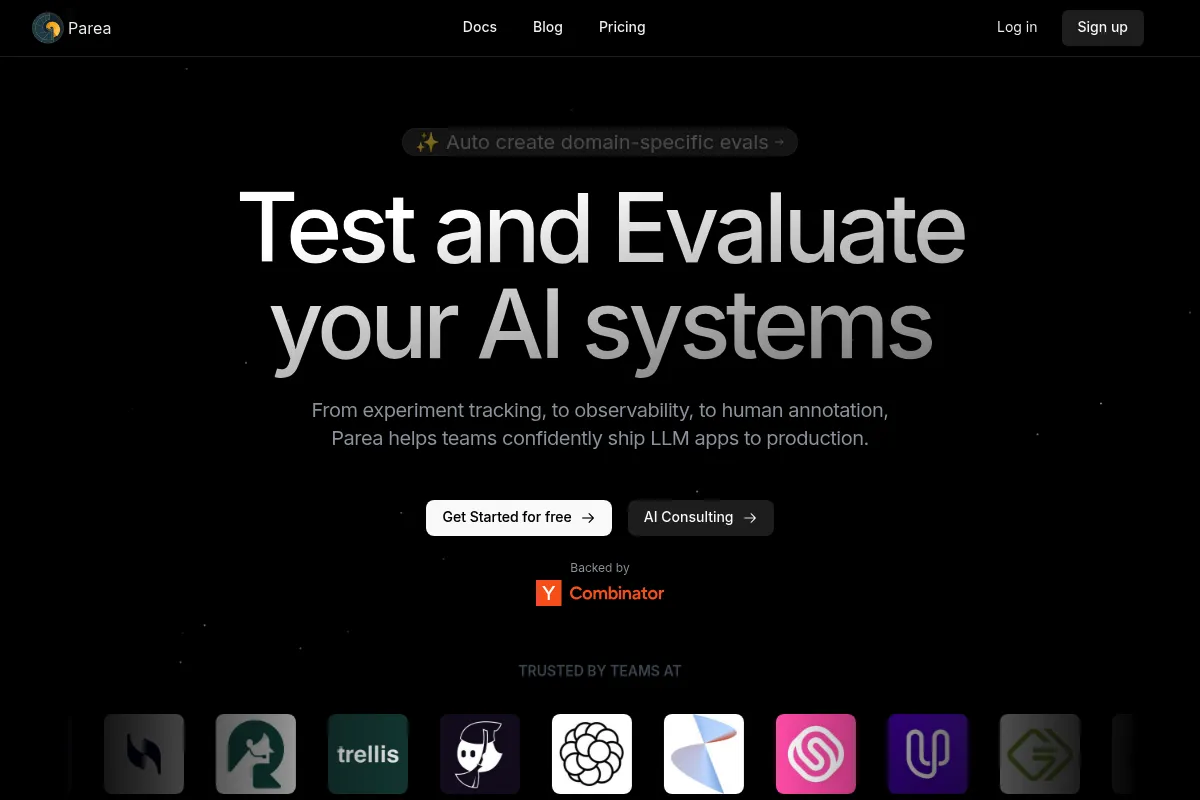
Parea is a developer-centric evaluation and observability suite that prioritizes the testing lifecycle, making it a strong choice for teams moving from prompt hacking to production-grade LLM engineering.
Excellent for developers who need rigorous CI/CD evaluation workflows, though potentially overkill for teams only looking for simple logging.
Analysis based on product data, pricing structure, traffic signals, and public user sentiment.
Who Should Use Parea?
Typical users
Software engineers and AI researchers building LLM-backed products who need to quantify model performance before and after deployment.
Maturity fit
scaling
Choose this if…
- Your priority is automated evaluation within CI/CD pipelines
- You want to compare model outputs across different versions or providers side-by-side
- You need to trace complex, multi-step LLM chains to identify latency or cost bottlenecks
Skip this if…
- You only need basic request logging without evaluation metrics
- Your team lacks the engineering capacity to integrate SDKs into your codebase
- You are looking for a non-technical prompt management tool for marketing teams
About Parea
Parea is an integrated platform designed to bridge the gap between prompt engineering and production monitoring. It provides the infrastructure to test, version, and observe LLM applications, ensuring that updates to prompts or models don't degrade performance.
Official profiles
What it actually does
It allows developers to run batch evaluations against datasets, monitor live production traces, and experiment in a playground environment. The platform tracks metrics like cost, latency, and custom evaluation scores to provide a clear picture of application health.
What makes it different
Unlike general observability tools, Parea focuses heavily on the 'evals' workflow, allowing users to turn production traces into test cases with one click. Its tight integration between the playground and the SDK means prompts can be updated in the UI and pulled into code without redeploying.
Key Features
One-click Test Cases
Convert problematic production traces into permanent test cases to prevent regressions.
LLM-as-a-Judge
Use models like GPT-4 to automatically grade the quality of outputs based on custom rubrics.
Prompt Playground
Test prompts across multiple models simultaneously before committing to code.
Trace Visualization
View the entire execution path of nested LLM calls to find where logic breaks.
Deployment Tags
Manage different prompt versions for staging and production environments via API.
Dataset Management
Centralize golden datasets for consistent benchmarking across the team.
Pricing
Free
- Up to 1,000 traces per month
- Basic evaluation metrics
- Community support
- Prompt playground access
Pro
- Up to 10,000 traces per month
- Advanced evaluation workflows
- Dataset management
- Email support
Enterprise
- Unlimited traces
- SSO and advanced security
- Custom data retention policies
- Dedicated account manager
Pricing checked 5 months ago
Pricing guidance
- When you exceed 1,000 traces per month
- When you need to share datasets across a team
- When you want to automate evaluations in your CI/CD pipeline
- Trace retention periods may vary by plan
- High-volume LLM-as-a-judge evaluations will incur additional costs from your model provider
Competitive with other developer-focused AI observability tools like LangSmith, offering a mid-tier entry point for growing teams.
Pros & Cons
Strengths
-
Strong focus on the evaluation loop
The ability to easily create datasets from production logs makes it faster to build a robust testing suite than using disconnected tools.
-
Developer-first SDK design
The Python and TypeScript SDKs are lightweight and designed to wrap existing code with minimal friction, supporting asynchronous calls natively.
-
Unified playground and monitoring
Having the experimentation environment and production data in one place reduces the context switching required to debug edge cases.
Weaknesses
-
Learning curve for evaluation logic
Setting up meaningful 'LLM-as-a-judge' metrics requires careful prompt engineering of the evaluator itself, which can be time-consuming.
Affects: Small teams without dedicated AI engineers
-
UI can feel dense
The interface packs a lot of data into traces and logs, which can be overwhelming compared to simpler alternatives like Helicone.
Affects: Product managers or less technical stakeholders
-
Dependency on Parea's proxy/SDK
Like most observability tools, you are introducing a third-party dependency into your critical path, which may raise latency or privacy concerns for some.
Affects: Enterprise security teams
Real User Sentiment
Users generally appreciate the tool's focus on the developer experience and its ability to make LLM testing more scientific.
Users tend to like
- Ease of converting traces to test cases
- Clean SDK integration
- Responsiveness of the founding team to feature requests
Users commonly complain about
- Initial setup of custom evaluators can be finicky
- Occasional UI lag when viewing very large traces
Recurring tradeoffs
- Users trade some simplicity for much deeper testing and evaluation capabilities compared to basic loggers.
Happiest users
Engineers building complex RAG applications who need to track how changes in retrieval affect final output quality.
Often frustrated
Users who just want a 'set it and forget it' logging tool without engaging in the evaluation process.
Use Cases
Regression Testing
Running a suite of 100 test cases every time a prompt is modified to ensure accuracy doesn't drop.
Cost Optimization
Identifying which steps in a chain are consuming the most tokens and testing cheaper model alternatives.
RAG Debugging
Tracing exactly which retrieved document led to a hallucination in the final response.
A/B Testing Prompts
Deploying two versions of a prompt to see which one performs better based on user feedback or automated metrics.
Production Monitoring
Setting up alerts for when average latency or cost per request exceeds a certain threshold.
Frequently Asked Questions
How does Parea compare to LangSmith?
LangSmith is deeply tied to the LangChain ecosystem, whereas Parea is more framework-agnostic. Parea often feels faster to set up for teams not using LangChain and places a heavier emphasis on the 'one-click' transition from production logs to test datasets. While LangSmith is more mature, Parea is often praised for its cleaner, more focused developer experience.
Does Parea offer a free plan?
Yes, Parea has a free tier that includes up to 1,000 traces per month and access to the playground. It is suitable for individual developers or early-stage prototyping, but teams running production traffic will likely need to upgrade to the Pro plan starting at $50/month.
Can I use my own evaluation metrics?
Absolutely. Parea allows you to define custom evaluation functions in code or use 'LLM-as-a-judge' where you provide a prompt and a rubric for a model like GPT-4 to grade your application's outputs. This is a core strength of the platform.
What are the main limitations of Parea?
The primary limitation is that it requires an engineering-heavy approach; it is not a 'no-code' tool. Additionally, while it supports many models, the deepest integrations and best-supported features are currently centered around the OpenAI and Anthropic ecosystems.
Does Parea store my data?
Parea stores the traces and logs you send to it via the SDK. For enterprise customers with strict data residency requirements, they offer custom data retention policies and can discuss private cloud or on-premise deployment options.
Which programming languages are supported?
Parea currently provides official SDKs for Python and TypeScript/JavaScript. These cover the vast majority of LLM application development, but if you are using another language, you would need to interface directly with their REST API.
Why trust this page?
This evaluation combines product positioning, pricing analysis, traffic and market signals, and public user sentiment into a single decision-support page. Content is generated editorially — not copied from the vendor's website.
Funding & Company
Founded
2023
Stage
Seed
Total Raised
$500K
Latest Round
Seed (Jul 2023)
Notable Investors
Parea AI has raised a total of $500,000 in a seed round from the prestigious accelerator Y Combinator as part of its Summer 2023 batch. This initial funding provides the company with the capital to build out its core product and establish an early market presence.
Market Signals & Traffic
Estimated visits, global rank, geography, traffic sources, monthly visit trends, and organic search keywords (Similarweb)—on a dedicated page built for depth and search.
- Estimated visits
- 3,545
- Global rank
- #4,702,829
- Snapshot
- Apr 2026
- Traffic trend
- Surging
Estimated monthly visits
Alternatives to Parea
View all alternatives
Similar Tools
Playwright
Developer Tools, Automation, Workflow

Cross-browser end-to-end testing and automation for modern web applications.
Promptfoo
Developer Tools, Automation, Workflow

Test and evaluate LLM output quality with automated benchmarks
Radiant
Developer Tools, Automation, Workflow

Integrated AI infrastructure and cloud platform for scaling model deployment.
Martian
Developer Tools, Automation, Workflow

Dynamic router that automatically selects the best LLM for every prompt.
Deepchecks
Developer Tools, Automation, Workflow

Testing and monitoring platform for machine learning and LLM applications.
ZenML
Developer Tools, Automation, Workflow

Open-source MLOps framework for building portable machine learning pipelines.