
ZenML
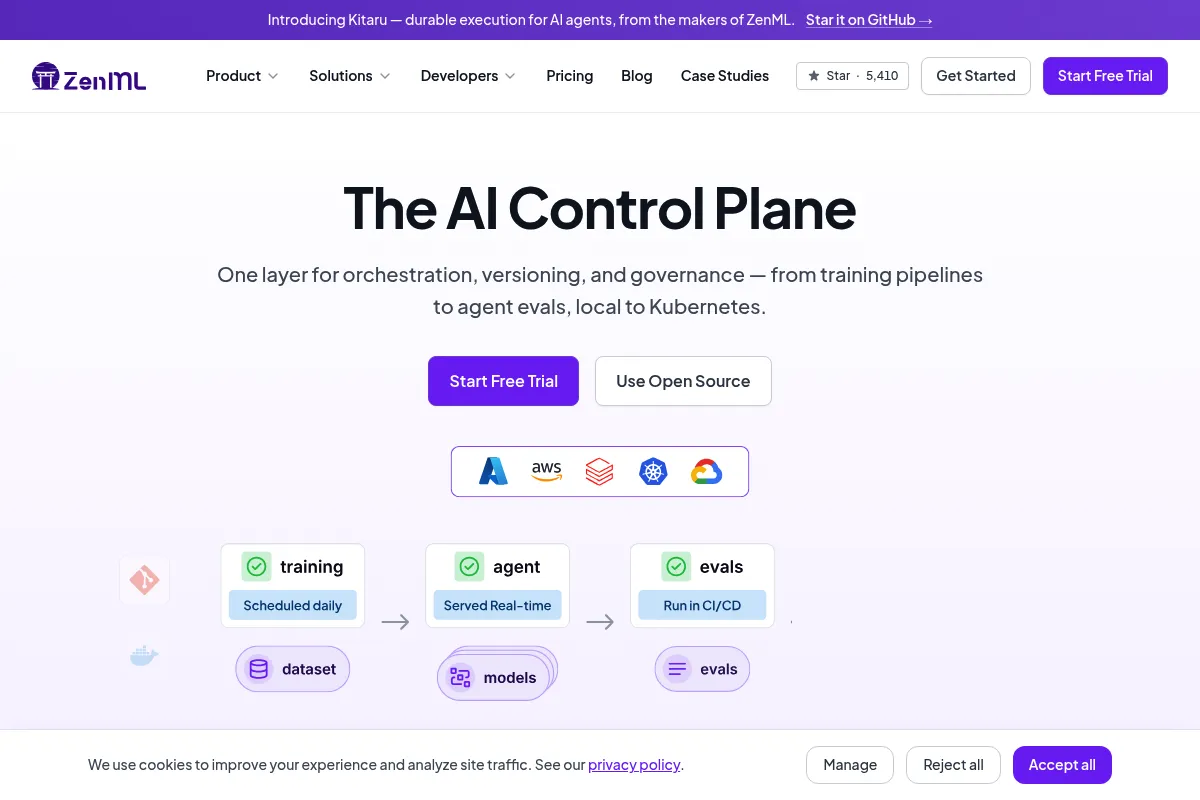
An orchestration framework that decouples machine learning code from infrastructure, allowing teams to swap tools like orchestrators or experiment trackers without rewriting their Python pipelines.
Excellent for teams requiring cloud-agnostic ML pipelines and tool flexibility, weaker for solo researchers who prefer the simplicity of local notebooks.
Analysis based on product data, pricing structure, traffic signals, and public user sentiment.
Who Should Use ZenML?
Typical users
ML engineers and data science teams in scaling organizations who need to move models from local development to production cloud environments.
Maturity fit
scaling to advanced
Choose this if…
- You want to write pipeline code once and run it on local, AWS, or GCP without changes.
- Your priority is avoiding vendor lock-in by maintaining an abstraction layer over cloud services.
- You need to integrate a fragmented stack of tools like MLflow, Kubeflow, and Great Expectations into a single workflow.
Skip this if…
- You are a solo practitioner only working in local Jupyter notebooks.
- Your organization is fully committed to a single cloud provider's native ML platform (e.g., SageMaker) and has no plans to diversify.
- You need a 'black box' AutoML solution rather than a pipeline orchestration framework.
About ZenML
ZenML is an open-source MLOps framework designed to standardize the transition from experimental code to production-ready pipelines. It acts as a structural layer that sits between your ML code and the underlying infrastructure, ensuring that workflows remain portable and reproducible across different environments.
Official profiles
What it actually does
It provides a Python SDK to define ML workflows as a series of steps. These pipelines are then mapped to 'Stacks'—configurations that specify which tools (like Airflow for orchestration or S3 for storage) should execute the code, allowing for environment-specific execution without code modifications.
What makes it different
Unlike MLflow, which focuses primarily on experiment tracking, or Kubeflow, which is a heavy infrastructure platform, ZenML is an abstraction layer. Its unique 'Stack' architecture allows developers to treat infrastructure as a configuration file, making it possible to switch from local execution to a Kubernetes cluster by changing a single CLI command.
Key Features
ZenML Stacks
Defines the combination of orchestrator, artifact store, and metadata store used for a run.
Step Decorators
Converts standard Python functions into reproducible pipeline steps with minimal boilerplate.
Artifact Versioning
Automatically tracks and versions data inputs and outputs across every pipeline run.
Stack Recipes
Pre-configured Terraform scripts to deploy entire MLOps infrastructures on AWS, GCP, or Azure.
Model Control Plane
A centralized view to manage model versions, metadata, and deployment status.
Secret Management
Securely handles API keys and cloud credentials within the pipeline execution context.
Client SDK & CLI
Provides full control over pipeline execution and stack configuration from the terminal.
Pricing
Open Source
- Self-hosted
- Unlimited pipelines
- All community integrations
- Local and remote stacks
Cloud Standard
- Hosted ZenML dashboard
- Managed secret store
- Team collaboration tools
- Basic RBAC
Cloud Pro
- Advanced RBAC
- Priority support
- Custom integrations
- SLA guarantees
Enterprise
- Single Sign-On (SSO)
- VPC deployment options
- Dedicated account manager
- Custom security compliance
Pricing checked 4 months ago
Pricing guidance
- When you need a hosted, zero-maintenance dashboard for non-technical stakeholders.
- When you require Role-Based Access Control (RBAC) for a growing team.
- When you need centralized secret management across multiple cloud environments.
- The OSS version requires you to manage your own database and container registry.
- Cloud pricing is per-user, which can become expensive for large data science departments.
Competitive pricing for the managed tier, following a standard 'open-core' model where convenience and collaboration are the primary paid drivers.
Pros & Cons
Strengths
-
High portability across environments
The ability to run the exact same code on a local machine and a production Kubernetes cluster reduces 'it works on my machine' errors during deployment.
-
Tool-agnostic integration
It supports over 50 integrations, meaning teams can keep using their preferred tools for tracking, deployment, and monitoring without being forced into a specific ecosystem.
-
Standardized pipeline structure
Enforces a clean, modular code structure that makes it easier for multiple engineers to collaborate on and maintain complex ML workflows.
Weaknesses
-
Steep initial configuration curve
Setting up the initial 'Stacks' and understanding the relationship between components requires significant time and CLI interaction.
Affects: Small teams looking for immediate results
-
Debugging abstraction layers
When a pipeline fails, it can be difficult to discern if the error is in the Python code, the ZenML configuration, or the underlying infrastructure tool.
Affects: Engineers troubleshooting complex cloud deployments
-
Documentation density
The rapid pace of development means documentation can sometimes lag behind the latest features, leading to confusion during implementation.
Affects: New users trying to implement advanced custom components
Real User Sentiment
Generally positive, with users praising the framework's ability to clean up messy experimental code, though some find the 'Stack' concept initially confusing.
Users tend to like
- The 'write once, run anywhere' portability
- Clean Pythonic API for defining steps
- Extensive list of pre-built integrations
- Active and helpful Slack community
Users commonly complain about
- Complexity of setting up remote stacks for the first time
- CLI-heavy workflow can be intimidating for pure data scientists
- Occasional breaking changes in rapid version updates
Recurring tradeoffs
- You gain portability but lose some of the fine-grained control you would have by writing raw Kubernetes manifests or Airflow DAGs.
Happiest users
ML Engineers who are tired of rewriting deployment scripts every time a data scientist finishes a new model.
Often frustrated
Data scientists who want a simple 'click to deploy' button without learning about orchestrators or artifact stores.
Use Cases
Local to Cloud Migration
Moving a model from a laptop to a production AWS EKS cluster without changing code.
Multi-Cloud Strategy
Running training on GCP for TPUs while deploying the inference pipeline on Azure.
Tool Standardization
Forcing a consistent pipeline structure across different teams using different tracking tools.
Automated Retraining
Setting up scheduled pipelines that pull new data, retrain models, and update the model registry.
Audit & Compliance
Using the built-in lineage tracking to prove exactly which data version produced a specific model.
Frequently Asked Questions
How does ZenML differ from MLflow?
MLflow is primarily an experiment tracking and model versioning tool. ZenML is an orchestrator that can use MLflow as a component. While MLflow tracks what happened, ZenML defines how the work is executed across different infrastructure pieces.
Is ZenML free to use?
Yes, the core ZenML framework is open-source and free. You only pay if you choose to use ZenML Pro, which provides a hosted dashboard, team collaboration features, and managed infrastructure for the ZenML server.
Does ZenML replace Airflow or Kubeflow?
No, ZenML acts as a wrapper around them. You define your pipeline in ZenML, and it 'compiles' that pipeline to run on Airflow or Kubeflow. This allows you to switch between them without rewriting your ML logic.
What are the main limitations of ZenML?
The primary limitation is the initial setup complexity. It requires a solid understanding of MLOps concepts like artifact stores and orchestrators. Additionally, while it has many integrations, custom integrations require writing specific 'Stack Component' wrappers.
Can I use ZenML with my existing AWS/GCP setup?
Yes, ZenML is designed specifically for this. It provides 'Stack Recipes' using Terraform to help you connect your existing cloud resources (like S3 buckets or SageMaker) to the ZenML framework.
Does ZenML handle model deployment?
ZenML integrates with deployment tools like BentoML, Seldon, and KServe. It manages the pipeline that leads to deployment, ensuring the right model version is handed off to the serving infrastructure.
Why trust this page?
This evaluation combines product positioning, pricing analysis, traffic and market signals, and public user sentiment into a single decision-support page. Content is generated editorially — not copied from the vendor's website.
Funding & Company
Founded
2021
Stage
Seed
Total Raised
$6.4M
Latest Round
Seed (Oct 2023)
Notable Investors
ZenML has raised a total of $6.4 million over two seed rounds, indicating steady early-stage investor confidence. [4, 5, 7] The most recent funding in late 2023 provides capital to expand its team and develop its commercial cloud offering on top of its open-source framework. [1, 5]
Market Signals & Traffic
Estimated visits, global rank, geography, traffic sources, monthly visit trends, and organic search keywords (Similarweb)—on a dedicated page built for depth and search.
- Estimated visits
- 122,797
- Global rank
- #336,484
- Snapshot
- Apr 2026
- Traffic trend
- Steady
Estimated monthly visits
Similar Tools
Deepchecks
Developer Tools, Automation, Workflow

Testing and monitoring platform for machine learning and LLM applications.
Martian
Developer Tools, Automation, Workflow

Dynamic router that automatically selects the best LLM for every prompt.
Playwright
Developer Tools, Automation, Workflow
Cross-browser end-to-end testing and automation for modern web applications.
Parea
Developer Tools, Automation, Workflow

Platform for evaluating, testing, and monitoring LLM applications.
Hasty
Developer Tools, Automation, Workflow
Data-centric vision platform for labeling, training, and deploying models.
Hopsworks
Developer Tools, Automation, Workflow

Feature store and MLOps platform for managing machine learning pipelines.