

A comprehensive validation framework for ML and LLM pipelines that bridges the gap between experimental research and production-grade monitoring.
Excellent for data scientists needing automated model validation suites, weaker for teams looking for lightweight, single-metric uptime monitoring.
Analysis based on product data, pricing structure, traffic signals, and public user sentiment.
Who Should Use Deepchecks?
Typical users
Data scientists and ML engineers in mid-to-large organizations managing complex model lifecycles and RAG applications.
Maturity fit
scaling to advanced
Choose this if…
- You want a standardized way to test data integrity before training without writing custom scripts
- Your priority is detecting subtle model decay and data drift over simple performance metrics
- You need to evaluate LLM outputs for hallucinations and bias in a RAG pipeline
Skip this if…
- You need a simple 'up/down' monitor for basic API endpoints
- Your workflow requires a tool that manages the entire training infrastructure, not just the testing
- You lack a dedicated data science team to interpret complex statistical check results
About Deepchecks
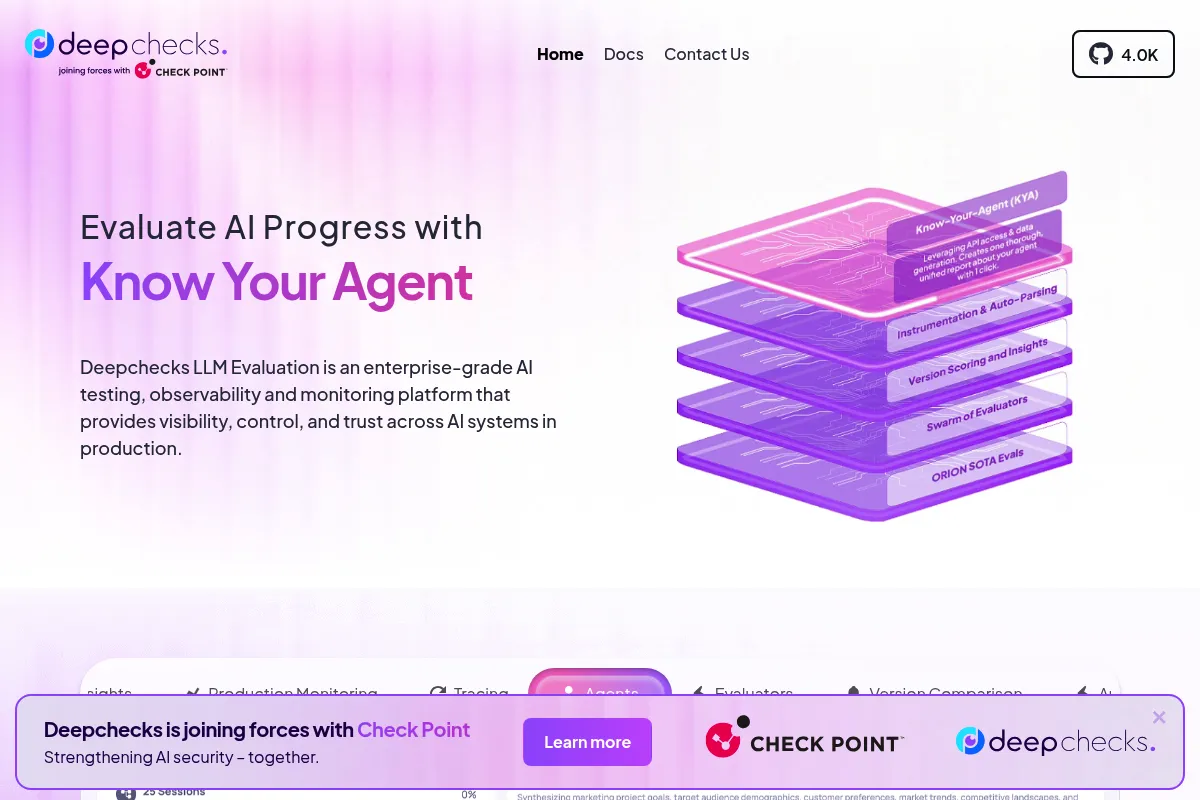
Deepchecks is a testing and monitoring platform designed to ensure the reliability of machine learning models and LLM applications. It provides automated suites to detect data drift, model decay, and integrity issues from development through production.
Official profiles
What it actually does
It automates the process of checking data and models for errors, biases, and performance drops. Users run pre-built 'suites' during research to validate data, in CI/CD to prevent bad models from deploying, and in production to monitor live data.
What makes it different
Unlike generic observability tools, Deepchecks focuses heavily on the testing phase with a library of over 100 pre-built, domain-specific checks. It treats ML testing as a continuous requirement rather than a one-off evaluation.
Ratings across the web
Ratings aggregated from independent review platforms.
Key Features
Check Suites
Groups of tests that run automatically to validate data and model health in one go.
LLM Evaluation
Specific modules for testing RAG pipelines, including context relevance and groundedness.
Drift Detection
Identifies when production data distribution deviates from training data.
Data Integrity Alerts
Notifies teams when null values, duplicates, or schema changes occur.
Visual Reports
Generates HTML reports that make it easier to share findings with non-technical stakeholders.
Open Source Core
A free Python library for local testing before committing to the cloud platform.
Property-Based Testing
Evaluates LLM responses based on specific criteria like politeness or toxicity.
Pricing
Open Source (ML)
- Core ML testing library
- Data integrity checks
- Train-test validation
- Local HTML reports
LLM Eval Free
- 1 user
- 1,000 steps per month
- Basic LLM properties
- Community support
LLM Eval Team
- Up to 5 users
- 10,000 steps per month
- Advanced LLM properties
- Standard support
Enterprise
- Unlimited users
- VPC or On-prem deployment
- SSO and RBAC
- Dedicated success manager
Pricing checked 4 months ago
Pricing guidance
- When you need to monitor models in a live production environment
- When your LLM application exceeds 1,000 evaluation steps per month
- When you require SOC2 compliance or VPC deployment
- Step-based pricing for LLMs can become expensive if you evaluate every single user interaction
- The open-source version lacks the collaborative dashboard and historical tracking of the SaaS version
Mid-market pricing that is competitive with Arize and WhyLabs, but can scale quickly for high-volume LLM applications.
Pros & Cons
Strengths
-
Extensive pre-built check library
Saves hundreds of hours by providing ready-made tests for common ML issues like label leakage and feature importance shifts.
-
Bridges the gap between Dev and Ops
Allows the same testing logic used during model development to be applied in production monitoring, ensuring consistency.
-
Strong LLM-specific evaluations
The LLM Evaluation product specifically addresses modern problems like RAG retrieval quality and output safety.
Weaknesses
-
High initial learning curve
Understanding how to configure custom suites and interpret complex statistical outputs requires significant data science expertise.
Affects: Junior developers or non-specialized teams
-
Resource intensive for large datasets
Running comprehensive check suites on massive production datasets can lead to performance overhead or high compute costs.
Affects: Teams handling high-velocity, big data streams
-
UI can feel cluttered
The density of information in the dashboard can be overwhelming when managing dozens of models simultaneously.
Affects: Managers looking for high-level executive summaries
Real User Sentiment
Users generally respect Deepchecks for its technical depth and the 'batteries-included' nature of its testing suites.
Users tend to like
- The ability to catch data leakage before deployment
- Comprehensive visual reports for model audits
- The flexibility of the open-source Python library
- Specific focus on RAG pipeline metrics
Users commonly complain about
- Documentation can be fragmented between the ML and LLM products
- Setting up custom checks requires deep Python knowledge
- The SaaS UI can be slow when loading large reports
Recurring tradeoffs
- You trade simplicity for depth; it takes longer to set up than basic monitors but provides much more insight.
Happiest users
Data scientists who are tired of writing boilerplate code for data validation and want a professional testing framework.
Often frustrated
Software engineers tasked with 'AI monitoring' who don't have the background to understand statistical drift metrics.
Use Cases
Pre-deployment Validation
Running a full suite of tests to ensure a new model version outperforms the old one.
RAG Quality Control
Evaluating if an LLM's answers are actually supported by the retrieved documents.
Data Drift Monitoring
Detecting when changes in user behavior make your training data obsolete.
Regulatory Compliance
Generating detailed reports on model bias and performance for auditing purposes.
CI/CD for ML
Automatically failing a build if the model shows signs of label leakage or integrity issues.
Frequently Asked Questions
Is Deepchecks open source?
Yes, the core ML testing library is open source and available on GitHub. However, the LLM evaluation platform and the production monitoring features are primarily offered as SaaS or managed services with a free tier.
How does Deepchecks compare to Arize or WhyLabs?
Deepchecks is more focused on the 'testing' and 'validation' suites during the development phase, whereas Arize and WhyLabs traditionally leaned more toward production observability. Deepchecks provides more out-of-the-box statistical checks for data scientists.
What are the limitations of the free plan?
The LLM Eval free plan is limited to 1,000 steps per month and a single user. For traditional ML, the open-source library is unlimited for local use but lacks the persistent monitoring and team collaboration features of the paid cloud version.
Does it support RAG applications?
Yes, Deepchecks has a dedicated LLM Evaluation product that includes specific properties for RAG, such as Groundedness (checking if the answer is in the context) and Relevance (checking if the answer matches the query).
Can I run Deepchecks on-premises?
On-premises and VPC deployment options are available, but they are typically reserved for the Enterprise tier. Small teams are encouraged to use the SaaS version.
What integrations are supported?
Deepchecks integrates with popular ML tools like PyTorch, Scikit-Learn, and XGBoost, as well as orchestration platforms like Airflow and CI/CD tools like GitHub Actions.
Why trust this page?
This evaluation combines product positioning, pricing analysis, traffic and market signals, and public user sentiment into a single decision-support page. Content is generated editorially — not copied from the vendor's website.
Funding & Company
Founded
2019
Stage
Acquired
Total Raised
$14M
Latest Round
Seed (Jun 2023)
Notable Investors
Deepchecks raised a single, substantial Seed round of $14 million in June 2023 from notable investors including Alpha Wave Global, Grove Ventures, and Hetz Ventures. The company's trajectory culminated in its acquisition by cybersecurity giant Check Point in May 2026, ensuring the technology's long-term persistence within a larger platform.
Market Signals & Traffic
Estimated visits, global rank, geography, traffic sources, monthly visit trends, and organic search keywords (Similarweb)—on a dedicated page built for depth and search.
- Estimated visits
- 83,028
- Global rank
- #458,947
- Snapshot
- Apr 2026
- Traffic trend
- Falling
Estimated monthly visits
Alternatives to Deepchecks
View all alternativesEvidently AI
Developer Tools, Workflow, Research

Open-source framework for evaluating, testing, and monitoring machine learning models.
Fiddler
Developer Tools, Privacy & Compliance, Automation

Monitor, explain, and analyze machine learning models and LLMs.
Similar Tools
Promptfoo
Developer Tools, Automation, Workflow

Test and evaluate LLM output quality with automated benchmarks
Hasty
Developer Tools, Automation, Workflow

Data-centric vision platform for labeling, training, and deploying models.
Parea
Developer Tools, Automation, Workflow

Platform for evaluating, testing, and monitoring LLM applications.
Playwright
Developer Tools, Automation, Workflow

Cross-browser end-to-end testing and automation for modern web applications.
Radiant
Developer Tools, Automation, Workflow

Integrated AI infrastructure and cloud platform for scaling model deployment.
V7
Developer Tools, Automation, Workflow

Data platform for computer vision and automated image labeling