

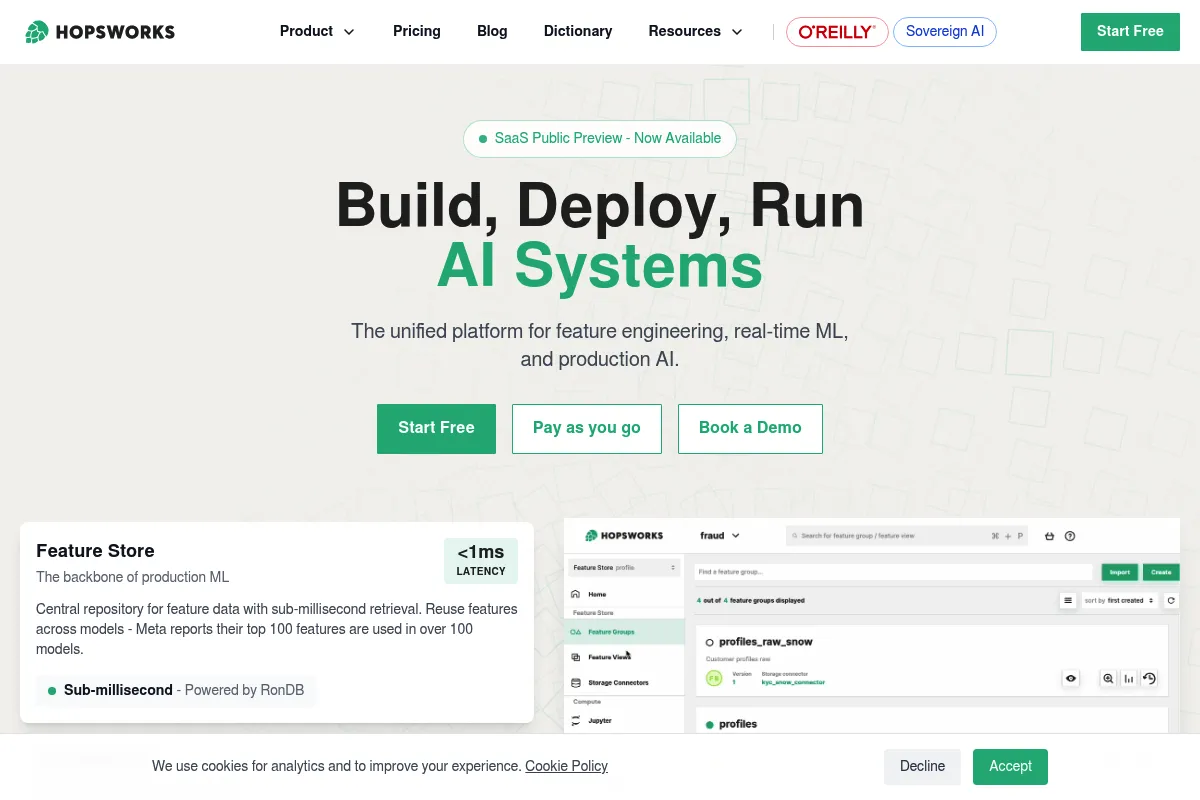
A comprehensive MLOps platform centered on a high-performance feature store that bridges the gap between batch training and real-time inference.
Excellent for teams requiring a unified feature store for sub-10ms online serving, weaker for those seeking a lightweight, standalone model orchestrator.
Analysis based on product data, pricing structure, traffic signals, and public user sentiment.
Who Should Use Hopsworks?
Typical users
ML engineers and data scientists in mid-to-large enterprises managing complex, data-intensive pipelines.
Maturity fit
scaling to advanced
Choose this if…
- You need a single source of truth for features across both training and production
- Your priority is sub-10ms feature retrieval for real-time applications
- You want an open-source core to avoid total vendor lock-in
- Your workflow is heavily Python-centric
Skip this if…
- You only need basic model tracking and can use a simpler tool like MLflow
- Your feature set is small and rarely changes
- You are already fully committed to the Databricks or SageMaker ecosystems and want to minimize third-party layers
About Hopsworks
Hopsworks is an integrated MLOps platform designed to manage the entire lifecycle of machine learning features and models. It originated from research at KTH Royal Institute of Technology and focuses on solving the 'data for AI' problem through a modular architecture.
Official profiles
What it actually does
It provides a centralized repository for sharing, discovering, and serving machine learning features. The platform synchronizes an offline store for historical training data with an online store for real-time predictions, ensuring data consistency across the environment.
What makes it different
Unlike competitors that focus solely on feature storage, Hopsworks includes an integrated model registry and serving layer. It utilizes RonDB as its online storage engine, which is specifically optimized for the high-throughput, low-latency requirements of real-time AI.
Ratings across the web


Ratings aggregated from independent review platforms.
Key Features
Feature Store
Centralizes feature logic to eliminate training-serving skew.
RonDB Integration
Powers the online store for ultra-low latency feature retrieval at scale.
Point-in-Time Joins
Prevents data leakage by ensuring training data is accurate to the specific timestamp of the event.
Python SDK
Enables data scientists to interact with the store using familiar Pandas and Scikit-learn patterns.
Model Registry
Tracks model versions, lineage, and deployment status in a unified interface.
Transformation Functions
Allows users to define feature logic once and apply it consistently during training and inference.
Data Validation
Integrates Great Expectations to catch data quality issues before they reach production models.
Pricing
Serverless (Free)
- 25GB storage
- Limited compute credits
- Shared infrastructure
- Community support
Serverless (Pay-as-you-go)
- Unlimited storage
- Pay for compute units used
- Standard support
- No upfront commitment
Enterprise
- VPC deployment (AWS, Azure, GCP)
- High availability
- SLA-backed support
- Advanced security and RBAC
Pricing checked 5 months ago
Pricing guidance
- When you need to deploy within your own VPC for security compliance
- When you require 24/7 production support
- When your feature volume exceeds the free tier storage limits
- Cloud infrastructure costs (S3, EC2) are separate from Hopsworks licensing
- Data egress fees from cloud providers can add up during large training runs
Premium positioning justified by its high-performance database and end-to-end MLOps coverage.
Pros & Cons
Strengths
-
Unified feature management
By providing one interface for both batch and streaming data, it reduces the engineering effort required to move models from research to production.
-
High-performance online serving
The use of RonDB allows for massive horizontal scaling and extremely low latency, which is critical for fraud detection and recommendation engines.
-
Open-source flexibility
The core platform is open-source, allowing teams to inspect the code and run it on-premises or in any major cloud provider.
Weaknesses
-
High operational complexity
The platform has a steep learning curve and requires significant DevOps effort to manage the underlying distributed systems if self-hosting.
Affects: Small teams without dedicated MLOps engineers
-
Cluttered user interface
The management console can feel overwhelming and less intuitive compared to newer, more focused MLOps startups.
Affects: Data scientists who prefer a minimalist workspace
-
Documentation gaps
While extensive, the documentation can sometimes lag behind new feature releases, making troubleshooting difficult.
Affects: Early-stage adopters and developers
Real User Sentiment
Generally positive among engineers who value technical depth, though some find the setup process daunting.
Users tend to like
- Python-first approach
- Performance of RonDB
- Point-in-time join accuracy
- End-to-end integration
Users commonly complain about
- Steep learning curve
- UI can be confusing
- Initial configuration is complex
Recurring tradeoffs
- You trade simplicity for a much more powerful and flexible feature management system.
Happiest users
ML Engineers at mid-sized tech companies building real-time recommendation or fraud systems.
Often frustrated
Solo data scientists looking for a simple way to track a few experiments without infrastructure overhead.
Use Cases
Real-time Fraud Detection
Serving features with sub-10ms latency to catch fraudulent transactions instantly.
Personalized Recommendations
Managing user behavior features that update in real-time to provide relevant content.
Credit Scoring
Using point-in-time joins to train models on historical financial data without data leakage.
Churn Prediction
Automating the pipeline from raw customer data to production-ready features.
Supply Chain Optimization
Managing time-series features for demand forecasting across thousands of SKUs.
Frequently Asked Questions
How does Hopsworks compare to Feast?
Feast is a lightweight, open-source feature store that focuses primarily on the storage and serving layer. Hopsworks is a full MLOps platform that includes a feature store, model registry, and serving, along with a more performant online database (RonDB) compared to Feast's default options.
Is there a free version of Hopsworks?
Yes, Hopsworks offers a Serverless Free tier that includes 25GB of storage and limited compute credits, which is suitable for testing and small projects.
Does Hopsworks support real-time feature engineering?
Yes, it supports streaming feature engineering using tools like Flink or Spark Streaming, allowing features to be updated in the online store as events occur.
Can I run Hopsworks on my own infrastructure?
Yes, Hopsworks offers a self-managed Enterprise version that can be deployed on-premises or in a private cloud (VPC) on AWS, Azure, or GCP.
What are the main limitations of the platform?
The primary limitations are its complexity and the operational overhead required to manage its distributed components. It is not a 'plug-and-play' tool for beginners and requires a solid understanding of data engineering.
Does it integrate with Databricks or SageMaker?
Yes, Hopsworks can act as an external feature store for both Databricks and SageMaker, allowing you to use their compute environments while managing features in Hopsworks.
Why trust this page?
This evaluation combines product positioning, pricing analysis, traffic and market signals, and public user sentiment into a single decision-support page. Content is generated editorially — not copied from the vendor's website.
Funding & Company
Founded
2016
Stage
Series a
Total Raised
$13.72M
Latest Round
Series A (Jun 2023)
Notable Investors
Hopsworks, developed by Logical Clocks AB, has raised a total of $13.7 million across three funding rounds, including a notable $6.5 million Series A extension in June 2023. This consistent backing from Nordic and European VCs provides the company with a solid financial runway to support product development and expand its commercial operations, particularly in the US market.
Market Signals & Traffic
Estimated visits, global rank, geography, traffic sources, monthly visit trends, and organic search keywords (Similarweb)—on a dedicated page built for depth and search.
- Estimated visits
- 37,024
- Global rank
- #852,448
- Snapshot
- Apr 2026
- Traffic trend
- Falling
Estimated monthly visits
Alternatives to Hopsworks
View all alternatives

Similar Tools
Promptfoo
Developer Tools, Automation, Workflow

Test and evaluate LLM output quality with automated benchmarks
Lepton AI
Developer Tools, Automation, Workflow

Cloud platform for building and deploying efficient model applications.
V7
Developer Tools, Automation, Workflow

Data platform for computer vision and automated image labeling
Hasty
Developer Tools, Automation, Workflow

Data-centric vision platform for labeling, training, and deploying models.
Radiant
Developer Tools, Automation, Workflow

Integrated AI infrastructure and cloud platform for scaling model deployment.
ZenML
Developer Tools, Automation, Workflow

Open-source MLOps framework for building portable machine learning pipelines.