

Promptfoo
A developer-centric evaluation framework that replaces subjective 'vibe checks' with automated, local-first benchmarking for LLM prompts and models.
Excellent for engineering teams needing CI/CD-integrated prompt testing, weaker for non-technical users who require a no-code interface.
Analysis based on product data, pricing structure, traffic signals, and public user sentiment.
Who Should Use Promptfoo?
Typical users
Software engineers, AI researchers, and security teams building LLM-backed applications who need to prevent regressions.
Maturity fit
scaling to advanced
Choose this if…
- You want to run evaluations locally without sending data to a third-party observability platform
- Your priority is integrating prompt testing into a GitHub Actions or GitLab CI pipeline
- You need to compare outputs across multiple providers like OpenAI, Anthropic, and local Llama models simultaneously
Skip this if…
- You are a non-technical product manager who cannot work with YAML configurations or a CLI
- You require a full-stack production observability suite with real-time tracing and monitoring
- Your workflow is entirely browser-based and you avoid terminal-driven tools
About Promptfoo
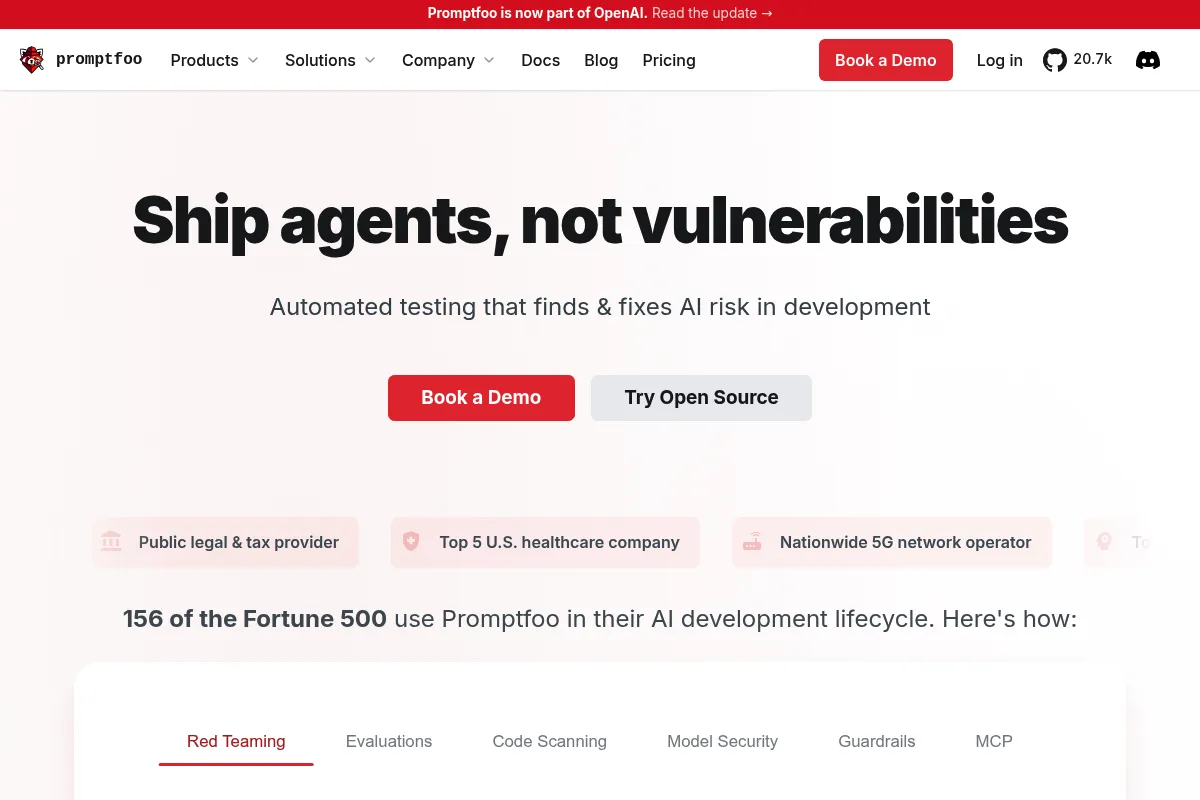
Promptfoo is an open-source CLI tool and library designed for systematic testing of LLM outputs. It allows developers to define test cases, run them against various prompts and models, and view results in a matrix view to identify the best-performing configurations.
What it actually does
It executes a matrix of prompts and test cases across different LLMs to generate side-by-side comparisons. Users define assertions—ranging from simple keyword checks to complex LLM-graded evaluations—to programmatically determine if a model's response meets quality, safety, and accuracy standards.
What makes it different
Unlike many competitors that are SaaS-first dashboards, Promptfoo is local-first and open-source. It prioritizes the developer workflow by treating prompts as code, enabling version control and automated testing before deployment rather than just monitoring after the fact.
Key Features
Red Teaming
Automatically generates adversarial inputs to test for PII leaks, toxicity, and jailbreaks.
LLM-as-a-Judge
Uses high-reasoning models to grade the quality of outputs from smaller or faster models.
Provider Agnostic
Supports OpenAI, Anthropic, Azure, Google Vertex, and local models via Ollama or vLLM.
Assertion Library
Includes pre-built checks for toxicity, relevance, and factual consistency.
Caching Mechanism
Stores previous results locally to avoid re-paying for the same API calls during iterative testing.
Exportable Reports
Generates CSV, JSON, and HTML reports for sharing results with stakeholders.
Python/Javascript Library
Can be imported directly into existing codebases for programmatic evaluation.
Prompt Versioning Support
Facilitates A/B testing of different prompt iterations to find the optimal phrasing.
Pricing
Open Source
- Full CLI functionality
- Unlimited local evaluations
- All standard providers
- Red teaming capabilities
- CI/CD integration
Enterprise / Cloud
- Centralized team dashboard
- Shared test history
- Role-based access control (RBAC)
- SSO integration
- Priority support
Pricing checked 5 months ago
Pricing guidance
- When you need a centralized history of all evaluations across a large team
- When you require SSO or advanced security compliance for a cloud-hosted dashboard
- When you need to collaborate on prompt engineering with non-technical stakeholders in a shared UI
- The open-source version requires you to manage your own storage for test results if you want long-term persistence.
- API costs from LLM providers (OpenAI, etc.) are still your responsibility.
Disruptively affordable due to its open-source core, positioning itself against expensive SaaS seats.
Pros & Cons
Strengths
-
Local-first and privacy-focused
Since it runs as a CLI, your prompts and test data stay on your machine or within your VPC, which is critical for regulated industries.
-
Significant cost savings
The built-in caching prevents redundant API calls, and the ability to run evals against local models reduces reliance on expensive proprietary providers.
-
High extensibility
Developers can write custom Javascript or Python functions to handle complex validation logic that standard assertions can't cover.
-
Fast feedback loops
The matrix view makes it immediately obvious which prompt change or model upgrade caused a regression across dozens of edge cases.
Weaknesses
-
Steep learning curve for non-coders
Configuration is handled via YAML files and the command line, which may alienate product or marketing team members.
Affects: Cross-functional teams where non-developers manage prompts
-
Limited production monitoring
While excellent for pre-deployment testing, it lacks the deep production tracing and 'live' data feedback loops found in tools like LangSmith.
Affects: Teams looking for an all-in-one lifecycle management tool
-
YAML configuration complexity
As test suites grow to hundreds of cases with complex assertions, the YAML files can become verbose and difficult to manage without strict organization.
Affects: Large-scale projects with hundreds of test permutations
Real User Sentiment
Highly positive among developers who value speed, local execution, and 'as-code' workflows.
Users tend to like
- The speed of the CLI compared to heavy web UIs
- The ability to use LLMs to grade other LLMs (model-graded evals)
- The red teaming feature for security testing
- The fact that it is open-source and MIT licensed
Users commonly complain about
- Initial setup of complex YAML configs can be tedious
- Documentation can sometimes lag behind the rapid release of new features
- The web UI is functional but lacks the polish of premium SaaS competitors
Recurring tradeoffs
- You trade a polished, hosted UI for complete control and data privacy.
Happiest users
Backend engineers who want to treat LLM prompts like unit tests.
Often frustrated
Product managers who want a 'playground' experience without touching a terminal.
Use Cases
Regression Testing
Ensuring a new prompt version doesn't break existing edge cases before merging a PR.
Model Comparison
Deciding if switching from GPT-4 to a cheaper model like Claude Haiku maintains quality.
Security Auditing
Running automated red teaming to find ways to bypass a chatbot's safety filters.
Hallucination Detection
Using factual consistency assertions to verify that RAG outputs match the provided context.
CI/CD Quality Gates
Automatically failing a build if the LLM's performance score drops below a specific threshold.
Frequently Asked Questions
Is Promptfoo free to use?
Yes, the core Promptfoo tool is open-source (MIT license) and free to use locally. You only pay for the API calls you make to LLM providers like OpenAI or Anthropic. There is a paid Enterprise version for teams needing a hosted dashboard and collaboration features.
How does Promptfoo compare to LangSmith?
LangSmith is a comprehensive SaaS platform focused on production tracing and monitoring with a premium price tag. Promptfoo is a lightweight, local-first CLI focused specifically on evaluation and testing. Choose Promptfoo for pre-deployment testing and LangSmith for post-deployment observability.
Can I use Promptfoo with local models?
Yes, Promptfoo supports local models through integrations with Ollama, vLLM, and LocalAI. This allows you to run your entire evaluation pipeline without any data leaving your machine.
What are the limitations of the open-source version?
The open-source version is nearly feature-complete but lacks centralized team management. If you have a large team that needs to share test results, view a history of all runs in a central place, or use SSO, you will likely need the Enterprise/Cloud version.
Does Promptfoo support RAG evaluation?
Yes, it has specific assertions for Retrieval-Augmented Generation (RAG), such as 'factuality', 'answer relevancy', and 'context adherence', often using an LLM to grade how well the response matches the source documents.
How do I integrate Promptfoo into my CI/CD?
You can run the `promptfoo eval` command as a step in your CI pipeline (e.g., GitHub Actions). It can output a summary to the console or generate a comment on a Pull Request with the test results, allowing you to block merges if quality scores drop.
Why trust this page?
This evaluation combines product positioning, pricing analysis, traffic and market signals, and public user sentiment into a single decision-support page. Content is generated editorially — not copied from the vendor's website.
Funding & Company
Founded
2024
Stage
Acquired
Total Raised
$23.4M
Latest Round
Series A (Jul 2025)
Notable Investors
Promptfoo raised a total of $23.4 million across two rounds, a Seed and a Series A, from notable investors including Andreessen Horowitz and Insight Partners. The company was subsequently acquired by OpenAI in March 2026 for an undisclosed amount.
Market Signals & Traffic
Estimated visits, global rank, geography, traffic sources, monthly visit trends, and organic search keywords (Similarweb)—on a dedicated page built for depth and search.
- Estimated visits
- 188,413
- Global rank
- #237,726
- Snapshot
- Apr 2026
- Traffic trend
- Surging
Estimated monthly visits
Alternatives to Promptfoo
View all alternatives
Similar Tools
ZenML
Developer Tools, Automation, Workflow

Open-source MLOps framework for building portable machine learning pipelines.
Playwright
Developer Tools, Automation, Workflow

Cross-browser end-to-end testing and automation for modern web applications.
V7
Developer Tools, Automation, Workflow

Data platform for computer vision and automated image labeling
Hopsworks
Developer Tools, Automation, Workflow

Feature store and MLOps platform for managing machine learning pipelines.
Hasty
Developer Tools, Automation, Workflow

Data-centric vision platform for labeling, training, and deploying models.
Martian
Developer Tools, Automation, Workflow

Dynamic router that automatically selects the best LLM for every prompt.