

A feature platform that automates the engineering and serving of ML data pipelines—strongest for real-time production models, but often overkill for teams doing simple batch-only analysis.
Excellent for enterprise teams needing low-latency feature serving at scale, weaker for small teams with limited engineering resources or pure offline workflows.
Analysis based on product data, pricing structure, traffic signals, and public user sentiment.
Who Should Use Tecton?
Typical users
ML engineers and data engineers at mid-to-large enterprises or high-growth startups running production-grade operational ML.
Maturity fit
scaling to advanced
Choose this if…
- You need to eliminate training-serving skew for real-time models
- Your priority is sub-100ms feature retrieval for applications like fraud detection
- You want to manage features as code with versioning and CI/CD
- You need to reuse features across multiple models and teams
Skip this if…
- You only perform batch inference and don't need real-time serving
- Your data volume is small enough to manage via manual SQL scripts
- You lack a dedicated ML engineering resource to manage the integration
- You are looking for a low-cost, lightweight open-source tool
About Tecton
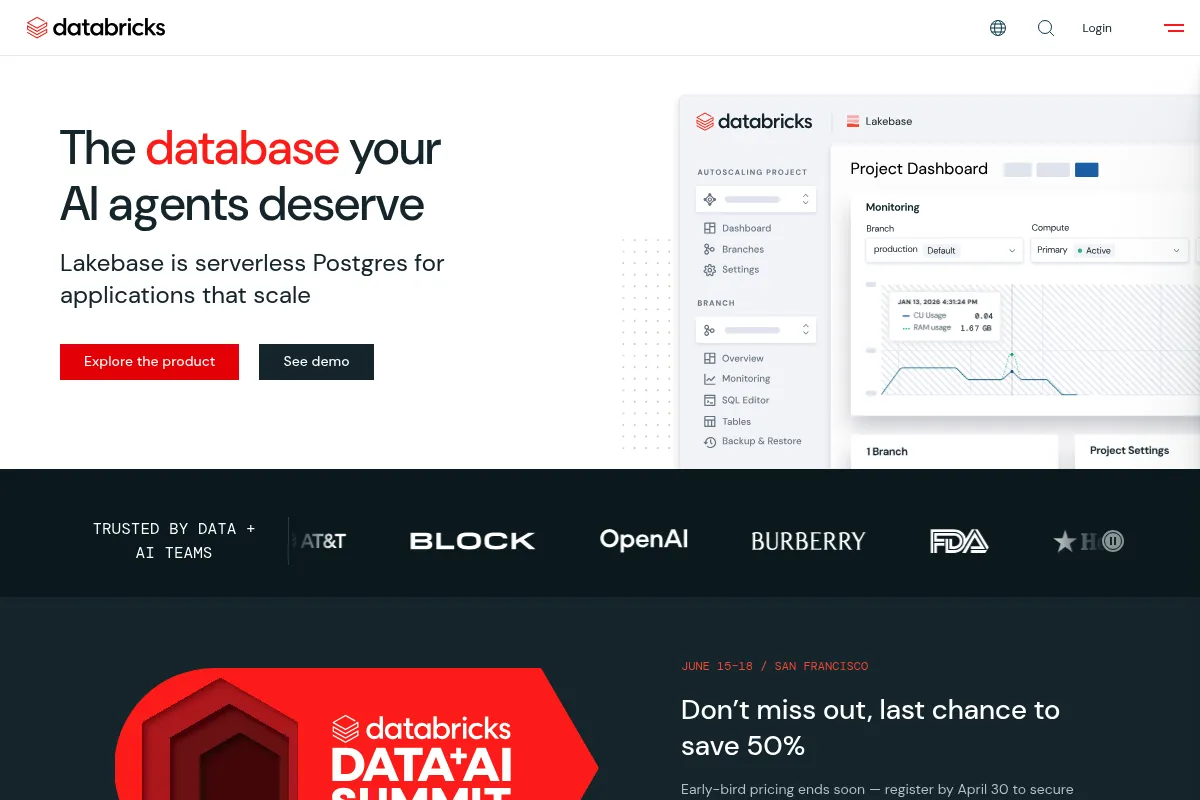
Tecton is an enterprise-grade feature platform designed to manage the data lifecycle for machine learning. It bridges the gap between raw data sources and production models by providing a unified interface for feature definition, transformation, and serving.
Official profiles
What it actually does
It automates feature engineering pipelines by connecting to batch and streaming sources like Snowflake, Databricks, and Kafka. It stores feature values in an offline store for training and an online store for real-time inference, ensuring both environments use identical logic.
What makes it different
Unlike basic feature stores that only act as a database, Tecton manages the actual transformation logic (compute). It uses a 'features as code' approach via a Python SDK, allowing for versioning and automated backfilling that most competitors leave to the user.
Ratings across the web
Ratings aggregated from independent review platforms.
Key Features
Tecton Rift
A compute engine that allows running Python-based transformations directly on the platform without external Spark clusters.
Point-in-Time Joins
Prevents data leakage by ensuring training sets only use data available at the exact time of the historical event.
Online/Offline Consistency
Uses the same code for both training data generation and real-time serving to eliminate skew.
Feature Registry
A searchable catalog for discovering and reusing existing features across different teams and projects.
Stream Processing
Native support for Kafka and Kinesis to update feature values in milliseconds as new data arrives.
On-Demand Transformations
Computes features at request time using data passed directly from the application, useful for user-specific context.
Pricing
Free Trial
- Access to Tecton's core platform
- Support for batch and streaming features
- Limited compute resources for testing
- Documentation and community support
Enterprise / Growth
- Full feature lifecycle management
- SLA-backed production serving
- Advanced security and SSO
- Dedicated support and architecture review
- Usage-based pricing on 'Feature Units'
Pricing checked 5 months ago
Pricing guidance
- When moving from model experimentation to production serving
- When you need to automate backfills for large historical datasets
- When you require SOC2 compliance and enterprise security
- Cloud provider costs for the online and offline stores are typically billed separately to your own AWS/GCP account
- Feature Unit pricing can scale quickly if you have high-cardinality features
Premium enterprise positioning justified by the complexity of the problem it solves for high-scale ML teams.
Pros & Cons
Strengths
-
Eliminates training-serving skew
Ensures the logic used to train a model is exactly what is used in production, which is the most common cause of ML model failure in the wild.
-
High-performance serving
Optimized for sub-100ms retrieval, making it viable for mission-critical applications like real-time fraud detection and recommendation engines.
-
Developer-centric workflow
The Python SDK integrates with standard software engineering practices like Git, allowing features to be peer-reviewed and versioned.
-
Reduced engineering overhead
Automates the 'plumbing' of data pipelines, allowing ML engineers to focus on modeling rather than infrastructure maintenance.
Weaknesses
-
High total cost of ownership
The platform fees combined with underlying cloud infrastructure costs (Spark, DynamoDB/Redis) can become significant at high volumes.
Affects: Budget-conscious startups and mid-sized teams
-
Steep learning curve
Requires significant effort to integrate with existing data stacks and learn Tecton-specific abstractions and DSLs.
Affects: Small teams without dedicated ML platform engineers
-
Infrastructure heavy
Even with serverless options, it often requires managing or paying for significant compute resources to handle backfills and streaming.
Affects: Teams looking for a 'plug-and-play' SaaS experience
Real User Sentiment
Generally high among enterprise users who value reliability and the 'features as code' philosophy, though cost is a recurring pain point.
Users tend to like
- Point-in-time join accuracy
- Reliability of the serving layer
- Integration with Snowflake and Databricks
- The ability to version features like software
Users commonly complain about
- High cost of the platform and underlying compute
- Complexity of the initial setup and configuration
- Documentation can be sparse for advanced streaming edge cases
Recurring tradeoffs
- Users trade high operational costs and setup time for extreme reliability and low-latency performance.
Happiest users
ML platform teams at large tech companies who need to support dozens of models with shared data logic.
Often frustrated
Solo data scientists or small teams who find the infrastructure overhead too heavy for simple projects.
Use Cases
Real-time Fraud Detection
Serving user transaction history features with sub-100ms latency to catch fraud at the point of sale.
Personalized Recommendations
Updating user preference features in real-time based on their current session clicks.
Dynamic Pricing
Calculating supply and demand features from streaming data to adjust prices for ride-sharing or e-commerce.
Credit Scoring
Combining historical financial data with real-time application data for instant loan approvals.
Real-time RAG for LLMs
Managing and serving the context data needed to ground Large Language Models in real-time.
Frequently Asked Questions
How does Tecton compare to Feast?
Feast is an open-source feature store created by the same founders, but it is primarily a storage layer. Tecton is a complete platform that includes the compute layer for transformations, automated backfilling, and enterprise security that Feast lacks.
Is there a free version of Tecton?
No, Tecton does not offer a permanent free tier. They provide a limited-time free trial for teams to run a proof-of-concept, but production use requires a custom enterprise contract.
Does Tecton work with Snowflake?
Yes, Snowflake is a primary integration. Tecton can use Snowflake as an offline store and push transformations to Snowflake's compute engine, or use its own Rift engine to process data.
What is the difference between a feature store and a feature platform?
A feature store (like Feast) mainly handles the storage and retrieval of features. A feature platform (like Tecton) handles the entire lifecycle, including the compute/transformation logic, orchestration, and monitoring.
What are the main limitations of Tecton?
The main limitations are its cost and the complexity of setup. It also requires your data to be in a supported cloud data warehouse or stream source, making it less ideal for on-premise environments.
How does Tecton handle training-serving skew?
It uses a single Python definition for a feature. Tecton then compiles that definition into the appropriate SQL or Spark code for both the offline (training) and online (serving) environments, ensuring the logic is identical.
Why trust this page?
This evaluation combines product positioning, pricing analysis, traffic and market signals, and public user sentiment into a single decision-support page. Content is generated editorially — not copied from the vendor's website.
Funding & Company
Founded
2019
Stage
Acquired
Total Raised
$160M
Latest Round
Series C (Jul 2022)
Notable Investors
Tecton raised a total of $160 million across four rounds from top-tier investors like Andreessen Horowitz, Sequoia Capital, and Kleiner Perkins before being acquired by Databricks. This significant backing from leading venture capital firms, along with strategic investments from Databricks and Snowflake, underscores strong market confidence in its feature platform for machine learning. The acquisition by Databricks provides substantial long-term stability and deep integration into a major data and AI ecosystem.
Market Signals & Traffic
Estimated visits, global rank, geography, traffic sources, monthly visit trends, and organic search keywords (Similarweb)—on a dedicated page built for depth and search.
- Estimated visits
- 0
- Global rank
- —
- Snapshot
- May 2026
- Traffic trend
- Steady
Estimated monthly visits
Alternatives to Tecton
View all alternativesHopsworks
Developer Tools, Automation, Workflow

Feature store and MLOps platform for managing machine learning pipelines.
Amazon CodeWhisperer
Developer Tools

AI-powered coding companion that generates code recommendations.
Featureform
Developer Tools, Workflow

Open-source feature store for managing and serving machine learning features.
Similar Tools
OpenPipe
Developer Tools, Automation

Fine-tune specialized models using production data from existing providers.
Viam
Developer Tools, Automation

Software platform for building and managing smart hardware devices.
Koyeb
Developer Tools, Automation

Serverless platform for deploying high-performance applications and AI models
Roboflow
Developer Tools, Automation

Platform for building, deploying, and managing computer vision models.
Appwrite
Developer Tools, Automation

Backend platform for building web, mobile, and flutter applications.
LaunchDarkly
Developer Tools, Automation

Feature management platform for controlled software releases and experimentation.