

The enterprise standard for feature management that decouples code deployment from feature release, offering the most mature targeting engine at a premium price point.
Excellent for large engineering organizations requiring granular rollout control and compliance, but often overpriced for teams only needing basic toggles.
Analysis based on product data, pricing structure, traffic signals, and public user sentiment.
Who Should Use LaunchDarkly?
Typical users
Engineering leaders and DevOps teams in mid-to-large enterprises managing complex microservices and high-stakes release cycles.
Maturity fit
scaling to advanced
Choose this if…
- You need to manage hundreds of flags across multiple environments without performance lag
- Your compliance requirements demand detailed audit logs and role-based access control
- You want to empower non-engineers to toggle features safely in production
- Your priority is SDK reliability and broad language support over low cost
Skip this if…
- You only need simple 'on/off' switches for a small internal application
- You have a massive B2C user base and a limited budget (MAU-based pricing scales aggressively)
- You prefer an open-source, self-hosted solution to keep data entirely on-premise
About LaunchDarkly
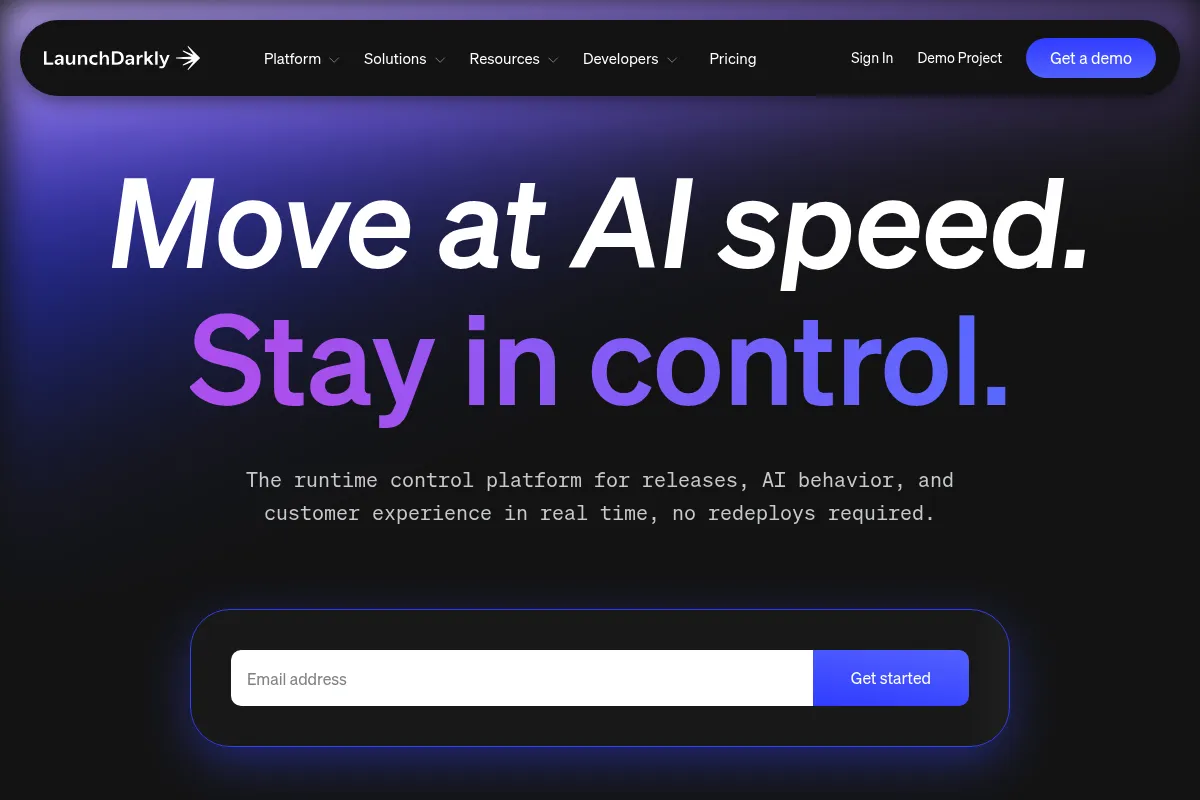
LaunchDarkly is a centralized feature management platform designed to reduce deployment risk. It allows teams to wrap new code in flags, enabling them to push code to production while keeping features hidden until they are ready for specific user segments.
What it actually does
It provides a dashboard and SDKs to control feature visibility in real-time without redeploying code. It handles the logic of who sees what, when they see it, and how a feature is rolled out—from 1% canary tests to 100% global launches.
What makes it different
Unlike homegrown solutions or basic libraries, LaunchDarkly uses a streaming architecture to update flags in milliseconds across millions of users. Its 'Release Assistant' and deep integration with observability tools like Datadog create a closed loop for automated rollbacks if errors spike.
Ratings across the web

Ratings aggregated from independent review platforms.
Key Features
Targeting Rules
Define exactly which users see a feature based on any custom attribute.
Flag Triggers
Automatically disable features based on alerts from monitoring tools like New Relic.
Release Assistant
Orchestrates the progression of a feature through different stages of a rollout.
Insights Dashboards
Track flag health and identify 'stale' flags that need removal to prevent technical debt.
Contextual Targeting
Move beyond simple user IDs to target based on organization, location, or device type.
Data Export
Stream flag evaluation data to external warehouses for deep analysis.
Code References
Scan your GitHub or GitLab repos to see exactly where a flag is used in the codebase.
Pricing
Starter
- Up to 1,000 Monthly Active Users (MAUs)
- Unlimited feature flags
- Basic targeting
- Client-side and server-side SDKs
Professional
- Up to 10,000 Monthly Active Users (MAUs)
- Bulk user targeting
- Flag triggers
- Approval workflows
- Integrations with Slack and Jira
Enterprise
- Custom MAU limits
- Single Sign-On (SSO)
- Advanced lifecycle management
- Experimentation add-on available
- Dedicated support
Pricing checked 6 months ago
Pricing guidance
- When you exceed the 1,000 or 10,000 MAU limit
- When you need SSO or advanced RBAC for compliance
- When you require change request workflows to prevent accidental toggles
- MAU overages can be expensive if not monitored
- Experimentation and specialized insights are often separate line items
- Seat minimums may apply to certain contract types
Premium positioning justified by its status as the category leader and its deep security features.
Pros & Cons
Strengths
-
Unmatched SDK ecosystem
Supports over 20 languages and frameworks with high reliability, ensuring flags work consistently across the entire stack.
-
Granular targeting logic
The ability to create complex, nested rules for feature delivery is more advanced than almost any competitor.
-
Enterprise-grade security
Offers SSO, RBAC, and approval workflows that satisfy the strict requirements of fintech and healthcare sectors.
-
Reduced deployment anxiety
Decoupling deployment from release allows engineers to merge code faster while product managers control the actual launch timing.
Weaknesses
-
Aggressive MAU-based pricing
Costs can skyrocket for B2C apps with high traffic, as pricing is tied to Monthly Active Users (MAUs) and seats.
Affects: High-traffic consumer startups
-
UI clutter and complexity
The platform has become so feature-rich that the interface can be overwhelming for new users or simple tasks.
Affects: Small teams and beginners
-
Experimentation is an expensive add-on
Unlike some competitors who bundle A/B testing, LaunchDarkly often charges significantly extra for full experimentation capabilities.
Affects: Product managers focused on data-driven testing
Real User Sentiment
Users generally view LaunchDarkly as the most reliable and feature-complete option, though price is a recurring point of friction.
Users tend to like
- Rock-solid SDK performance
- Ease of setting up complex targeting rules
- The peace of mind provided by kill switches
- Excellent documentation
Users commonly complain about
- The cost scales poorly for high-traffic apps
- The UI feels heavy and sometimes slow
- Lack of a generous free tier for side projects
Recurring tradeoffs
- You trade a higher monthly bill for significantly reduced risk of production outages.
Happiest users
Enterprise engineering managers who need to sleep at night knowing they can instantly roll back a failed feature.
Often frustrated
Bootstrapped startup founders who find the MAU-based pricing prohibitive as they scale.
Use Cases
Canary Releases
Testing a new checkout flow on 5% of users before a full rollout.
Kill Switches
Instantly disabling a broken third-party integration without a code push.
Beta Testing
Granting early access to specific features for a 'Power User' segment.
Entitlement Management
Controlling which features are available based on a user's subscription tier.
Infrastructure Migrations
Safely switching database backends by toggling traffic at the application level.
Mobile App Updates
Releasing features to mobile users without waiting for App Store approval cycles.
Frequently Asked Questions
How does LaunchDarkly pricing work for high-traffic apps?
Pricing is primarily based on 'seats' (team members) and 'Monthly Active Users' (MAUs). For high-traffic B2C apps, the MAU count is the biggest cost driver. Once you exceed the limits in the Starter (1k) or Professional (10k) plans, you typically must move to an Enterprise contract, which can be significantly more expensive.
Is there a free version of LaunchDarkly?
LaunchDarkly does not have a 'free forever' tier. They offer a 14-day free trial that includes most Professional features. If you need a free-forever tool, you might look at Flagsmith or the community edition of Unleash.
How does LaunchDarkly compare to Statsig?
LaunchDarkly is a feature-management-first tool that added experimentation later. Statsig is an experimentation-first tool that includes feature flags. Statsig is often cheaper for high-volume event data, while LaunchDarkly offers more mature governance and security features for large enterprises.
Will feature flags slow down my application?
LaunchDarkly uses a streaming architecture (Server-Sent Events) to push flag updates to SDKs. This means flag evaluations happen locally in memory on your server or client, resulting in sub-millisecond latency. It is significantly faster than making an HTTP request for every flag check.
Can I use LaunchDarkly for A/B testing?
Yes, but it requires the Experimentation add-on. This allows you to run multivariate tests and track metrics like conversion rates or page load times. If your primary goal is data science and complex A/B testing, some users find dedicated tools like Optimizely or Statsig more intuitive.
What happens if LaunchDarkly's servers go down?
The SDKs are designed with 'default' values. If the SDK cannot connect to LaunchDarkly's servers, it will automatically serve the default value you defined in your code. This ensures your application remains functional even during a service interruption.
Why trust this page?
This evaluation combines product positioning, pricing analysis, traffic and market signals, and public user sentiment into a single decision-support page. Content is generated editorially — not copied from the vendor's website.
Funding & Company
Founded
2014
Stage
Late stage
Total Raised
$330.3M
Latest Round
Series D (Aug 2021)
Notable Investors
LaunchDarkly has raised over $330 million, culminating in a $200 million Series D in 2021 that valued the company at $3 billion. This substantial backing from top-tier investors like Lead Edge Capital and Bessemer Venture Partners indicates strong market confidence and provides a long operational runway.
Market Signals & Traffic
Estimated visits, global rank, geography, traffic sources, monthly visit trends, and organic search keywords (Similarweb)—on a dedicated page built for depth and search.
- Estimated visits
- 585,641
- Global rank
- #67,440
- Snapshot
- Apr 2026
- Traffic trend
- Rising
Estimated monthly visits
Similar Tools
OpenPipe
Developer Tools, Automation

Fine-tune specialized models using production data from existing providers.
Banana
Developer Tools, Automation

Serverless GPU infrastructure for deploying and scaling machine learning models.
Roboflow
Developer Tools, Automation

Platform for building, deploying, and managing computer vision models.
Temporal
Developer Tools, Automation

Durable execution platform for building and running reliable distributed applications
Koyeb
Developer Tools, Automation

Serverless platform for deploying high-performance applications and AI models
Tecton
Developer Tools, Automation

Feature platform for building and serving real-time machine learning