

A serverless GPU platform that prioritizes deployment simplicity and per-second billing—best for intermittent ML workloads, though cold starts and scaling speed lag behind specialized competitors like Modal.
Excellent for developers needing on-demand scaling for LLMs or Diffusion models without infrastructure overhead, weaker for latency-sensitive applications requiring sub-second response times.
Analysis based on product data, pricing structure, traffic signals, and public user sentiment.
Who Should Use Banana?
Typical users
ML engineers and solo developers deploying open-source models who want to avoid Kubernetes management.
Maturity fit
scaling
Choose this if…
- Your traffic is bursty and you want to pay $0 during idle periods
- You prefer a standard Docker-based workflow for model packaging
- You need access to high-end GPUs like A100s without a long-term contract
Skip this if…
- Your application requires consistent sub-500ms latency (cold starts will break this)
- You have steady, high-volume traffic where reserved instances would be 40-60% cheaper
- You need a deep ecosystem of pre-built model libraries like those found on Replicate
About Banana
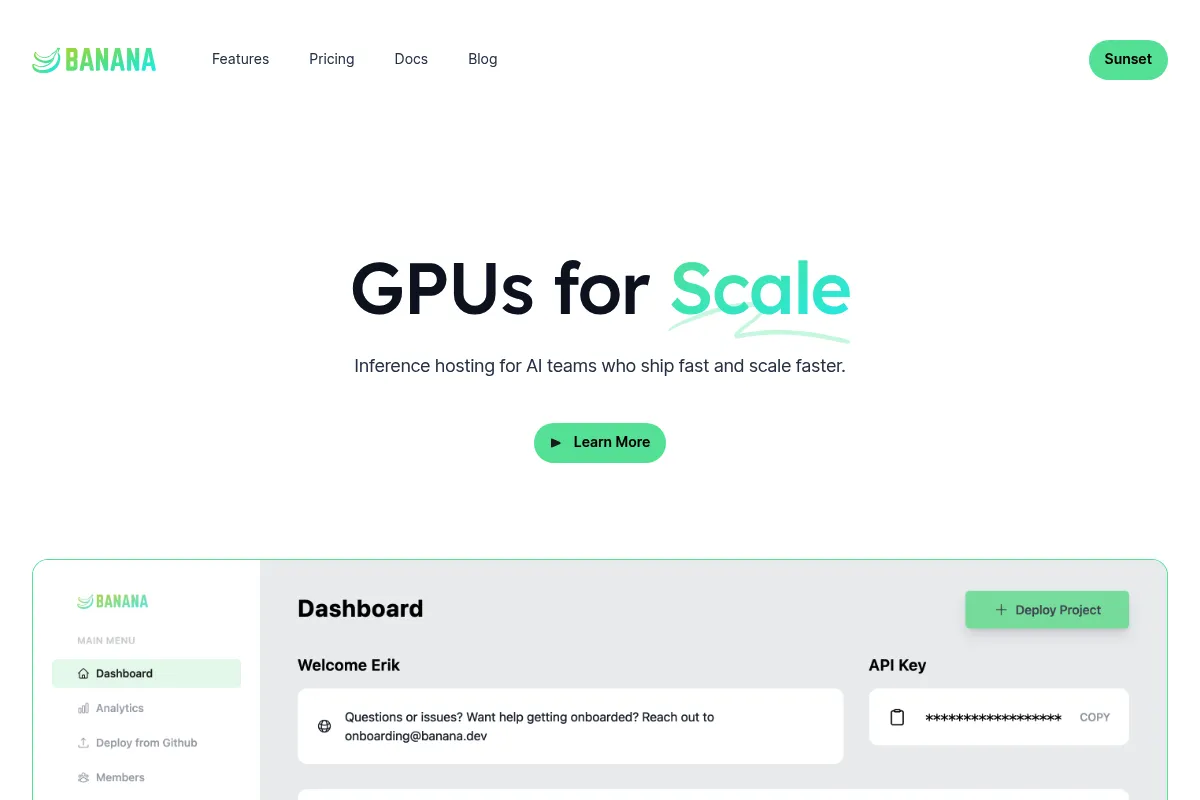
Banana provides serverless infrastructure designed to host machine learning models as production APIs. It eliminates the need for manual GPU provisioning by spinning up resources only when an inference request is received. The platform targets teams that need to scale from zero to thousands of replicas without managing the underlying hardware.
Official profiles
What it actually does
Users package their ML models using the Potassium framework, push them to Banana's registry, and receive an API endpoint. When the endpoint is called, Banana handles the GPU allocation, model loading, and execution, billing only for the exact duration the GPU was active.
What makes it different
Unlike general-purpose cloud providers, Banana uses a custom-built 'Potassium' framework to wrap models, which is designed specifically to minimize the overhead of serverless cold starts. It offers a more 'raw' developer experience than Replicate, giving users more control over the container environment while remaining fully managed.
Ratings across the web

Ratings aggregated from independent review platforms.
Key Features
Potassium Framework
Standardizes how models handle requests to optimize container warm-up times.
Scale-to-Zero
Automatically shuts down all resources when no requests are active to eliminate idle costs.
Template Library
Provides pre-configured setups for popular models like Whisper, Stable Diffusion, and Llama.
Webhooks
Allows for asynchronous processing of long-running inference tasks.
Multi-GPU Support
Enables deploying models that require more than a single card's VRAM.
Direct GitHub Integration
Automates deployments when changes are pushed to your model repository.
Pricing
Pay-as-you-go
- Access to all GPU types (A100, A10G, T4)
- Scale to zero
- Community support
- Standard cold start priority
Enterprise
- Reserved capacity options
- SLA guarantees
- Dedicated support engineer
- Custom security configurations
Pricing checked 4 months ago
Pricing guidance
- When monthly spend exceeds the cost of a reserved instance
- When you require guaranteed GPU availability (SLA)
- When you need custom VPC peering for security
- GPU availability is not always guaranteed on the serverless tier during peak demand
- Maximum timeout limits on inference requests can truncate long-running tasks
Competitive for serverless GPU compute, but more expensive than raw spot instances.
Pros & Cons
Strengths
-
Granular cost control
Billing by the second means you aren't penalized for short inference tasks or long periods of inactivity, which is ideal for early-stage startups.
-
Infrastructure abstraction
Removes the need for a dedicated DevOps or MLOps engineer to manage NVIDIA drivers, CUDA versions, or K8s clusters.
-
High-end hardware access
Provides easy access to A100 80GB instances which are often difficult to secure on larger clouds without high spend commitments.
Weaknesses
-
Cold start latency
Even with optimizations, spinning up a GPU container can take several seconds, making it unsuitable for real-time interactive features.
Affects: User-facing chat or real-time image generation apps
-
Limited observability tools
The built-in logging and monitoring are basic compared to dedicated MLOps platforms like Weights & Biases or Arize.
Affects: Enterprise teams needing deep performance auditing
-
Pricing at scale
The premium paid for serverless flexibility becomes a liability once traffic is predictable; reserved instances on Lambda Labs or RunPod are significantly cheaper.
Affects: High-growth apps with steady baseline traffic
Real User Sentiment
Users generally appreciate the simplicity but express frustration with the reliability of cold start times and occasional platform instability.
Users tend to like
- Ease of moving from a local Dockerfile to a production API
- The Potassium framework's approach to request handling
- Responsive founder and engineering team in Discord
Users commonly complain about
- Unpredictable cold start durations
- Occasional 'no capacity' errors for high-demand GPUs
- Documentation can be out of sync with the latest API changes
Recurring tradeoffs
- You trade lower cost and higher control for the potential of 5-10 second delays on initial requests.
Happiest users
Developers building internal tools or non-real-time batch processing apps where a 10-second delay doesn't ruin the experience.
Often frustrated
Founders building 'instant' AI products who find the serverless lag creates a poor user experience.
Use Cases
Asynchronous Image Generation
Processing Stable Diffusion requests where the user expects a short wait.
Batch Document Processing
Running LLMs over large datasets where throughput matters more than instant response.
Internal ML Tools
Deploying models for team use without maintaining a 24/7 server.
MVP Testing
Quickly validating an AI product idea without committing to monthly GPU rentals.
Audio Transcription
Using Whisper to process uploaded files in the background.
Frequently Asked Questions
How much does Banana.dev actually cost?
Banana uses per-second billing based on the GPU type. For example, an A100 80GB typically costs around $0.000513 per second ($1.85/hr) while active. You pay nothing when the model is not processing a request.
How does Banana compare to Replicate?
Replicate is a model marketplace and API; you use their pre-built models. Banana is a deployment platform; you bring your own code and Docker containers. Banana offers more flexibility for custom logic, while Replicate is faster for standard models.
What are the cold start times like?
Cold starts typically range from 5 to 15 seconds depending on the model size and hardware availability. Using their Potassium framework and optimizing your Docker layers can reduce this, but it is rarely sub-second.
Can I use my own Docker images?
Yes, Banana is built around Docker. You can push your images to their registry or use a supported public registry, provided you follow their Potassium framework requirements for the entry point.
Does Banana support multi-GPU setups?
Yes, you can configure your deployment to use multiple GPUs for models that exceed the memory of a single card, though this increases the per-second cost proportionally.
Is there a free tier?
Banana does not offer a perpetual free tier. It is a strictly pay-as-you-go service, though they often provide $5-$10 in trial credits to new developers to cover initial testing.
Why trust this page?
This evaluation combines product positioning, pricing analysis, traffic and market signals, and public user sentiment into a single decision-support page. Content is generated editorially — not copied from the vendor's website.
Funding & Company
Founded
2021
Stage
Seed
Total Raised
$5M
Latest Round
Seed (Mar 2021)
Notable Investors
Banana.dev raised a total of $5 million across two rounds, a Pre-Seed and a Seed round, to build its serverless GPU infrastructure for machine learning. Despite this initial backing, the company ceased operations in March 2024, highlighting the challenges of building a sustainable business in the competitive AI infrastructure market.
Market Signals & Traffic
Estimated visits, global rank, geography, traffic sources, monthly visit trends, and organic search keywords (Similarweb)—on a dedicated page built for depth and search.
- Estimated visits
- 3,671
- Global rank
- #4,734,130
- Snapshot
- Apr 2026
- Traffic trend
- Falling
Estimated monthly visits
Alternatives to Banana
View all alternativesReplicate
Developer Tools, Content Creation, AI Assistant

Run and deploy open-source AI models via a cloud API.
Together AI
AI Assistant, Developer Tools, Productivity

AI Acceleration Cloud for building and deploying generative AI models.
Hugging Face
Developer Tools, Productivity

Open-source platform for machine learning models, datasets, and tools.
Similar Tools
Tecton
Developer Tools, Automation

Feature platform for building and serving real-time machine learning
OpenPipe
Developer Tools, Automation

Fine-tune specialized models using production data from existing providers.
Temporal
Developer Tools, Automation

Durable execution platform for building and running reliable distributed applications
Appwrite
Developer Tools, Automation

Backend platform for building web, mobile, and flutter applications.
Koyeb
Developer Tools, Automation

Serverless platform for deploying high-performance applications and AI models
Viam
Developer Tools, Automation

Software platform for building and managing smart hardware devices.