

OpenPipe
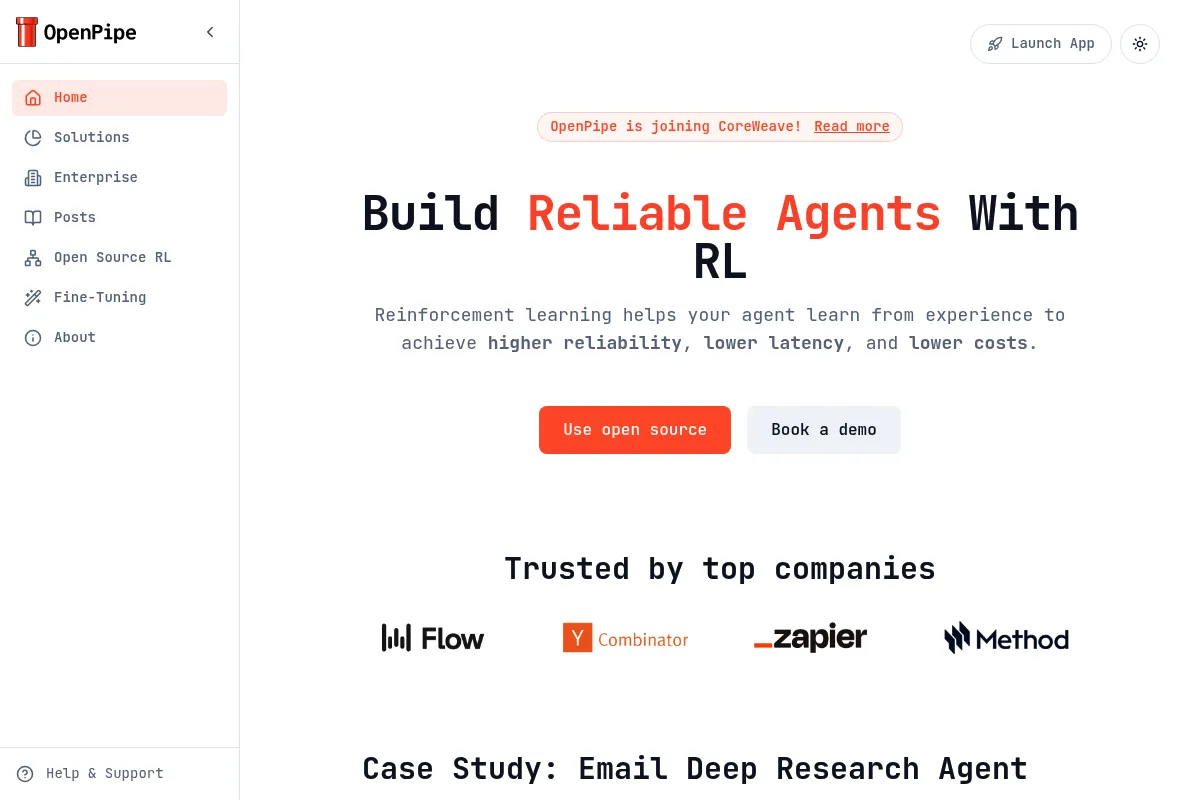
OpenPipe is a specialized developer tool that automates the distillation of expensive LLM outputs into smaller, faster, and significantly cheaper fine-tuned models.
Excellent for teams looking to slash API costs by moving production workloads from GPT-4 to specialized models, but overkill for low-volume or general-purpose chat applications.
Analysis based on product data, pricing structure, traffic signals, and public user sentiment.
Who Should Use OpenPipe?
Typical users
Backend engineers and ML teams at scaling startups who have high OpenAI or Anthropic bills and need to optimize for cost or latency.
Maturity fit
scaling to advanced
Choose this if…
- You are spending over $500/month on GPT-4 for specific, repetitive tasks
- You need lower latency than what general-purpose frontier models provide
- You want to automate the data collection and training pipeline without building custom MLOps infrastructure
Skip this if…
- Your LLM prompts change daily or cover a wide variety of unpredictable topics
- You have very low request volume where the cost of fine-tuning outweighs API savings
- You require the broad reasoning capabilities of a 1T+ parameter model for every request
About OpenPipe
OpenPipe is a fine-tuning platform designed to help developers transition from general-purpose LLMs to specialized, smaller models. It focuses on the 'distillation' workflow, using production logs from high-end models to train smaller alternatives like Llama 3 or Mistral.
What it actually does
The platform provides an SDK that wraps existing LLM calls to capture production data automatically. Once enough data is collected, OpenPipe handles the training process and hosts the resulting fine-tuned model on an OpenAI-compatible endpoint.
What makes it different
Unlike generic fine-tuning services that just provide a training server, OpenPipe manages the entire data flywheel. It handles the collection, filtering, and evaluation of training pairs, making it a workflow tool rather than just an infrastructure provider.
Key Features
OpenAI-Compatible SDK
Replace one line of code to start logging production data for future training.
Distillation Pipeline
Uses GPT-4 outputs as 'ground truth' to teach smaller models how to perform specific tasks.
Integrated Evals
Compare the performance of your fine-tuned model against the original provider using real-world test cases.
Dataset Management
Tools to prune low-quality or redundant examples from your training sets to improve model accuracy.
Serverless Inference
Deploy fine-tuned models immediately without managing GPU clusters or scaling logic.
Model Export
Download your fine-tuned weights to run on your own infrastructure if you want to avoid vendor lock-in.
Pricing
Training (Llama 3 / Mistral)
- Automated training pipeline
- Dataset management tools
- Evaluation suite access
Inference (Llama 3 8B)
- Hosted OpenAI-compatible endpoint
- Auto-scaling infrastructure
- Monitoring and logging
Enterprise
- VPC deployment options
- Custom base models
- SLA-backed support
- Dedicated GPU clusters
Pricing checked 6 months ago
Pricing guidance
- When you need to deploy in a private cloud (VPC)
- When your volume requires dedicated GPU reservations for consistent latency
- When you need to fine-tune models larger than 70B parameters
- Storage costs for large datasets may apply over time
- Model export is available but requires technical effort to set up your own inference stack
Highly competitive pricing that positions itself as a cost-saving alternative to direct OpenAI/Anthropic usage.
Pros & Cons
Strengths
-
Drastic cost reduction
Moving a high-volume task from GPT-4 to a fine-tuned Llama 3 model on OpenPipe can reduce token costs by 90% or more.
-
Reduced latency
Smaller, specialized models respond significantly faster than frontier models, improving the user experience for real-time applications.
-
Automated data flywheel
The hardest part of fine-tuning is data collection; OpenPipe makes this passive by capturing real production inputs and outputs.
Weaknesses
-
Task specificity
A model fine-tuned for data extraction will fail at general reasoning or creative writing, requiring a different model for each use case.
Affects: Teams with multi-purpose agents
-
Cold start potential
On serverless plans, low-traffic models may experience initial latency spikes as the model is loaded into memory.
Affects: Applications with sporadic, low-volume traffic
-
Training data requirements
You typically need several hundred to a few thousand high-quality examples before fine-tuning yields better results than a well-engineered prompt.
Affects: Early-stage products with no traffic
Real User Sentiment
Users are generally impressed by the ease of integration and the tangible cost savings achieved after the first successful fine-tune.
Users tend to like
- The 'drop-in' SDK that requires minimal code changes
- The ability to export model weights
- The side-by-side evaluation UI
- Responsive developer support
Users commonly complain about
- Initial difficulty in understanding how many samples are 'enough'
- Occasional UI bugs in the dataset filtering tool
- The cost of training can add up if you have very large, unoptimized datasets
Recurring tradeoffs
- You trade general model intelligence for specific task performance and lower cost.
Happiest users
Developers managing high-volume, structured tasks like classification, extraction, or summarization.
Often frustrated
Users trying to fine-tune for 'vibes' or creative writing where evaluation is subjective and difficult to quantify.
Use Cases
Classification
Replacing GPT-4 for high-volume support ticket tagging or content moderation.
Data Extraction
Pulling structured JSON from messy documents at 1/10th the cost of frontier models.
Summarization
Generating consistent, domain-specific summaries for news or legal documents.
Query Translation
Converting natural language into specific SQL or API calls for internal tools.
Latency Optimization
Moving a user-facing autocomplete feature from a slow API to a fast, fine-tuned 8B model.
Frequently Asked Questions
How much does OpenPipe cost compared to OpenAI fine-tuning?
OpenPipe is generally cheaper for inference because it uses open-source base models like Llama 3. While OpenAI charges roughly $3.00 per 1M tokens for fine-tuned GPT-4o-mini, OpenPipe's inference for a Llama 3 8B model is approximately $0.12 per 1M tokens.
Do I own the models I train on OpenPipe?
Yes. One of OpenPipe's core selling points is that you can export your fine-tuned model weights at any time to host them on your own infrastructure using tools like vLLM or TGI.
How many examples do I need to start fine-tuning?
While you can start with as few as 50-100 examples, most users see significant performance gains and GPT-4 parity when they reach 500 to 2,000 high-quality production examples.
Can I use OpenPipe with Anthropic or other providers?
Yes. The OpenPipe SDK can wrap any LLM provider. You can use Claude 3.5 Sonnet as your 'teacher' model to collect data and then fine-tune an open-source 'student' model.
Is my data used to train OpenPipe's own models?
No. OpenPipe states that your data and fine-tuned models are private to your account and are not used to improve their base models or shared with other customers.
Does OpenPipe support function calling?
Yes, OpenPipe has first-class support for function calling and tool use, ensuring that your fine-tuned models can maintain the same structured output capabilities as the original OpenAI models.
Why trust this page?
This evaluation combines product positioning, pricing analysis, traffic and market signals, and public user sentiment into a single decision-support page. Content is generated editorially — not copied from the vendor's website.
Funding & Company
Founded
2023
Stage
Acquired
Total Raised
$7.2M
Latest Round
Seed (Mar 2024)
Notable Investors
OpenPipe raised a total of $7.2M in funding, including a $6.7M seed round in March 2024 led by Costanoa Ventures. In September 2025, the company was acquired by AI cloud infrastructure provider CoreWeave for an undisclosed amount, securing its long-term operational future.
Market Signals & Traffic
Estimated visits, global rank, geography, traffic sources, monthly visit trends, and organic search keywords (Similarweb)—on a dedicated page built for depth and search.
- Estimated visits
- 10,485
- Global rank
- #2,176,868
- Snapshot
- Apr 2026
- Traffic trend
- Falling
Estimated monthly visits
Alternatives to OpenPipe
View all alternativesHugging Face
Developer Tools, Productivity

Open-source platform for machine learning models, datasets, and tools.
Weights & Biases (W&B)
Developer Tools, Research

Developer platform for tracking, visualizing, and managing machine learning experiments.
Similar Tools
Banana
Developer Tools, Automation

Serverless GPU infrastructure for deploying and scaling machine learning models.
Viam
Developer Tools, Automation

Software platform for building and managing smart hardware devices.
Koyeb
Developer Tools, Automation

Serverless platform for deploying high-performance applications and AI models
LaunchDarkly
Developer Tools, Automation

Feature management platform for controlled software releases and experimentation.
Mona
Developer Tools, Automation

Observability and monitoring platform for production machine learning models.
Roboflow
Developer Tools, Automation

Platform for building, deploying, and managing computer vision models.