

A comprehensive computer vision pipeline that excels at dataset management and rapid prototyping, though the jump from free to paid is steep for small teams.
Best for teams needing to move from raw images to a deployed model quickly, weaker for those with strict privacy requirements on a budget.
Analysis based on product data, pricing structure, traffic signals, and public user sentiment.
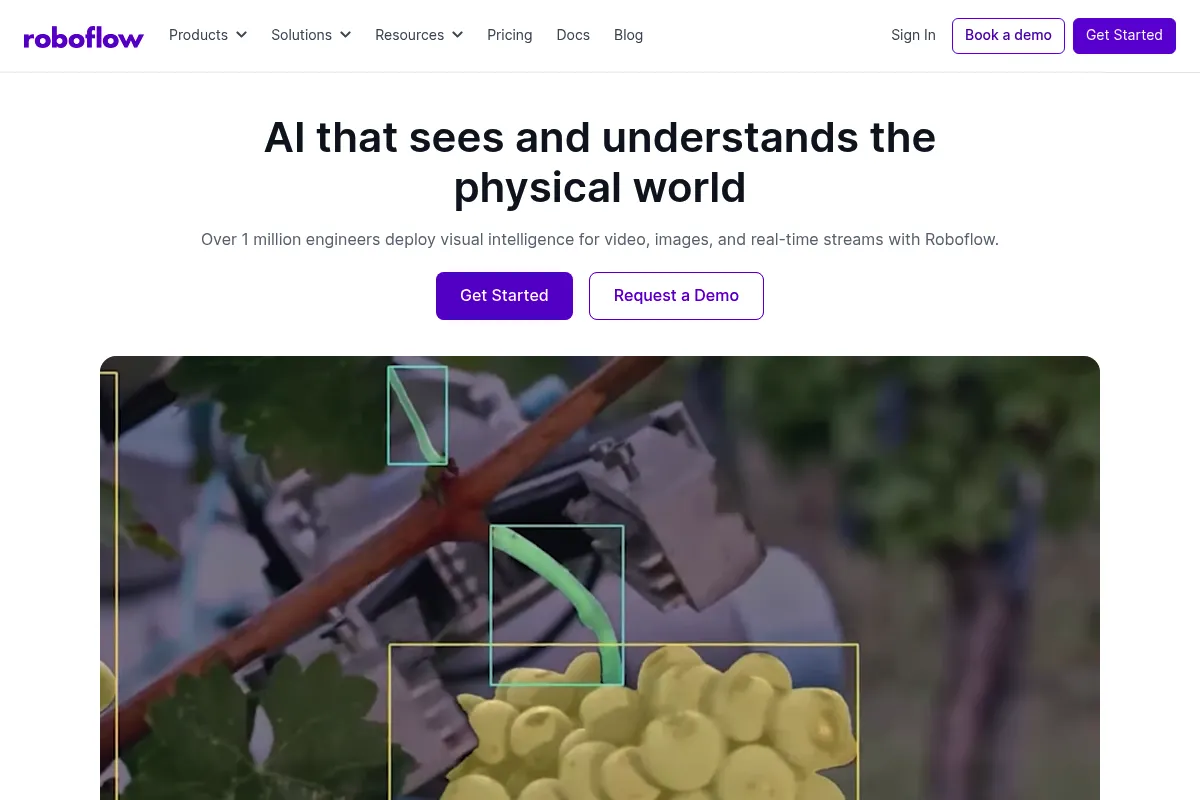
Who Should Use Roboflow?
Typical users
ML engineers and software developers building custom vision applications without dedicated MLOps infrastructure.
Maturity fit
beginner to scaling
Choose this if…
- You want to outsource the infrastructure of dataset versioning and augmentation
- Your priority is speed to production over low-level model customization
- You need to deploy models to diverse environments like web, mobile, or edge devices
Skip this if…
- You have sensitive data but no budget for the $249/mo Starter plan
- You require highly specialized 3D point cloud or medical imaging annotation tools
- You prefer managing your own training infrastructure to minimize recurring costs
About Roboflow
Roboflow is a developer-centric platform designed to manage the entire lifecycle of computer vision. It bridges the gap between raw image data and production-ready models by providing tools for annotation, augmentation, and deployment.
Official profiles
What it actually does
It centralizes image datasets, provides a browser-based annotation interface, and automates data preprocessing. Users can train models directly on the platform or export data in dozens of formats for external training.
What makes it different
The Roboflow Universe repository provides access to over 200,000 open-source datasets, giving users a massive head start. Unlike pure annotation tools, it includes a hosted inference engine and edge deployment SDKs, creating a verticalized solution rather than a point tool.
Ratings across the web
Ratings aggregated from independent review platforms.
Key Features
Roboflow Universe
Access a massive library of pre-labeled datasets to jumpstart projects.
Auto-labeling
Uses existing models to pre-annotate new images, reducing manual labor.
Dataset Versioning
Creates immutable snapshots of data to ensure reproducible model training.
One-click Augmentation
Generates synthetic variations like rotations and blurs to increase model accuracy.
Deployment SDKs
Provides ready-to-use code for deploying models to NVIDIA Jetson, iOS, and web browsers.
Health Check
Visualizes class balance and image distribution to identify dataset biases.
Model Comparison
Evaluates different versions of a model side-by-side to track performance gains.
Pricing
Free
- Public datasets only
- Up to 1,000 source images
- 3 project collaborators
- Community support
Starter
- Private projects
- Up to 5,000 source images
- 10 project collaborators
- Standard support
Enterprise
- Unlimited images
- SSO and SAML
- Dedicated success manager
- Custom deployment options
Pricing checked 4 months ago
Pricing guidance
- When you need to keep your image data private
- When your dataset exceeds 1,000 images
- When you need more than 3 team members collaborating
- Training credits are consumed per job
- API usage limits apply to hosted inference
- Public-by-default policy on the free tier
Premium positioning justified by the breadth of the managed pipeline, but expensive for small-scale private use.
Pros & Cons
Strengths
-
Rapid speed to production
Reduces the time from data collection to a working API from weeks to hours by automating the infrastructure setup.
-
Extensive format support
Supports exports to over 30 formats including YOLO, COCO, and TensorFlow, preventing vendor lock-in for the data itself.
-
Integrated inference
Eliminates the need to build and maintain a custom backend for model hosting and scaling.
-
Collaborative workflow
Built-in tools for team-based labeling and review cycles make it easier to manage large-scale data projects.
Weaknesses
-
Privacy on free tier
All data uploaded to the free plan is public by default, which is a disqualifier for proprietary or sensitive projects.
Affects: Early-stage startups and corporate R&D teams
-
Significant pricing cliff
The jump from the free tier to the $249/mo Starter plan is a high barrier for hobbyists and small teams.
Affects: Solo developers and small agencies
-
Limited advanced labeling
Lacks specialized tools for complex video interpolation or 3D data compared to high-end labeling services.
Affects: Advanced ML researchers
Real User Sentiment
Users generally praise the intuitive interface and the value of Roboflow Universe, while expressing frustration over the cost of private plans.
Users tend to like
- Ease of use for non-experts
- Massive library of open datasets
- Excellent documentation and tutorials
- Versatile deployment options
Users commonly complain about
- High cost for small private projects
- Public-by-default data policy
- Occasional lag in the web-based annotator
Recurring tradeoffs
- You trade lower-level control and higher costs for significant development speed and managed infrastructure.
Happiest users
Developers and small teams who need to ship a working vision model quickly without hiring a dedicated MLOps engineer.
Often frustrated
Privacy-conscious hobbyists and developers on a tight budget who find the $249/mo entry price too steep.
Use Cases
Inventory Management
Training a model to count products on retail shelves from mobile photos.
Quality Control
Detecting defects in manufacturing components on an assembly line in real-time.
Autonomous Drones
Deploying object detection models to edge hardware for obstacle avoidance.
Medical Imaging
Annotating X-rays to assist in identifying specific pathologies for research.
Agriculture
Monitoring crop health or identifying weeds using aerial imagery from drones.
Frequently Asked Questions
Is Roboflow free for private projects?
No. The free tier requires all datasets and models to be public in the Roboflow Universe. For private projects, you must subscribe to the Starter plan starting at $249 per month.
How does Roboflow compare to CVAT?
CVAT is a powerful open-source annotation tool that is better for complex video labeling and is free if self-hosted. Roboflow is a managed platform that handles the entire pipeline, including versioning, training, and deployment, making it faster but more expensive.
Can I export my data from Roboflow?
Yes. Roboflow supports over 30 export formats, including YOLOv5, YOLOv8, COCO, Pascal VOC, and TensorFlow TFRecord, ensuring you can move your data to other training environments.
Does Roboflow support video files?
Yes. You can upload video files, and Roboflow will allow you to sample frames at specific intervals to convert them into images for annotation.
Where are the models hosted?
You can use Roboflow's hosted API for cloud inference, or use their Inference Server to deploy models locally on your own hardware or edge devices.
Is Roboflow good for OCR?
Roboflow is excellent for text detection (finding where text is), but for character recognition (reading the text), you may need to integrate it with specialized OCR tools or use a specific OCR model architecture.
Why trust this page?
This evaluation combines product positioning, pricing analysis, traffic and market signals, and public user sentiment into a single decision-support page. Content is generated editorially — not copied from the vendor's website.
Funding & Company
Founded
2019
Stage
Series b
Total Raised
$62.24M
Latest Round
Series B (Nov 2024)
Notable Investors
Roboflow has raised a total of $62.2M, culminating in a $40M Series B in late 2024 led by GV. This significant, recent funding from top-tier investors provides a strong financial cushion for product development and market expansion. The consistent funding history indicates investor confidence in their position within the developer-focused computer vision market.
Market Signals & Traffic
Estimated visits, global rank, geography, traffic sources, monthly visit trends, and organic search keywords (Similarweb)—on a dedicated page built for depth and search.
- Estimated visits
- 1,568,057
- Global rank
- #13,704
- Snapshot
- Apr 2026
- Traffic trend
- Surging
Estimated monthly visits
Alternatives to Roboflow
View all alternativesSuperAnnotate
Developer Tools, Research, Automation

Platform for data labeling, management, and high-quality dataset curation.
Encord
Developer Tools, Workflow, Research

Data development platform for labeling, managing, and evaluating multimodal datasets.
Labelbox
Developer Tools, Research, Automation

Platform for data labeling, management, and model evaluation workflows.
Similar Tools
LaunchDarkly
Developer Tools, Automation

Feature management platform for controlled software releases and experimentation.
Appwrite
Developer Tools, Automation

Backend platform for building web, mobile, and flutter applications.
Tecton
Developer Tools, Automation

Feature platform for building and serving real-time machine learning
Koyeb
Developer Tools, Automation

Serverless platform for deploying high-performance applications and AI models
Viam
Developer Tools, Automation

Software platform for building and managing smart hardware devices.
Mona
Developer Tools, Automation

Observability and monitoring platform for production machine learning models.