

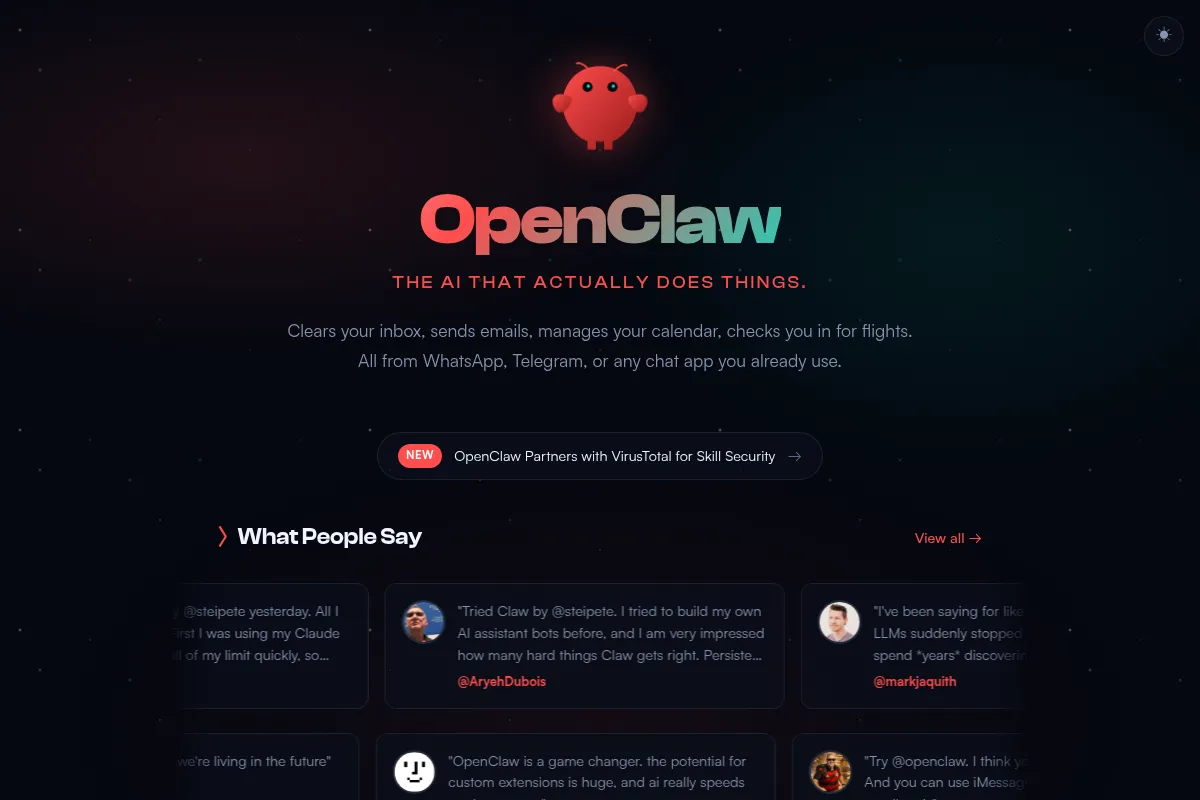
OpenClaw is an open-source AI agent framework for automating tasks across applications, best suited for technically proficient users willing to manage its self-hosted infrastructure and associated costs.
Best for developers and power users automating complex workflows, but not for non-technical users due to setup and security considerations.
Analysis based on product data, pricing structure, traffic signals, and public user sentiment.
Who Should Use OpenClaw?
Typical users
Developers, IT professionals, and technical hobbyists comfortable with command-line interfaces, Docker, and server management. It's for individuals or small teams looking to build custom, autonomous AI workflows.
Maturity fit
beginner to advanced
Choose this if…
- You need to automate complex, multi-step tasks across various applications.
- You prioritize data privacy and control by self-hosting your AI agent.
- You have the technical expertise to manage server infrastructure and API keys.
- You want to experiment with building custom AI agent behaviors and integrations.
Skip this if…
- You are not comfortable with command-line interfaces, Docker, or server setup.
- You require a user-friendly, out-of-the-box solution with minimal configuration.
- Your primary need is simple conversational AI or task execution within a single app.
- You are concerned about potential security risks and lack the expertise to mitigate them.
About OpenClaw
OpenClaw is an open-source, self-hosted AI agent framework that allows users to automate tasks by connecting AI models to applications and services. It acts as a personal AI operator, capable of executing commands, managing files, and interacting with messaging platforms autonomously. Developed for technical users, it offers deep customization but requires significant user management of infrastructure and security.
Official profiles
What it actually does
OpenClaw enables users to build autonomous AI agents that can perform actions across their digital environment. It integrates with various AI models and messaging platforms, allowing it to execute tasks like managing emails, browsing the web, running shell commands, and interacting with files without constant human supervision. The framework focuses on enabling AI to 'do things' rather than just respond to queries.
What makes it different
Unlike traditional chatbots, OpenClaw is designed as an agentic interface that can take action and operate autonomously. Its self-hosted nature provides users with greater control over data and privacy, while its extensive integration capabilities and skill system allow for deep customization of AI agent behavior. The framework prioritizes enabling AI to execute tasks across systems rather than just generating text responses.
Ratings across the web

Ratings aggregated from independent review platforms.
Key Features
Autonomous Agent
Acts on your behalf across applications and services without constant prompting.
Multi-Channel Communication
Integrates with popular messaging apps (WhatsApp, Telegram, Discord, etc.) for interaction and control.
Extensible Skills System
Allows for custom functionalities and integrations, expanding the agent's capabilities.
Persistent Memory
Remembers past interactions and context to improve future performance and continuity.
Self-Hosted Architecture
Runs on user's hardware or server, offering control over data and privacy.
AI Model Agnostic
Connects with various LLMs (OpenAI, Anthropic, local models via Ollama) through API keys.
Web Automation
Can interact with web browsers to perform tasks like data scraping and form filling.
Pricing
Open-Source (Self-Hosted)
- Software is free (MIT license)
- Requires user-provided infrastructure (servers, cloud VPS)
- User pays for AI model API calls
- Full control over data and configuration
Pricing checked 6 months ago
Pricing guidance
- When you need more processing power for complex workflows.
- When you require 24/7 uptime and reliability (necessitating a dedicated server).
- When you opt for more advanced or proprietary AI models that have higher API costs.
- AI model API costs can be unpredictable and scale with usage.
- Server hosting and maintenance require ongoing technical management.
- Security requires constant vigilance and updates to mitigate vulnerabilities.
The software is free and open-source, but operational costs are entirely borne by the user through infrastructure and AI model API usage, making it a 'pay-as-you-go' model for execution.
Pros & Cons
Strengths
-
High degree of automation and autonomy
OpenClaw can execute complex, multi-step tasks across applications without continuous user input, acting as a true personal operator.
-
Data privacy and control
Being self-hosted, OpenClaw allows users to maintain full control over their data and AI model interactions, which is crucial for sensitive workflows.
-
Extensive integration possibilities
Supports a wide range of AI models and messaging platforms, enabling deep customization and integration into existing workflows.
-
Open-source and customizable
The open-source nature allows for modification and extension, catering to users who want to build highly specific AI agent behaviors.
Weaknesses
-
Steep learning curve and technical setup
Requires significant technical expertise, including command-line proficiency, Docker knowledge, and server management, making it inaccessible for non-technical users.
Affects: Non-technical users and those new to server management.
-
Security risks and potential for misuse
Granting an autonomous agent system access carries inherent security risks, including potential data breaches or unintended actions if not properly configured and monitored. Vulnerabilities have been disclosed.
Affects: All users, but especially those handling sensitive data or lacking robust security practices.
-
Unpredictable behavior and 'hallucinations'
The underlying AI models can still make errors or misunderstand instructions, leading to unintended consequences when the agent has system-level access.
Affects: Users relying on precise execution for critical tasks.
-
Cost of infrastructure and API usage
While the software is free, running OpenClaw incurs costs for server hosting and AI model API calls, which can escalate with heavy usage.
Affects: All users, particularly those running complex or continuous automations.
Real User Sentiment
OpenClaw is viewed as a highly promising and powerful tool for automation, especially among technical users, but its complexity, security risks, and setup requirements are significant drawbacks for broader adoption.
Users tend to like
- Its ability to automate complex, multi-step tasks.
- The potential for deep customization and integration.
- The control and privacy offered by its self-hosted nature.
- Its rapid development and growing community support.
- The concept of an AI agent that 'does things' rather than just converses.
Users commonly complain about
- Difficult and time-consuming setup process requiring technical expertise.
- Significant security risks and potential for unintended actions.
- Unpredictable behavior and 'hallucinations' from underlying AI models.
- API and infrastructure costs can become substantial with heavy use.
- Lack of user-friendly interface and documentation for non-technical users.
Recurring tradeoffs
- Power and autonomy vs. security risks and complexity.
- Flexibility and customization vs. steep learning curve and setup time.
- Control over data vs. the need for ongoing technical management and cost optimization.
Happiest users
Developers, IT professionals, and technically adept hobbyists who value control, customization, and the ability to build complex autonomous workflows.
Often frustrated
Non-technical users who struggle with the setup, configuration, and security implications, or those who expect a simple, plug-and-play AI assistant.
Use Cases
Automating daily administrative tasks like email triage and scheduling.
Developing custom AI agents for research and data analysis.
Managing software development workflows, including code review and deployment assistance.
Creating personalized content generation and social media posting agents.
Building smart home automation routines and IoT device control.
Processing and summarizing large volumes of text data, such as documents or transcripts.
Creating automated customer support or lead generation workflows.
Frequently Asked Questions
What is OpenClaw?
OpenClaw is an open-source, self-hosted AI agent framework that allows users to build autonomous AI assistants. It connects AI models to various applications and services, enabling it to perform tasks like managing emails, browsing the web, and interacting with messaging platforms. It's designed for users who want an AI that can 'do things' rather than just converse.
Is OpenClaw free to use?
The OpenClaw software itself is free and open-source under the MIT license. However, running it incurs costs for server hosting (e.g., a VPS) and AI model API calls, which are variable and depend on your usage. There is also an optional paid 'OpenClaw Cloud' service for $59/month that handles hosting and setup.
Who is OpenClaw for?
OpenClaw is primarily for developers, IT professionals, and power users who are comfortable with command-line interfaces, server management, and API key configuration. It's for individuals or teams looking to build custom, autonomous AI workflows and who prioritize data control and privacy through self-hosting.
What are the security risks of using OpenClaw?
Because OpenClaw can be granted system-level access to your files, applications, and shell commands, there are significant security risks. If misconfigured or compromised, it could lead to data breaches, unintended actions, or system damage. Vulnerabilities have been disclosed, and users must actively manage security, monitor activity, and use sandboxing techniques. It is not recommended for non-technical users or for handling highly sensitive data without expert oversight.
What AI models can OpenClaw use?
OpenClaw is designed to be AI model agnostic. It can integrate with a wide range of large language models (LLMs) through API keys, including models from OpenAI (GPT series), Anthropic (Claude series), Google (Gemini series), and various open-source models via platforms like Ollama or Hugging Face. Users can also connect to models via gateways like OpenRouter.
What are the main limitations of OpenClaw?
The primary limitations include its steep technical learning curve and complex setup process, which are barriers for non-technical users. Security is another major concern, as the agent's system access requires careful management. The underlying AI models can also exhibit unpredictable behavior or 'hallucinations,' leading to errors. Finally, the operational costs for hosting and API usage can accumulate.
How does OpenClaw compare to ChatGPT?
ChatGPT is primarily a conversational AI chatbot focused on generating text responses and providing information. OpenClaw, on the other hand, is an autonomous AI agent framework that uses LLMs like ChatGPT as its 'brain' but adds the capability to take actions, execute commands, and interact with applications and systems across your computer. OpenClaw is about 'doing,' while ChatGPT is about 'responding.'
Can OpenClaw run locally without internet access?
OpenClaw itself can run locally, but its ability to function effectively often depends on its connection to AI model APIs, which typically require internet access. If you use local AI models (e.g., via Ollama), OpenClaw can operate with limited or no internet connectivity for the AI processing part, but for integrations with cloud services or external APIs, internet access is necessary.
Why trust this page?
This evaluation combines product positioning, pricing analysis, traffic and market signals, and public user sentiment into a single decision-support page. Content is generated editorially — not copied from the vendor's website.
Funding & Company
Founded
2025
Stage
Acquired
Total Raised
Bootstrapped
Latest Round
—
OpenClaw is not a traditional venture-backed company but a popular open-source project. Its creator, Peter Steinberger, was hired by OpenAI in February 2026 in a deal that also established the independent OpenClaw Foundation, which OpenAI now supports. This structure provides the project with significant stability and resources without traditional funding rounds.
Market Signals & Traffic
Estimated visits, global rank, geography, traffic sources, monthly visit trends, and organic search keywords (Similarweb)—on a dedicated page built for depth and search.
- Estimated visits
- 14,196,545
- Global rank
- #4,261
- Snapshot
- Apr 2026
- Traffic trend
- Falling
Estimated monthly visits
Alternatives to OpenClaw
View all alternatives

Similar Tools
TextQL
AI Assistant, Automation, Developer Tools

Query data warehouses and documentation using natural language.
Minion
AI Assistant, Automation & Agents, Productivity

Autonomous browser agent that completes complex web tasks for users.
Pyramid Flow
Video Creation, Developer Tools, Content Creation

Generate high-resolution videos from text and image prompts efficiently.
AssemblyAI
Developer Tools, Data Extraction, Automation

Speech-to-text and audio intelligence APIs for developers and enterprises.
Anysphere
Developer Tools, Productivity

Development platform and code editor for intelligent software engineering.
OpusClip
Video Creation, Content Creation, Marketing Automation

Repurpose long-form videos into viral short-form clips.