

TextQL
A semantic-aware AI data analyst that translates natural language into SQL by indexing your data warehouse alongside your internal documentation in Notion, Confluence, and dbt.
Best for mid-to-large data teams using dbt who need to automate repetitive ad-hoc queries, weaker for teams with undocumented or messy data schemas.
Analysis based on product data, pricing structure, traffic signals, and public user sentiment.
Who Should Use TextQL?
Typical users
Data analysts, analytics engineers, and business operations leads at companies with established data warehouses.
Maturity fit
scaling to advanced
Choose this if…
- Your data team is drowning in 'how many X happened last month' Slack messages
- You already use dbt and have well-maintained documentation
- You want business users to query data directly in Slack or Teams without learning SQL
Skip this if…
- Your company lacks a centralized data warehouse like Snowflake or BigQuery
- Your business logic isn't documented anywhere (the AI will lack context)
- You need a tool for complex visual dashboarding rather than answering specific questions
About TextQL
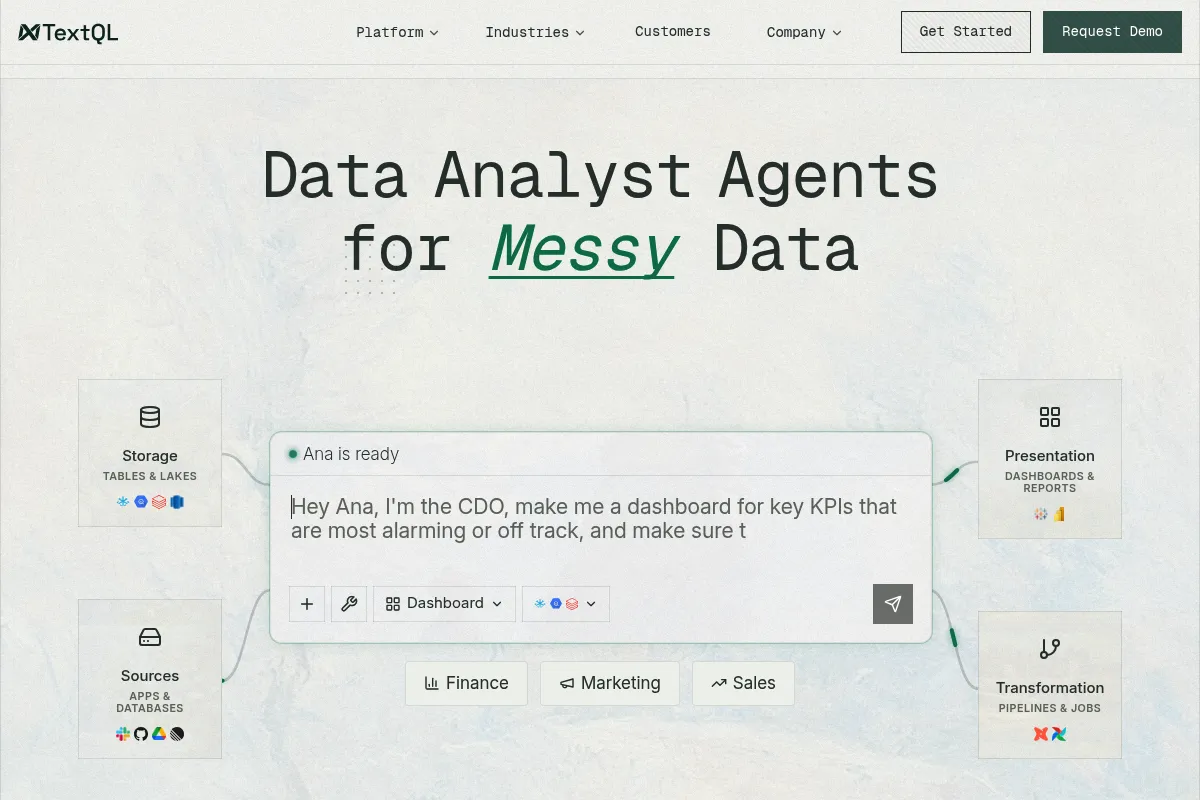
TextQL is an AI-powered data assistant designed to function as a virtual member of a data team. It connects to modern data stacks to automate the translation of natural language questions into accurate, executable SQL queries.
Official profiles
What it actually does
It indexes your data warehouse schemas and internal documentation to understand company-specific terminology. Users ask questions in plain English via a web interface or chat apps, and TextQL generates the SQL, runs it, and explains the logic behind the result.
What makes it different
Most text-to-SQL tools only look at table and column names, which leads to errors when business logic is complex. TextQL differentiates itself by 'reading' your dbt docs, Notion pages, and Confluence files to understand exactly how your company defines metrics like 'active user' or 'churn.'
Key Features
Documentation Indexing
Connects to Notion and Confluence to learn business-specific definitions.
dbt Integration
Pulls logic directly from dbt models, descriptions, and tests to ensure query accuracy.
Slack/Teams Bot
Enables non-technical stakeholders to get data answers without leaving their communication tools.
SQL Transparency
Displays the generated code alongside the answer so analysts can audit the logic.
Semantic Layer Awareness
Syncs with existing metrics defined in tools like Looker or Cube.
Contextual Explanations
Provides a plain-English breakdown of how the AI interpreted the question and which tables it used.
Pricing
Enterprise
- Full data warehouse integration
- Unlimited documentation indexing
- Slack & Teams deployment
- SSO and enterprise security
- Dedicated support and fine-tuning
Pricing checked 4 months ago
Pricing guidance
- Moving from a pilot to full organizational rollout
- Adding multiple data sources or BI tools
- Requiring advanced security features like SSO
- Pricing is likely based on the number of data sources or seats
- Performance may vary based on the size of the indexed documentation
Premium enterprise positioning that reflects the high value of saving expensive analyst time.
Pros & Cons
Strengths
-
High accuracy through context
By indexing internal docs, it avoids the common 'hallucination' where AI guesses what a column name means, leading to more reliable answers than generic LLM wrappers.
-
Reduces analyst burnout
Automates the 'grunt work' of answering 80% of simple ad-hoc requests, allowing senior analysts to focus on deep strategic work.
-
Native dbt support
It treats dbt as the source of truth, meaning any updates to your data models are automatically reflected in the AI's understanding.
Weaknesses
-
Dependent on documentation quality
If your internal docs are outdated or non-existent, the tool will struggle to define complex metrics correctly.
Affects: Teams with low documentation maturity
-
High setup overhead
While the connection is fast, fine-tuning the AI to understand specific business nuances requires initial time investment from the data team.
Affects: Small teams looking for an 'out of the box' solution
-
Enterprise-skewed pricing
The lack of transparent, self-serve pricing suggests a focus on larger contracts, which may price out early-stage startups.
Affects: Small businesses and solo founders
Real User Sentiment
Users are generally impressed by the tool's ability to handle complex joins and business logic that other AI tools miss.
Users tend to like
- Integration with dbt
- Ability to 'read' Notion and Confluence
- Slack-first workflow
- Transparency of the generated SQL
Users commonly complain about
- Initial configuration takes effort
- Requires consistent documentation maintenance to stay accurate
- No self-serve entry point
Recurring tradeoffs
- You trade initial setup time for long-term reduction in ad-hoc support tickets.
Happiest users
Data leads at mid-market companies who have a well-documented dbt project and are tired of answering the same questions repeatedly.
Often frustrated
Users in chaotic data environments where table names are cryptic and no documentation exists.
Use Cases
Sales Ops
Asking 'What was the average deal size for EMEA in Q2?' directly in Slack.
Product Management
Querying user retention metrics without waiting for a weekly report.
Marketing
Identifying which campaigns led to the highest LTV customers using natural language.
Data Engineering
Generating starting SQL for complex reports to speed up development.
Executive Leadership
Getting quick answers to high-level KPIs during meetings without an analyst present.
Frequently Asked Questions
How much does TextQL cost?
TextQL does not publish its pricing publicly. It follows an enterprise sales model where pricing is customized based on your data volume, number of users, and specific integration needs. You must book a demo to receive a quote.
Does TextQL store my data?
No, TextQL typically does not store your raw data. It indexes metadata (table names, column names, and documentation) and generates queries that run directly on your warehouse. The results are passed through to the user, but the underlying data remains in your environment.
How does it compare to Vanna.ai or other SQL generators?
While tools like Vanna.ai focus on training a model on your SQL history, TextQL focuses on the 'semantic' context. It is unique in its ability to ingest documentation from Notion and Confluence to understand business logic that isn't present in the SQL code itself.
Do I need dbt to use TextQL?
While not strictly required, TextQL is heavily optimized for dbt users. It uses dbt's semantic layer and documentation to significantly improve the accuracy of its SQL generation. Without dbt or similar documentation, the setup requires more manual effort.
Can it create charts and dashboards?
TextQL is primarily focused on answering questions with data and SQL. While it can integrate with BI tools like Tableau and Looker to trigger existing reports, its core strength is providing text-based answers and data tables rather than being a full-scale visualization platform.
What happens if the AI gives a wrong answer?
TextQL provides the SQL code used to generate every answer. This allows data analysts to verify the logic. If an error is found, you can usually correct the AI by updating the relevant documentation in Notion or dbt, which the tool then re-indexes.
Why trust this page?
This evaluation combines product positioning, pricing analysis, traffic and market signals, and public user sentiment into a single decision-support page. Content is generated editorially — not copied from the vendor's website.
Funding & Company
Founded
2022
Stage
Series a
Total Raised
$21.1M
Latest Round
Series A (Apr 2026)
Notable Investors
TextQL has raised a total of $21.1M over two rounds, including a recent $17M Series A led by Blackstone's investment arm. This strategic investment from a major enterprise player validates TextQL's approach and provides significant capital to scale its AI-native analytics platform.
Market Signals & Traffic
Estimated visits, global rank, geography, traffic sources, monthly visit trends, and organic search keywords (Similarweb)—on a dedicated page built for depth and search.
- Estimated visits
- 0
- Global rank
- —
- Snapshot
- May 2026
- Traffic trend
- Surging
Estimated monthly visits
Alternatives to TextQL
View all alternatives
Similar Tools
OpenClaw
AI Assistant, Automation, Developer Tools

Open-source AI agent that automates tasks via messaging platforms.
Storm
Content Creation, Productivity, AI Assistant

AI system that researches and writes Wikipedia-like articles.
Navattic
Training & Onboarding, Marketing Automation, Automation & Agents

Create interactive, self-guided product demos for sales and marketing.
Ocoya
Social Media, Marketing Automation, Content Creation

Create, schedule, and analyze social media content across multiple platforms.
Boomi
Automation, Developer Tools, Productivity

Cloud-based integration platform for connecting applications and automating workflows.
AuraScape
Privacy & Compliance, Developer Tools

Real-time security and governance platform for generative applications.