

Atomic AI
A specialized biotech platform that uses deep learning to map RNA structures for drug discovery—essential for high-end pharmaceutical R&D but inaccessible as a standalone software product.
Excellent for pharmaceutical teams identifying druggable RNA targets, but strictly an enterprise-level partnership play rather than a self-serve tool.
Analysis based on product data, pricing structure, traffic signals, and public user sentiment.
Who Should Use Atomic AI?
Typical users
Computational biologists, medicinal chemists, and R&D leads at large pharmaceutical firms or well-funded biotech startups.
Maturity fit
advanced
Choose this if…
- You are targeting 'undruggable' diseases where protein-centric approaches have failed
- Your priority is high-resolution 3D RNA structural prediction over 2D sequence analysis
- You have the budget for a strategic R&D partnership rather than a software subscription
Skip this if…
- You are an individual academic researcher looking for a self-serve or free tool
- Your workflow is focused exclusively on protein folding (use AlphaFold instead)
- You need an off-the-shelf SaaS product with immediate login access
About Atomic AI
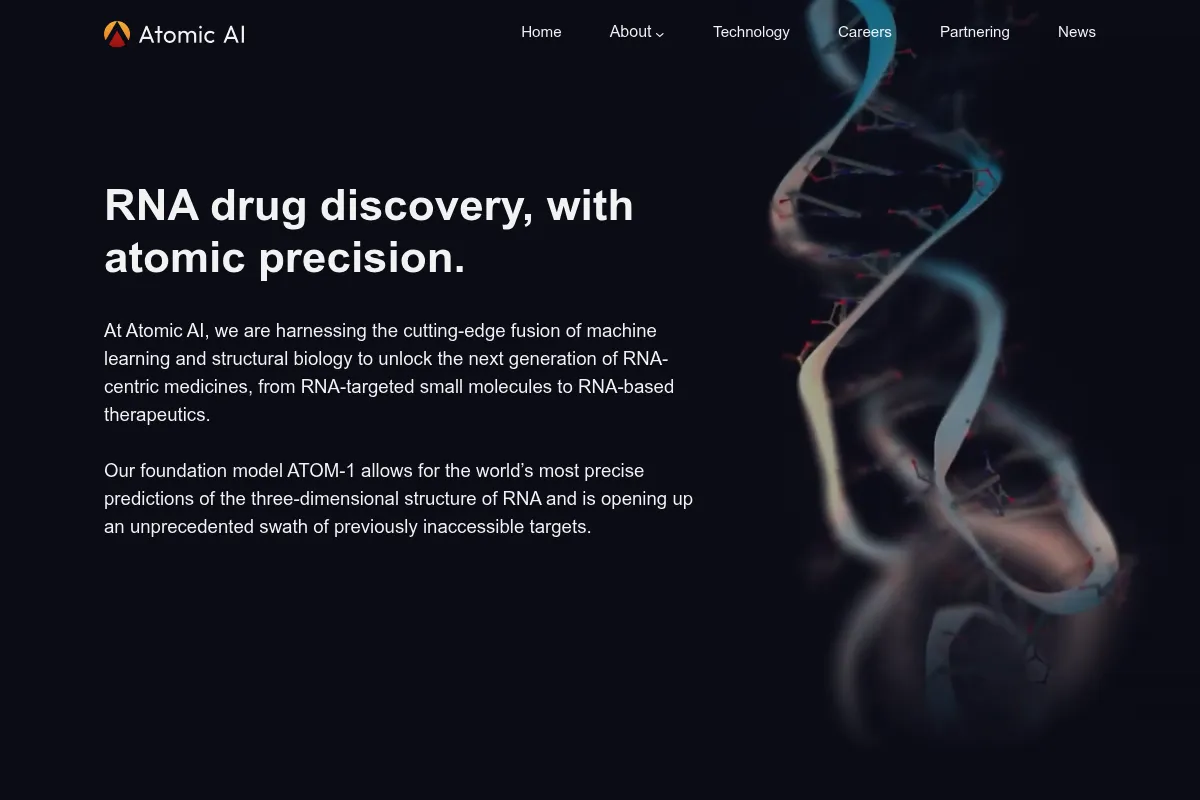
Atomic AI is a biotechnology platform designed to unlock RNA as a therapeutic target. It combines proprietary wet-lab data generation with deep learning to predict how RNA folds into complex 3D shapes, identifying novel binding sites for small-molecule drugs.
Official profiles
What it actually does
The platform generates high-resolution structural models of RNA molecules to find 'pockets' where drugs can bind. It integrates high-throughput experimental chemical mapping with machine learning to accelerate the discovery of RNA-targeted medicines.
What makes it different
Unlike general AI models trained on public data, Atomic AI uses a closed-loop system where they generate their own proprietary experimental data to train models specifically for RNA. This focus addresses the unique flexibility and structural complexity of RNA that general-purpose tools often miss.
Key Features
PARSE Platform
The core engine for high-throughput RNA structure exploration and data generation.
Deep Learning Engine
Predicts 3D atomic coordinates of RNA molecules without needing crystallization.
RNA-Targeted Small Molecule Discovery
Identifies specific sites where small molecules can modulate RNA function.
Proprietary RNA Data
Uses internal experimental results to refine AI accuracy beyond public datasets.
Multi-Disease Application
Capable of targeting oncology, neurology, and rare genetic disorders.
Wet-lab Feedback Loop
Validates AI-generated structural predictions with real-world biological testing.
Pricing
Enterprise Partnership
- Full access to PARSE platform
- Custom RNA target identification
- Collaborative R&D with Atomic AI scientists
- Proprietary data generation and validation
Pricing checked 4 months ago
Pricing guidance
- When moving from target identification to lead optimization
- When requiring proprietary wet-lab validation of AI predictions
- Access is gated by manual vetting
- Requires significant internal computational biology expertise to manage the partnership
Premium enterprise positioning typical of high-tech biotech platforms.
Pros & Cons
Strengths
-
Superior RNA structural precision
By focusing exclusively on RNA, the platform handles the molecule's dynamic nature better than general structural biology tools.
-
Proprietary data advantage
The integration of a dedicated wet-lab means their models are trained on high-quality, relevant data that isn't available in the public domain.
-
Targets 'undruggable' pathways
Enables researchers to go after disease-relevant RNA that was previously considered too complex for small-molecule intervention.
Weaknesses
-
Not a self-serve tool
You cannot simply sign up and use the software; it requires a formal business partnership or enterprise agreement.
Affects: Small labs and independent researchers
-
High barrier to entry
The cost and infrastructure required for these types of partnerships are typically only feasible for large organizations.
Affects: Early-stage startups with limited funding
-
Narrow specialization
The platform is highly optimized for RNA; it is not a general-purpose drug discovery suite for all biological targets.
Affects: Teams needing a broad-spectrum discovery platform
Real User Sentiment
Highly respected within the scientific and venture capital communities for its technical foundation, though it lacks a traditional 'user' base that leaves public reviews.
Users tend to like
- Technical rigor of the PARSE platform
- Focus on RNA, a high-potential but difficult target
- Strong leadership team with deep ML and biology expertise
Users commonly complain about
- Lack of public access to the tool
- Opaque pricing and partnership terms
Recurring tradeoffs
- Users trade immediate software access for a deep, collaborative R&D relationship.
Happiest users
Large pharmaceutical companies looking to expand their pipeline into RNA-targeted therapeutics.
Often frustrated
Academic researchers or small-scale developers looking for an open-source or affordable RNA folding tool.
Use Cases
Oncology Research
Identifying RNA structures that drive tumor growth to develop new inhibitors.
Neurological Disorders
Targeting RNA involved in neurodegenerative diseases like Huntington's or ALS.
Rare Disease Discovery
Finding druggable sites on RNA for conditions with no known protein targets.
Small Molecule Screening
Using AI models to predict which chemical compounds will bind effectively to a specific RNA fold.
Structural Biology
Generating high-resolution 3D models of RNA to understand its biological function.
Frequently Asked Questions
How much does Atomic AI cost?
Atomic AI does not have public pricing. It operates on a B2B partnership model where costs are determined by the scope of the research project, the number of targets, and the level of wet-lab integration required. Expect enterprise-level investment.
Can I use Atomic AI for protein folding?
No. Atomic AI is specifically engineered for RNA structural prediction. For protein folding, tools like Google DeepMind's AlphaFold or Meta's ESMFold are the industry standards.
How does Atomic AI compare to Arrakis Therapeutics?
Both focus on RNA-targeted small molecules. However, Atomic AI leans more heavily into the 'AI-first' structural prediction and proprietary data generation (the PARSE platform), whereas Arrakis is a more traditional, albeit advanced, biotech firm with its own established drug pipeline.
Is there a free version for students or academics?
Currently, there is no public-facing free version or academic license for the PARSE platform. Academics typically rely on open-source tools like RosettaRNA or secondary structure predictors like ViennaRNA.
What kind of data does Atomic AI use?
Atomic AI uses a combination of public structural data and their own proprietary high-throughput chemical mapping data. This 'closed-loop' approach allows them to train models on RNA-specific interactions that are often missing from public databases like the PDB.
Does Atomic AI provide the drugs or just the targets?
Atomic AI is a platform for discovery. They identify the targets and help design the molecules, but the actual manufacturing and clinical trials are typically handled in collaboration with their pharmaceutical partners.
Why trust this page?
This evaluation combines product positioning, pricing analysis, traffic and market signals, and public user sentiment into a single decision-support page. Content is generated editorially — not copied from the vendor's website.
Funding & Company
Founded
2021
Stage
Series a
Total Raised
$42M
Latest Round
Series A (Jan 2023)
Notable Investors
Atomic AI has raised a total of $42 million across two rounds, a Seed round and a Series A. [6, 8] The most recent funding was a $35 million Series A in January 2023, led by Playground Global. [2, 15] This capital suggests strong investor confidence in its specialized approach to RNA drug discovery.
Market Signals & Traffic
Estimated visits, global rank, geography, traffic sources, monthly visit trends, and organic search keywords (Similarweb)—on a dedicated page built for depth and search.
- Estimated visits
- 7,445
- Global rank
- #2,572,116
- Snapshot
- Apr 2026
- Traffic trend
- Surging
Estimated monthly visits
Similar Tools
Profluent
Research, Health & Wellness

Generative protein design platform for creating novel functional proteins
Cradle
Research, Health & Wellness

Design and optimize protein sequences for biotechnology and research.
Inceptive
Research, Health & Wellness
Designing novel RNA molecules for next-generation biological medicines.
Terray Therapeutics
Research, Health & Wellness

Generative platform for large-scale small molecule drug discovery.
AnswerThis
Research, Search

Research assistant for finding and citing peer-reviewed academic literature.
Prisync
Automation, Marketing Automation, Data Extraction

Competitor price tracking and dynamic pricing software for e-commerce businesses.