

Terray Therapeutics
A vertically integrated drug discovery platform that combines massive-scale physical chemical screening with generative AI to optimize small molecule development.
Excellent for pharmaceutical companies needing high-fidelity experimental data for AI training, but not a self-service software tool for individual researchers.
Analysis based on product data, pricing structure, traffic signals, and public user sentiment.
Who Should Use Terray Therapeutics?
Typical users
R&D leaders at large pharmaceutical companies and well-funded biotech startups looking for lead optimization and target validation.
Maturity fit
advanced
Choose this if…
- You need experimental data at a scale that exceeds traditional CRO capabilities
- Your priority is integrating physical lab validation with generative molecular design
- You are pursuing challenging targets that lack sufficient public data for AI training
Skip this if…
- You are looking for a standalone SaaS tool to run on your own hardware
- You are an individual academic researcher with a limited budget
- Your workflow requires a simple computational simulation tool without physical lab integration
About Terray Therapeutics
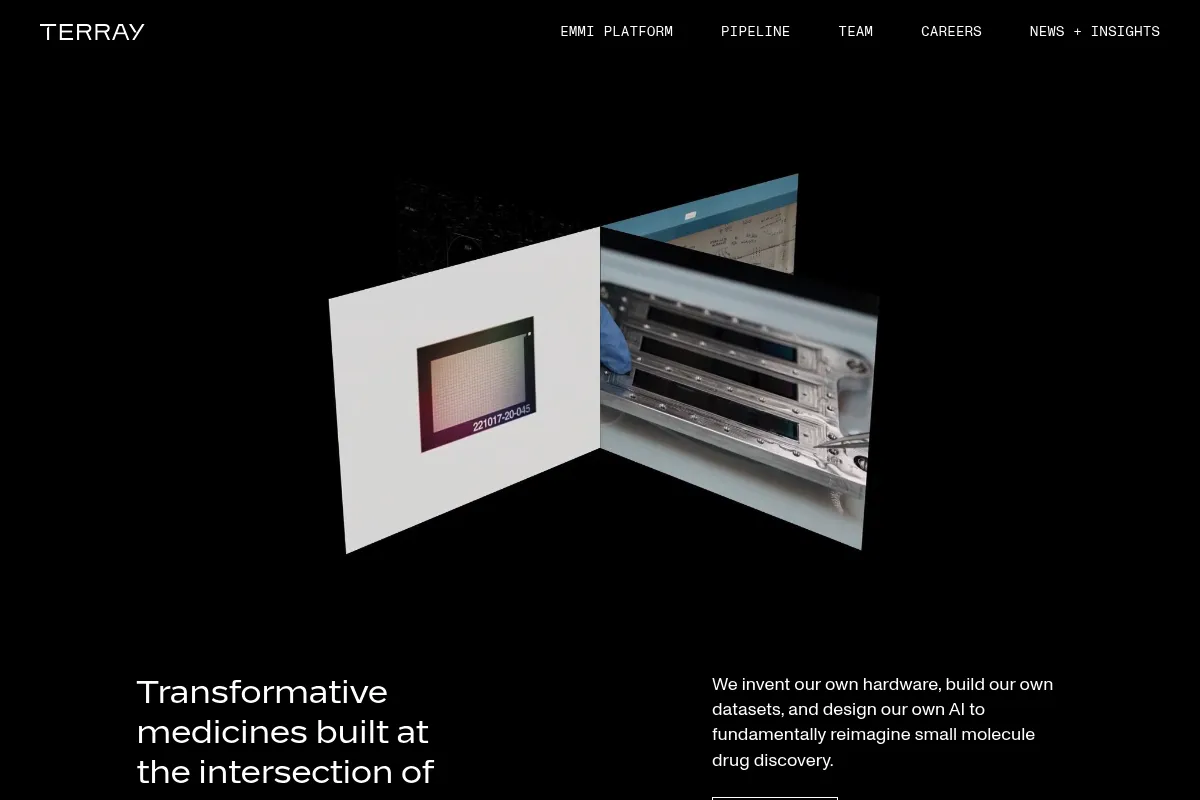
Terray Therapeutics is a biotechnology company that bridges the gap between computational modeling and physical experimentation. It operates a proprietary platform designed to generate massive, high-quality datasets in-house to solve complex small molecule discovery problems.
Official profiles
What it actually does
The platform synthesizes and screens billions of small molecules to create high-resolution datasets. These data points train generative AI models to design and refine drug candidates for diseases in immunology, oncology, and other therapeutic areas.
What makes it different
Unlike 'AI-first' companies that rely on sparse public data, Terray owns the entire data loop. Their tArray system uses physical lab hardware to feed their CODA AI models, ensuring predictions are based on billions of proprietary, real-world experimental results rather than just simulations.
Key Features
tArray Platform
Synthesizes and screens millions of compounds simultaneously to provide massive training data.
CODA Generative AI
Uses internal experimental data to predict and design novel small molecules with drug-like properties.
Closed-loop feedback
Integrates physical lab results directly back into AI models for rapid iteration cycles.
Massive Chemical Space Navigation
Maps billions of interactions to find optimal candidates for challenging targets.
Target-specific datasets
Creates custom data pools for specific biological targets where public data is non-existent.
Integrated Lead Optimization
Refines chemical structures to balance potency, selectivity, and safety.
Pricing
Strategic Partnership
- Full access to tArray and CODA platforms
- Joint R&D and pipeline development
- Intellectual property sharing
- Custom dataset generation
Pricing checked 4 months ago
Pricing guidance
- When moving from target discovery to lead optimization
- When expanding a partnership to include more therapeutic areas
- Access is limited by the company's internal capacity to manage partnerships
- Intellectual property rights are subject to negotiation
Premium enterprise positioning justified by the scale of physical infrastructure and proprietary data.
Pros & Cons
Strengths
-
Unmatched data volume
Generates billions of data points, providing a significantly larger and cleaner training set than what is available in public repositories.
-
Physical validation
Every AI prediction can be tested in their own high-throughput lab, which reduces the risk of 'hallucinated' molecules that cannot be synthesized.
-
Validated by industry leaders
Strategic partnerships with major players like Bristol Myers Squibb and GSK provide external validation of the platform's efficacy.
Weaknesses
-
Not a SaaS product
You cannot purchase a subscription or log in to a dashboard; access requires a deep institutional partnership.
Affects: Small teams and independent researchers
-
High barrier to entry
Only accessible to organizations with the capital for multi-million dollar R&D collaborations.
Affects: Early-stage startups and academic labs
-
Opaque pricing and timelines
Costs and project durations are tied to complex milestone and royalty agreements, making them unpredictable for standard budgeting.
Affects: Procurement and finance teams
Real User Sentiment
Highly respected within the biotech industry for prioritizing high-quality experimental data over purely computational approaches.
Users tend to like
- The scale of their internal data generation
- Integration of physical lab hardware with AI
- Strong leadership team with deep chemistry expertise
Users commonly complain about
- Lack of public software access
- High cost of entry for smaller firms
Recurring tradeoffs
- High upfront partnership costs versus the potential for significantly faster discovery timelines
Happiest users
R&D heads at Big Pharma who need to solve 'undruggable' targets.
Often frustrated
Computational chemists looking for a self-service tool to use on their own datasets.
Use Cases
Pharmaceutical R&D
Partnering to accelerate the discovery of small molecule leads for complex targets.
Target Validation
Using massive datasets to confirm if a biological target is actually druggable.
Lead Optimization
Refining chemical structures to improve potency and safety profiles using generative models.
Internal Pipeline Development
Terray developing its own proprietary drugs for immunology and oncology.
Data Generation
Creating high-fidelity datasets for specific protein-ligand interactions that lack public data.
Frequently Asked Questions
Is there a free trial or demo for Terray Therapeutics?
No. Terray Therapeutics is a biotechnology company, not a SaaS provider. Access to their platform is only available through strategic R&D partnerships or collaborations, which typically involve significant investment and long-term contracts.
How does Terray compare to Schrodinger?
Schrodinger provides a software suite that researchers buy to run simulations on their own. Terray is a platform that combines proprietary software (CODA) with a massive physical lab (tArray). You don't buy Terray's software; you partner with them to use their data and lab to find drugs.
What therapeutic areas does Terray focus on?
Terray focuses primarily on small molecule discovery for immunology, oncology, and neuroscience. They target complex diseases where traditional discovery methods have struggled to find effective chemical leads.
Can I integrate my own data into the Terray platform?
Yes, in a partnership context. While Terray's strength is their own massive datasets, collaborations often involve integrating a partner's specific target knowledge with Terray's generative and screening capabilities.
What is the tArray platform?
tArray is Terray's proprietary hardware system for high-throughput chemical synthesis and screening. It allows them to physically test billions of chemical interactions, providing the 'ground truth' data used to train their AI models.
Does Terray use public datasets like the Protein Data Bank (PDB)?
While they may use public data for initial training, their core advantage is the billions of proprietary data points they generate internally, which are often more consistent and higher-resolution than public data.
Why trust this page?
This evaluation combines product positioning, pricing analysis, traffic and market signals, and public user sentiment into a single decision-support page. Content is generated editorially — not copied from the vendor's website.
Funding & Company
Founded
2018
Stage
Series b
Total Raised
$200M
Latest Round
Series B (Oct 2024)
Notable Investors
Terray Therapeutics has raised a total of $200 million, culminating in a $120 million Series B in October 2024. This significant funding from notable investors like NVentures (NVIDIA's VC arm) and Madrona Ventures signals strong confidence in its AI-driven drug discovery platform and provides substantial runway for product development and clinical trials.
Market Signals & Traffic
Estimated visits, global rank, geography, traffic sources, monthly visit trends, and organic search keywords (Similarweb)—on a dedicated page built for depth and search.
- Estimated visits
- 0
- Global rank
- —
- Snapshot
- Jun 2026
- Traffic trend
- —
Alternatives to Terray Therapeutics
View all alternatives
Similar Tools
Atomic AI
Research, Health & Wellness

Platform for RNA-targeted drug discovery and structural biology research
Inceptive
Research, Health & Wellness
Designing novel RNA molecules for next-generation biological medicines.
Cradle
Research, Health & Wellness

Design and optimize protein sequences for biotechnology and research.
Profluent
Research, Health & Wellness

Generative protein design platform for creating novel functional proteins
MasterControl
Privacy & Compliance, Automation, Workflow

Quality management and manufacturing execution software for regulated industries.
Merlin
AI Assistant, Content Creation

An AI-powered assistant to research, write, and summarize content across the web.