

Iambic
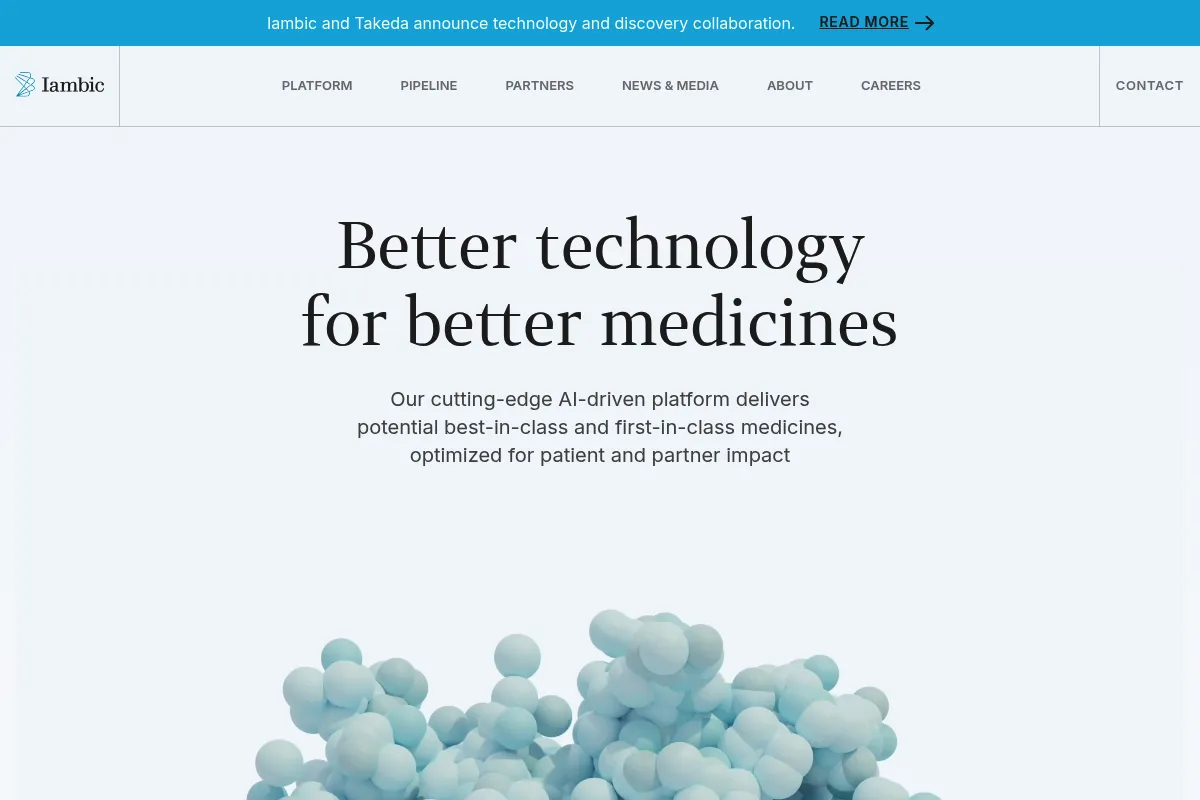
A high-performance AI-biotech platform that combines physics-informed models with generative chemistry to accelerate drug discovery; best for pharmaceutical partnerships rather than individual software users.
Excellent for solving complex protein-ligand binding and clinical property prediction, but inaccessible as a standalone SaaS.
Analysis based on product data, pricing structure, traffic signals, and public user sentiment.
Who Should Use Iambic?
Typical users
Pharmaceutical R&D leaders, biotech founders, and computational chemists looking for strategic co-development or high-end structure prediction.
Maturity fit
advanced
Choose this if…
- You need quantum-level accuracy for 'undruggable' targets without the computational overhead of traditional simulations.
- Your priority is accelerating the Design-Make-Test-Analyze (DMTA) cycle through integrated AI and wet-lab automation.
- You are a researcher looking for state-of-the-art open-source protein-ligand structure prediction models like NeuralPLexer.
Skip this if…
- You want a self-service SaaS tool with a simple monthly subscription.
- Your workflow requires a standard software license for internal use without a partnership agreement.
- You are working on simple molecular docking tasks that don't justify a high-end biotech partnership.
About Iambic
Iambic (formerly Entos) is a clinical-stage biotechnology company that uses a proprietary AI platform to shorten drug discovery timelines. It focuses on oncology and therapeutic areas where traditional chemistry struggles with multi-parameter optimization, moving candidates from launch to IND in as little as 24 months.
Official profiles
What it actually does
The platform predicts how molecules interact with proteins using physics-informed machine learning and generates new chemical structures optimized for potency and safety. It integrates these predictions with an internal automated wet lab to rapidly validate and iterate on drug candidates.
What makes it different
Unlike many AI tools that rely solely on historical data, Iambic uses 'physics-informed' models like NeuralPLexer and OrbNet. This allows it to predict molecular behavior with quantum chemistry precision at the speed of machine learning, effectively 'breaking the data wall' in sparse data regimes.
Key Features
NeuralPLexer
Predicts protein-ligand binding structures and conformational changes in seconds without experimental co-crystals.
Enchant v2
A multimodal transformer that predicts clinical endpoints (like half-life and clearance) even when human data is scarce.
OrbNet
Provides quantum-level accuracy for binding energies 1,000x faster than conventional density functional theory (DFT) methods.
Closed-loop DMTA
Integrates AI design with an automated laboratory that synthesizes and tests thousands of compounds weekly.
Magnet
A generative design engine that proposes novel chemical scaffolds optimized for multiple therapeutic objectives simultaneously.
Open-Source Components
Offers specific models like NeuralPLexer on GitHub for the broader scientific community.
Pricing
Open Source (NeuralPLexer)
- Access to NeuralPLexer code on GitHub
- Community-supported structure prediction
- Academic use cases
Strategic Partnership
- Full access to Enchant, NeuralPLexer, and OrbNet
- Integrated wet-lab automation and testing
- Co-development of therapeutic pipelines
- Bespoke model training on partner data
Pricing checked 4 months ago
Pricing guidance
- When you need to move from structure prediction to full lead optimization
- When you require integrated wet-lab validation for AI-designed molecules
- When you are targeting complex oncology or neurological indications
- Open-source models lack the proprietary data and wet-lab feedback loops of the full platform
- Partnerships often involve IP sharing or royalty obligations
Premium enterprise positioning focused on high-value pharma deals and internal drug development.
Pros & Cons
Strengths
-
Quantum-level accuracy at scale
OrbNet allows teams to run high-precision simulations on massive libraries that were previously too computationally expensive for traditional physics engines.
-
Proven clinical speed
The platform has demonstrated moving programs from launch to IND in 2 years, compared to the industry average of 6 years.
-
Handles sparse data regimes
The Enchant model is specifically designed to make high-confidence predictions for novel targets where little historical or clinical data exists.
Weaknesses
-
Not a standalone software product
You cannot simply buy a license; access typically requires a multi-million dollar strategic partnership or co-development deal.
Affects: Small biotech startups and individual researchers
-
High technical barrier
Interpreting and acting on platform outputs requires a deep bench of computational chemists and biologists.
Affects: Teams without specialized AI-drug discovery expertise
-
Opaque pricing and terms
Commercial terms are negotiated per deal and often involve milestone payments and royalties, making costs unpredictable.
Affects: Procurement and finance teams
Real User Sentiment
Highly positive within the scientific and pharma community for its technical rigor and ability to deliver clinical candidates quickly.
Users tend to like
- Physics-informed approach over 'black box' AI
- Speed of structure prediction compared to AlphaFold3
- Validation through high-impact Nature publications
- Successful transition of AI-designed drugs into Phase 1 trials
Users commonly complain about
- Lack of a self-service software portal
- Complexity of the underlying models
- Limited public documentation on enterprise workflow features
Recurring tradeoffs
- Users trade software autonomy for the high-touch, high-cost partnership model.
Happiest users
Pharma R&D heads who need to de-risk difficult targets and accelerate their pipeline.
Often frustrated
Individual computational chemists looking for a cheap, off-the-shelf docking tool.
Use Cases
Oncology Drug Discovery
Designing highly selective, brain-penetrant inhibitors for challenging cancer targets.
Lead Optimization
Iteratively refining molecules to balance potency, solubility, and safety profiles.
Structure Prediction
Using NeuralPLexer to determine the 3D coordinates of protein-ligand complexes in seconds.
Clinical Risk Reduction
Using Enchant to predict human pharmacokinetic properties before entering the clinic.
Target De-risking
Evaluating the 'druggability' of novel proteins with sparse experimental data.
Frequently Asked Questions
Is Iambic AI a software I can subscribe to?
No, Iambic is a biotechnology company, not a SaaS provider. While they have a proprietary software platform, access is typically granted through strategic partnerships or co-development agreements rather than a standard subscription.
How does Iambic compare to Schrödinger?
Schrödinger is primarily a software company that sells licenses for tools like Maestro and FEP+. Iambic is a 'TechBio' company that uses its own tools to develop drugs. Iambic's models, like OrbNet, are designed to provide quantum accuracy at much higher speeds than traditional physics-based software.
Can I use Iambic's models for free?
Yes, partially. Iambic has open-sourced NeuralPLexer, a state-of-the-art protein-ligand structure prediction model, which is available on GitHub for researchers and developers.
What therapeutic areas does Iambic focus on?
Iambic primarily focuses on oncology, with lead programs like IAM1363 (a HER2 inhibitor). They also have partnerships in gastrointestinal, inflammation, and neurological diseases.
Does Iambic have its own laboratories?
Yes, Iambic operates an automated wet lab in San Diego that is tightly integrated with its AI platform, allowing for a 'closed-loop' system where AI designs are tested and data is fed back into the models weekly.
What is NeuralPLexer?
NeuralPLexer is Iambic's generative AI model for predicting the 3D structure of protein-ligand complexes. It is notable for its ability to predict how both the protein and the drug molecule change shape upon binding, a task that challenges models like AlphaFold.
Why trust this page?
This evaluation combines product positioning, pricing analysis, traffic and market signals, and public user sentiment into a single decision-support page. Content is generated editorially — not copied from the vendor's website.
Funding & Company
Founded
2019
Stage
Series b
Total Raised
$303M
Latest Round
Undisclosed (Nov 2025)
Notable Investors
Iambic Therapeutics has raised a total of $303 million, providing a substantial financial runway to advance its AI-driven drug discovery platform and internal pipeline of clinical assets. This significant funding from a diverse group of high-profile investors underscores confidence in their technology and approach to developing novel therapeutics.
Market Signals & Traffic
Estimated visits, global rank, geography, traffic sources, monthly visit trends, and organic search keywords (Similarweb)—on a dedicated page built for depth and search.
- Estimated visits
- 14,120
- Global rank
- #1,622,628
- Snapshot
- Apr 2026
- Traffic trend
- Falling
Estimated monthly visits
Similar Tools
Kite
Video Creation, Content Creation

A screen recorder that creates polished, professional product demo videos with 3D animations and AI voiceovers.
Descript
Content Creation, Video Creation

AI-powered audio and video editor that edits like a document.
Copy.ai
Content Creation, AI Assistant

AI-powered copywriting and content generation platform.
Nomic
Developer Tools, Research, Search

Tools for visualizing unstructured data and running local language models.
Bria
Content Creation, Design, Developer Tools

Visual content generation platform for commercially safe images and videos
Shopify
Website Builder, Marketing Automation, Automation

Comprehensive platform for building and managing online retail stores.