
A visual generative AI platform built for commercial safety and developer integration, prioritizing legal compliance and API flexibility over the raw artistic flair of consumer-grade tools.
Excellent for enterprises needing legally safe AI imagery and developers building visual apps, weaker for solo creators seeking the highest aesthetic 'wow factor'.
Analysis based on product data, pricing structure, traffic signals, and public user sentiment.
Who Should Use Bria?
Typical users
Product teams at stock photo sites, marketing agencies, and developers building creative software who require programmatic image generation.
Maturity fit
scaling to advanced
Choose this if…
- Your legal department requires full indemnity against copyright claims for AI-generated content.
- You need to integrate image generation or editing directly into your own software via API.
- Your priority is ethical AI training and ensuring original creators are compensated.
Skip this if…
- You are a hobbyist looking for the most stylized or hyper-realistic artistic output.
- You need a simple, all-in-one design tool like Canva rather than a specialized image engine.
- Your workflow is purely manual and doesn't benefit from API automation.
About Bria
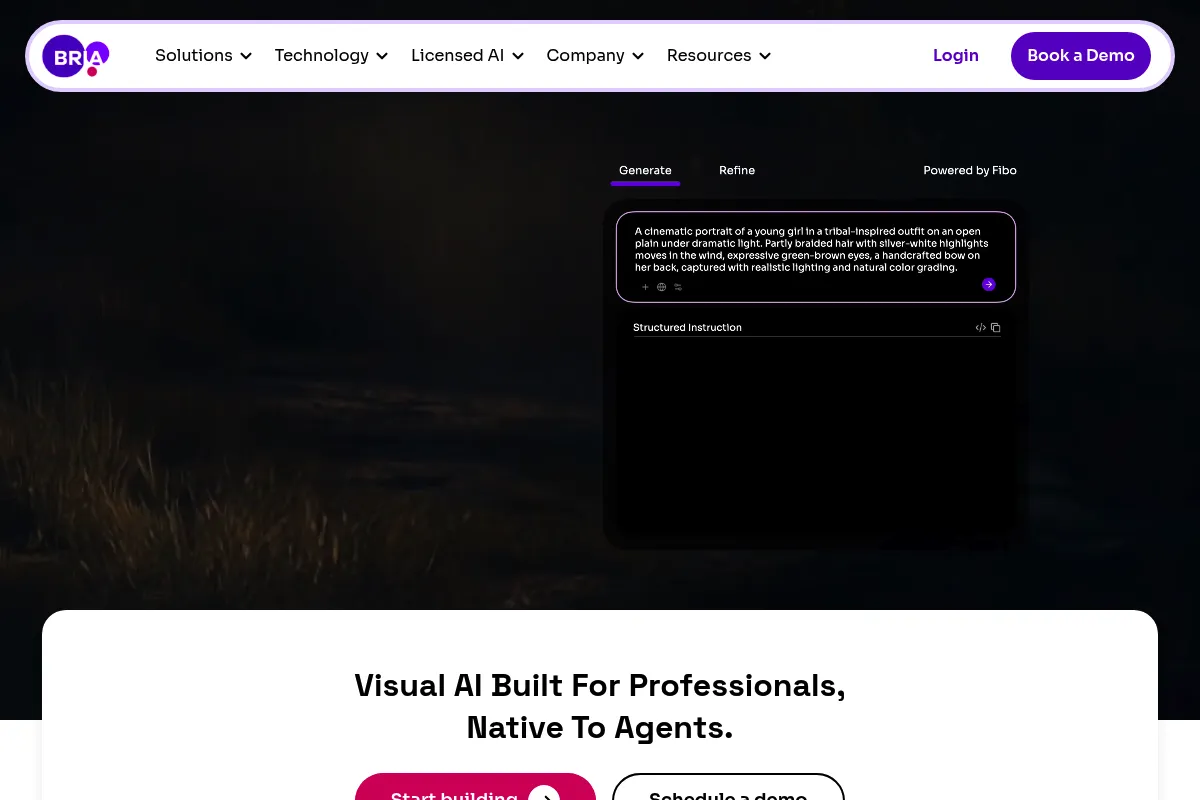
Bria is a generative AI visual engine designed specifically for commercial and enterprise applications. It provides a suite of APIs and SDKs that allow businesses to embed image generation and editing into their products while ensuring all training data is licensed and ethically sourced.
Official profiles
What it actually does
It generates and modifies high-quality images using text prompts or existing assets. Beyond simple generation, it offers granular control over image components like backgrounds, facial expressions, and object placement through a developer-centric interface.
What makes it different
Unlike Midjourney or Stable Diffusion, Bria is built on a 'Responsible AI' foundation where every image used to train their models is licensed. They offer a revenue-sharing model for original creators and provide full legal protection for commercial use, addressing the primary barrier to enterprise AI adoption.
Ratings across the web
Ratings aggregated from independent review platforms.
Key Features
Licensed Training Data
Ensures all outputs are commercially safe and legally defensible.
API-First Architecture
Allows developers to bake generative features into existing SaaS workflows.
Attribution Engine
Tracks and compensates the original creators of the training data.
Facial Expression Control
Adjusts specific emotions or gaze directions without regenerating the whole image.
Background Management
Automates the removal and replacement of product backgrounds for e-commerce.
Generative Expand
Extends image borders while maintaining stylistic consistency.
Pricing
Starter
- 1,000 credits per month
- Non-commercial use only
- Access to web platform
- Standard support
Basic
- 1,000 credits per month
- Commercial use rights
- API access
- No watermarks
Pro
- 10,000 credits per month
- Advanced API features
- Priority support
- Early access to new models
Enterprise
- Unlimited or high-volume credits
- Full legal indemnity
- Custom model fine-tuning
- Dedicated account manager
Pricing checked 4 months ago
Pricing guidance
- When you need to remove watermarks for client work
- When your monthly API calls exceed 1,000 credits
- When your legal team requires formal indemnity (Enterprise only)
- Credits do not always roll over depending on the specific contract
- Indemnity is typically reserved for Enterprise-tier customers
- High-resolution upscaling consumes significantly more credits than standard generation
Competitively priced for developers, but moves into premium territory for full enterprise legal protection.
Pros & Cons
Strengths
-
Full Legal Indemnity
Bria protects users from copyright infringement claims, which is a non-negotiable requirement for large brands and public companies.
-
Developer-Centric Tooling
The API and SDK documentation is superior to most competitors, making it easier to build custom applications on top of their models.
-
Ethical Sourcing
By using only licensed data, Bria avoids the 'data theft' criticisms leveled at other major AI models, making it a safer choice for brand reputation.
Weaknesses
-
Aesthetic Ceiling
While high quality, the output often lacks the artistic nuance and hyper-realism found in Midjourney's latest versions.
Affects: Creative directors and high-end digital artists
-
Credit-Based Complexity
The pricing model relies on credits which can be difficult to forecast for high-volume API users.
Affects: Finance and operations teams
-
Limited Web UI
The browser-based interface is functional but lacks the deep editing features found in Adobe Firefly's Photoshop integration.
Affects: Solo designers and non-technical users
Real User Sentiment
Generally positive among developers and corporate users who value compliance over pure artistic experimentation.
Users tend to like
- API reliability and documentation
- Peace of mind regarding copyright
- Effective background removal tools
- Fair compensation model for artists
Users commonly complain about
- Web interface feels a bit clinical
- Prompt adherence can be inconsistent compared to DALL-E 3
- Pricing can scale quickly for high-volume image processing
Recurring tradeoffs
- Users trade the 'infinite' creative variety of scraped models for the safety of licensed ones.
Happiest users
Product managers building e-commerce tools or marketing automation platforms.
Often frustrated
Digital artists trying to push the boundaries of surrealism or complex character design.
Use Cases
E-commerce Platforms
Automatically generating lifestyle backgrounds for product shots via API.
Stock Photo Sites
Offering AI-powered 'variations' of existing licensed images to customers.
Marketing Agencies
Creating brand-safe social media assets at scale without copyright risk.
App Developers
Integrating a 'remove background' or 'upscale' button into a mobile photo editor.
Corporate Communications
Generating internal presentation visuals that meet strict compliance standards.
Frequently Asked Questions
Is Bria.ai actually free?
Bria offers a Starter plan that is free for non-commercial use and testing, providing 1,000 credits per month. However, any business use or removal of watermarks requires a paid subscription starting at $9/month.
How does Bria compare to Adobe Firefly?
Both prioritize 'safe' training data. Firefly is better integrated into creative workflows (Photoshop/Illustrator), while Bria is superior for developers who need to build their own applications using a robust API and SDK.
What does 'commercially safe' actually mean here?
It means Bria only trains its models on images they have the legal right to use. For Enterprise customers, they provide legal indemnity, meaning they will defend you in court if an image generated by their tool is ever sued for copyright infringement.
Can I fine-tune Bria on my own brand assets?
Yes, Bria offers model fine-tuning capabilities, primarily at the Enterprise level, allowing brands to ensure generated images strictly adhere to their specific visual identity and style guides.
Does Bria support video generation?
As of now, Bria is primarily focused on 2D image generation and editing. While they are expanding their research, they do not currently offer a commercial text-to-video API comparable to tools like Runway or Sora.
What integrations are available for Bria?
Bria is designed to be integrated rather than to integrate with others. It provides Python and JavaScript SDKs, making it compatible with almost any modern web or mobile application stack.
Why trust this page?
This evaluation combines product positioning, pricing analysis, traffic and market signals, and public user sentiment into a single decision-support page. Content is generated editorially — not copied from the vendor's website.
Funding & Company
Founded
2020
Stage
Series b
Total Raised
$65M
Latest Round
Series B (Mar 2025)
Notable Investors
Bria has raised a total of $65 million, closing a significant $40 million Series B round in March 2025. The company is backed by a mix of prominent venture capital firms like Red Dot Capital and corporate investors such as Intel Capital and Getty Images. This financial backing signals strong market confidence in its strategy of providing a commercially safe, legally vetted generative AI platform.
Market Signals & Traffic
Estimated visits, global rank, geography, traffic sources, monthly visit trends, and organic search keywords (Similarweb)—on a dedicated page built for depth and search.
- Estimated visits
- 0
- Global rank
- —
- Snapshot
- May 2026
- Traffic trend
- Surging
Estimated monthly visits
Alternatives to Bria
View all alternativesMidjourney
Content Creation

AI tool that generates images from natural language text prompts.
Adobe Firefly
Content Creation, Video Creation

Generative AI tools for creating and editing images, video, and more.
Runway ML
Video Creation, Content Creation

AI-powered creative suite for generating and editing video, images, and audio.
Similar Tools
Civitai
Content Creation, Design, Developer Tools

Community platform for sharing and discovering generative image models
Minimax / Hailuo AI
Video Creation, Content Creation, AI Assistant

AI tool to generate high-quality videos from text or images.
Yepic AI
Video Creation, AI Assistant

AI-powered platform for creating, dubbing, and personalizing videos.
Skyvern
Automation, Automation & Agents, Productivity

AI-powered browser automation for complex web workflows.
Make AI
Automation & Agents, Developer Tools
Visual platform to connect apps and automate workflows without code.
Intrinsic
Automation, Developer Tools, Workflow

Software platform for industrial robotics and automated manufacturing