

Profluent
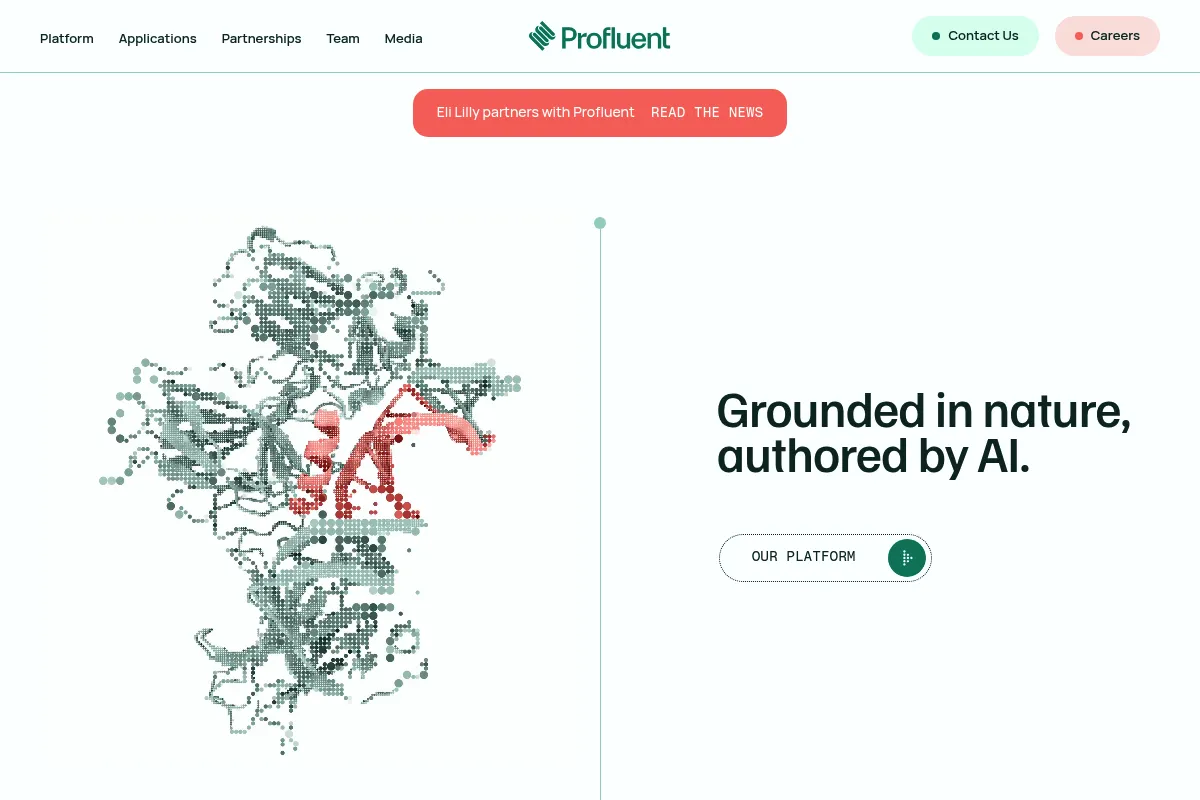
A generative AI platform for de novo protein design that creates functional, synthetic sequences for therapeutics and gene editing rather than just predicting natural structures.
Best for biopharma R&D teams needing novel protein scaffolds, weaker for labs lacking the infrastructure for high-throughput wet-lab validation.
Analysis based on product data, pricing structure, traffic signals, and public user sentiment.
Who Should Use Profluent?
Typical users
Biotechnology R&D departments, synthetic biologists, and pharmaceutical researchers focused on drug discovery and gene therapy.
Maturity fit
advanced
Choose this if…
- Your priority is generating entirely novel proteins rather than searching natural databases
- You want to design custom gene editors like CRISPR with specific functional constraints
- You have the wet-lab capacity to validate AI-generated sequences at scale
Skip this if…
- You need a low-cost, self-service tool for basic protein visualization
- Your workflow requires a tool with public, transparent per-user pricing
- You lack the biological testing infrastructure to verify synthetic protein functionality
About Profluent
Profluent is a biotechnology company that treats biology as a language, using large language models (LLMs) to design proteins from scratch. Founded by the lead of Salesforce Research’s ProGen project, it aims to move drug discovery beyond the limitations of natural evolution. The platform focuses on creating functional, de novo proteins tailored to specific therapeutic needs.
Official profiles
What it actually does
The platform generates novel protein sequences and gene editors by training on massive datasets of biological data. Users can specify desired functional traits, and the AI outputs synthetic sequences designed to perform those functions in a laboratory setting.
What makes it different
Unlike AlphaFold, which primarily predicts how a known sequence folds, Profluent focuses on the inverse: generating new sequences that achieve a specific function. Their release of OpenCRISPR-1 demonstrated the ability to create the first fully AI-generated, functional gene editor, proving their models can move from digital design to biological activity.
Key Features
ProGen Model Architecture
Uses LLM logic to learn the grammar of protein sequences for high-accuracy generation.
OpenCRISPR-1
An open-source, AI-designed gene editor that serves as a benchmark for the platform's capabilities.
Functional Tuning
Allows researchers to steer protein generation toward specific parameters like heat stability or binding affinity.
Sequence Diversity Engine
Generates candidates that are evolutionarily distinct from natural proteins to avoid existing IP.
Wet-lab Integration Loops
Designed to ingest experimental data to refine and improve subsequent generation rounds.
Multi-modal Biological Training
Incorporates diverse data types beyond just sequences to improve functional hit rates.
Pricing
Contact Sales
- Full access to generative protein design models
- Custom model training on proprietary data
- Collaborative R&D support
- Enterprise-grade security and data isolation
Pricing checked 4 months ago
Pricing guidance
- When moving from theoretical research to drug candidate development
- When proprietary data needs to be integrated into the training loop
- When seeking commercial rights for AI-generated sequences
- Commercial licensing terms for generated sequences are negotiated individually
- Computational costs may be bundled or separate depending on the agreement
Premium enterprise positioning typical of high-end biotech platforms.
Pros & Cons
Strengths
-
High functional success rates
Peer-reviewed research shows their generated proteins often match or exceed the performance of natural counterparts in lab tests.
-
Expands the searchable protein space
Enables discovery of proteins that natural evolution never produced, potentially unlocking new therapeutic pathways.
-
Strong scientific validation
The team has a track record of publishing in high-impact journals like Nature Biotechnology, providing more credibility than typical AI startups.
Weaknesses
-
Opaque pricing and access
There is no self-service tier; access requires high-level enterprise partnerships which excludes smaller independent labs.
Affects: Early-stage startups and academic researchers
-
Requires significant downstream validation
An AI-generated sequence is only a hypothesis; users still face the high cost and time of physical lab testing.
Affects: Teams with limited wet-lab budgets
-
High technical complexity
Interpreting and selecting the best candidates from AI-generated libraries requires deep expertise in computational biology.
Affects: Non-specialist biology teams
Real User Sentiment
The scientific community views Profluent as a serious contender in generative biology, praising their focus on functional validation over mere structural prediction.
Users tend to like
- The shift from predictive to generative workflows
- The transparency of their OpenCRISPR-1 release
- The high quality of their published research
Users commonly complain about
- Lack of a public-facing API for smaller developers
- High barrier to entry for non-enterprise users
- Complexity of the output sequences
Recurring tradeoffs
- Users trade the simplicity of natural sequence search for the high-risk, high-reward potential of de novo design.
Happiest users
Large pharmaceutical companies looking to diversify their drug pipelines with novel, patentable proteins.
Often frustrated
Academic researchers or small biotech startups who want to experiment with the models without a full enterprise contract.
Use Cases
Therapeutic Antibody Design
Creating novel antibodies with higher specificity and fewer side effects.
Enzyme Engineering
Designing synthetic enzymes for industrial processes that require high heat tolerance.
Gene Therapy
Developing custom CRISPR-like editors to target specific genetic mutations with high precision.
Vaccine Development
Generating stable protein antigens that trigger a stronger immune response.
Biomaterial Science
Creating new proteins with specific structural properties for use in medical implants.
Frequently Asked Questions
How much does Profluent cost?
Profluent does not publish a standard price list. They operate on an enterprise partnership model where pricing is customized based on the scope of the research, the number of targets, and the level of support required. Expect costs to be in the enterprise range, typical for specialized biotech R&D software.
How does Profluent differ from AlphaFold?
AlphaFold, developed by Google DeepMind, is primarily a 'folding' tool that predicts the 3D structure of a known protein sequence. Profluent is a 'generative' tool that creates entirely new sequences from scratch based on a desired function. While AlphaFold tells you what a protein looks like, Profluent helps you build a protein that does something specific.
Can I use Profluent for free?
The full commercial platform is not free. However, Profluent has open-sourced OpenCRISPR-1, which includes the sequence and weights for an AI-generated gene editor. This allows researchers to examine and test their technology's output without a paid contract, provided they follow the open-source license terms.
What is OpenCRISPR-1?
OpenCRISPR-1 is the world's first high-performance, AI-generated gene editor released by Profluent. It was designed using their LLM technology to perform similarly to natural CRISPR-Cas9 but with a synthetic sequence. It serves as a 'proof of concept' that their generative models can produce viable biological tools.
Do I need a wet-lab to use Profluent?
While you can generate sequences digitally, those sequences are useless without physical validation. Profluent is most effective for organizations that have a 'design-build-test' loop, where the AI designs the protein and a laboratory builds and tests it to confirm it works as predicted.
What kind of data does Profluent train on?
Profluent trains on massive datasets encompassing billions of protein sequences from across the tree of life. This includes public databases like UniProt, as well as proprietary datasets and functional data that help the model understand the relationship between a protein's 'text' (sequence) and its 'meaning' (function).
Why trust this page?
This evaluation combines product positioning, pricing analysis, traffic and market signals, and public user sentiment into a single decision-support page. Content is generated editorially — not copied from the vendor's website.
Funding & Company
Founded
2022
Stage
Series b
Total Raised
$150M
Latest Round
Series B (Nov 2025)
Notable Investors
Profluent has raised a total of $150 million across three rounds, culminating in a $106 million Series B in late 2025. This substantial backing from high-profile investors like Bezos Expeditions and Altimeter Capital signals strong confidence in its AI-driven protein design platform and provides significant operational runway.
Market Signals & Traffic
Estimated visits, global rank, geography, traffic sources, monthly visit trends, and organic search keywords (Similarweb)—on a dedicated page built for depth and search.
- Estimated visits
- 8,687
- Global rank
- #2,463,562
- Snapshot
- Apr 2026
- Traffic trend
- Surging
Estimated monthly visits
Alternatives to Profluent
View all alternativesSimilar Tools
Cradle
Research, Health & Wellness

Design and optimize protein sequences for biotechnology and research.
Inceptive
Research, Health & Wellness
Designing novel RNA molecules for next-generation biological medicines.
Terray Therapeutics
Research, Health & Wellness

Generative platform for large-scale small molecule drug discovery.
Atomic AI
Research, Health & Wellness

Platform for RNA-targeted drug discovery and structural biology research
Predibase
Developer Tools

Fine-tune and serve custom large language models at scale.
Meshy AI
Content Creation, Developer Tools, Design

AI-powered platform for generating 3D models and textures from text and images.