

A specialized e-commerce price monitoring tool that automates competitor tracking and price adjustments—strong for mid-market retailers on Shopify or Magento, but expensive for high-SKU catalogs.
Best fit for scaling e-commerce brands needing automated dynamic pricing, weaker for large-scale enterprises with 10,000+ SKUs on a budget.
Analysis based on product data, pricing structure, traffic signals, and public user sentiment.
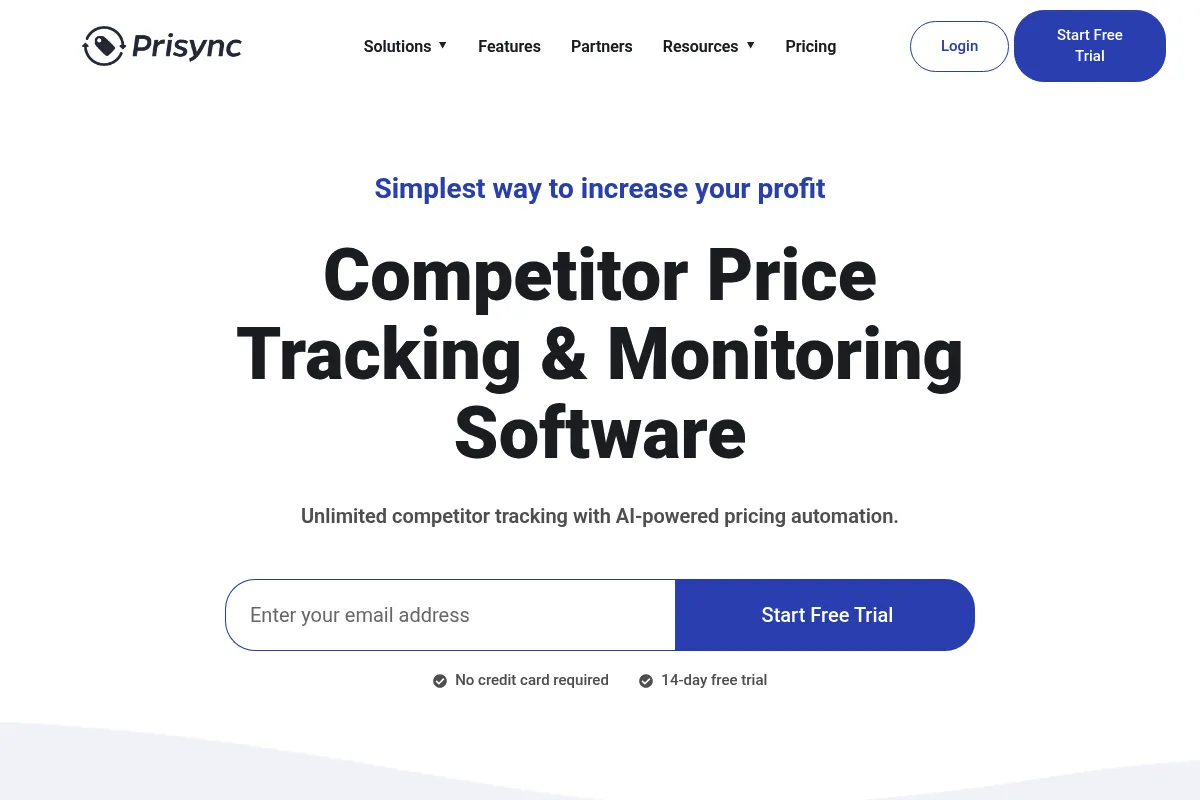
Who Should Use Prisync?
Typical users
E-commerce managers, small-to-medium retail owners, and category managers at digital-first brands.
Maturity fit
scaling to advanced
Choose this if…
- You need to automate price changes based on competitor moves without manual spreadsheet updates.
- Your priority is a fast setup with native Shopify, Magento, or WooCommerce integrations.
- You want to track an unlimited number of competitors for a specific set of products.
Skip this if…
- You have a massive inventory (10,000+ SKUs) and a limited budget, as per-SKU pricing scales quickly.
- You require real-time price updates every few minutes; lower tiers only refresh a few times daily.
- You need deep internal inventory management or ERP features beyond pricing data.
About Prisync
Prisync is a SaaS-based price tracking and dynamic pricing engine built specifically for the e-commerce sector. It automates the process of monitoring rival prices and stock levels, allowing retailers to react to market changes instantly. The tool exists to replace manual web scraping and spreadsheet-based price management.
Official profiles
What it actually does
It crawls competitor websites to extract price and stock data, centralizing this information in a dashboard. Users can set automated pricing rules that push updated prices directly to their e-commerce storefronts via API or native integrations.
What makes it different
Prisync differentiates itself through its 'Unlimited Competitors' policy; unlike many rivals that charge per competitor tracked, Prisync charges based on your own SKU count. It also prioritizes ease of use with a 'SmartMatch' feature that helps automate the initial linking of your products to competitor pages.
Ratings across the web


Ratings aggregated from independent review platforms.
Key Features
Dynamic Pricing Engine
Automatically pushes price updates to your store based on rules like 'be the cheapest' or 'maintain 20% margin'.
SmartMatch
Uses internal algorithms to find and suggest competitor product links, reducing manual setup time.
Unlimited Competitor Tracking
Monitor as many rivals as you want for each product in your catalog without additional fees.
Stock Tracking
Alerts you when a competitor goes out of stock, identifying opportunities to raise prices and increase margins.
Price History
Tracks how competitor prices fluctuate over time to help identify seasonal discounting patterns.
Daily Reports
Sends a summary of market movements to your inbox every morning so you don't have to check the dashboard daily.
Batch Import/Export
Allows for bulk management of product lists via CSV or Excel for faster catalog updates.
Pricing
Professional
- Up to 100 products
- Unlimited competitors
- Price tracking & stock monitoring
- Daily email reports
- 3 updates per day
Premium
- Up to 1,000 products
- Dynamic pricing engine
- Daily price change alerts
- API access
- Stock tracking
Platinum
- Up to 5,000 products
- Instant price change alerts
- Price refresh on demand
- Advanced reporting
- Priority support
Pricing checked 5 months ago
Pricing guidance
- When your catalog exceeds 100 SKUs.
- When you want to automate price updates rather than just viewing data.
- When you need API access to feed data into other internal systems.
- Dynamic pricing is completely locked behind the Premium tier.
- The number of daily price refreshes is capped based on your plan level.
- SmartMatch automation is more limited on the entry-level Professional plan.
Premium positioning that justifies its cost through deep integrations and a hands-off automation experience.
Pros & Cons
Strengths
-
Native platform integrations
Direct apps for Shopify, Magento, and WooCommerce mean you can sync prices without writing custom code or using third-party connectors.
-
Predictable per-SKU pricing
Because they don't charge per competitor, it is highly cost-effective for niche retailers who compete against a large number of small players.
-
Responsive customer support
Users consistently report high satisfaction with the support team's ability to help with custom scraping requests or technical setup.
Weaknesses
-
Aggressive price scaling
The jump from 1,000 SKUs to 5,000 SKUs is significant, making it one of the more expensive options for mid-to-large catalogs.
Affects: Retailers with large, low-margin inventories
-
Update frequency limitations
The entry-level plan only updates prices three times per day, which may be too slow for highly volatile markets like electronics.
Affects: High-frequency traders and competitive electronics retailers
-
Occasional data lag
Like all scraping tools, if a competitor changes their site structure, the data feed can break until the scraper is updated.
Affects: Users tracking niche or non-standard e-commerce sites
Real User Sentiment
Generally positive, with users praising the time saved on manual tracking, though some find the price jumps between tiers difficult to swallow.
Users tend to like
- Clean and intuitive dashboard UI
- Speed of the initial setup process
- Reliability of the Shopify integration
- Helpful customer success managers
Users commonly complain about
- High cost for retailers with many low-value SKUs
- Occasional errors in product matching
- Lack of a free-forever tier for very small shops
Recurring tradeoffs
- You trade a higher monthly fee for a significantly lower manual workload compared to cheaper, more manual scraping tools.
Happiest users
Shopify store owners with 100-1,000 high-margin products who face intense price competition.
Often frustrated
Large-scale dropshippers with thousands of low-margin items who find the per-SKU cost eats their entire profit.
Use Cases
Margin Protection
Setting price floors to ensure dynamic pricing never drops your price below a profitable level.
Stock-Out Exploitation
Automatically raising your prices when all major competitors show 'Out of Stock' for a high-demand item.
Market Entry Analysis
Tracking a new competitor's pricing strategy for a month before deciding on your own launch price.
Promotional Monitoring
Seeing how rivals react to your weekend sales in real-time.
MAP Monitoring
Brands using it to ensure their authorized resellers are not dropping prices below the Minimum Advertised Price.
Frequently Asked Questions
Does Prisync have a free plan?
No, Prisync does not offer a free-forever plan. They provide a 14-day free trial that includes all features, but after that, you must subscribe to one of the paid tiers starting at $99/month.
How does Prisync compare to Price2Spy?
Prisync is generally easier to set up and has a more modern UI, making it better for SMBs. Price2Spy is often considered more flexible for complex enterprise needs and custom scraping requirements, but it has a steeper learning curve.
Can Prisync track prices on Amazon and eBay?
Yes, Prisync can track prices on major marketplaces like Amazon, eBay, and Google Shopping, as well as individual competitor websites. However, marketplace tracking can sometimes be more complex due to multiple sellers on a single listing.
What are the SKU limits for each plan?
The Professional plan covers up to 100 products, Premium covers up to 1,000, and Platinum covers up to 5,000. If you have more than 5,000 products, you will need to contact them for an Enterprise quote.
Does it automatically change my prices?
Yes, but only on the Premium and Platinum plans. The entry-level Professional plan only tracks prices and alerts you; it does not have the dynamic pricing engine required to push updates to your store.
How often does Prisync update competitor data?
The update frequency depends on your plan. The Professional and Premium plans typically update data 3-4 times per day. The Platinum plan offers more frequent updates and the ability to refresh data on demand.
Why trust this page?
This evaluation combines product positioning, pricing analysis, traffic and market signals, and public user sentiment into a single decision-support page. Content is generated editorially — not copied from the vendor's website.
Funding & Company
Founded
2013
Stage
Seed
Total Raised
$1.27M
Latest Round
Seed (Jan 2020)
Notable Investors
Prisync has raised a total of $1.27 million over two seed rounds, with the most recent being $1.1 million in January 2020. The company has not announced any further funding in the six years since, suggesting a focus on sustainable growth through revenue.
Market Signals & Traffic
Estimated visits, global rank, geography, traffic sources, monthly visit trends, and organic search keywords (Similarweb)—on a dedicated page built for depth and search.
- Estimated visits
- 101,926
- Global rank
- #328,992
- Snapshot
- Mar 2026
- Traffic trend
- Rising
Estimated monthly visits
Similar Tools
Anara AI
Music Marketing, Productivity, Automation

Music rights management and sync licensing platform for artists.
Gumloop
Automation & Agents, Productivity

No-code platform for building AI agents and automating complex workflows.
Raycast
Productivity, Developer Tools, AI Assistant

A keyboard-first productivity launcher for managing applications and automated workflows.
Icons8 AI
Content Creation, Design, Productivity

Vast library of icons, illustrations, photos, music, and AI design tools.
MarqVision
E-commerce, Privacy & Compliance, Automation

Automated brand protection and intellectual property enforcement platform.
Letta
Developer Tools, Automation & Agents

Build stateful agents with persistent long-term memory and context.