

Symbolic
An enterprise content governance platform that encodes editorial standards into AI workflows—best for high-volume publishers, overkill for small marketing teams.
Excellent for maintaining strict brand voice and factual accuracy across large teams, weaker for creative brainstorming or solo content creation.
Analysis based on product data, pricing structure, traffic signals, and public user sentiment.
Who Should Use Symbolic?
Typical users
Editorial directors and content managers at mid-to-large media companies or enterprise marketing departments managing 20+ contributors.
Maturity fit
advanced
Choose this if…
- You need to enforce a complex style guide across a large, distributed team
- Your content is fact-heavy and requires rigorous verification before publishing
- Your priority is protecting intellectual property while using LLMs
Skip this if…
- You are a solo creator or small agency with low-stakes content
- You primarily need a tool for creative ideation rather than editorial oversight
- Your workflow is simple enough that a shared Google Doc style guide suffices
About Symbolic
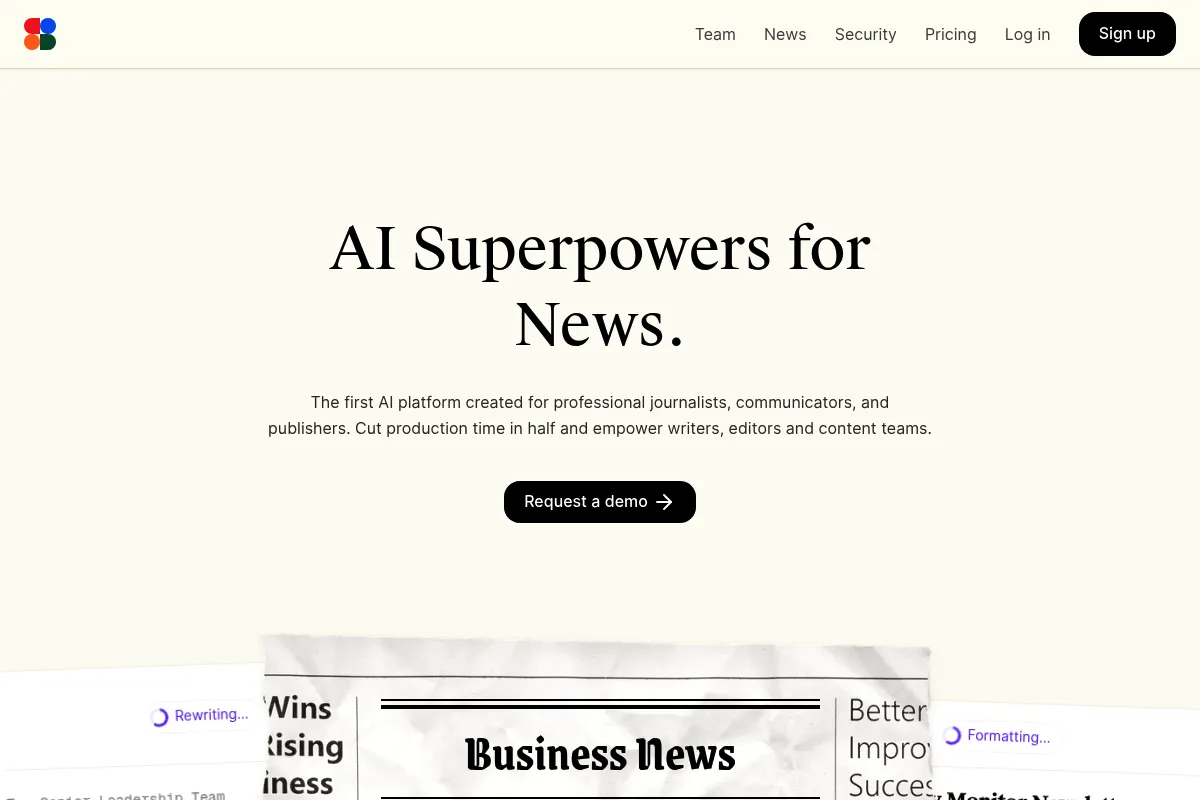
Symbolic is a workflow-centric AI platform designed to digitize institutional editorial knowledge. It moves beyond simple text generation by focusing on the specific standards, tone, and history of a professional publishing house.
Official profiles
What it actually does
It audits drafts against internal style guides, automates claim-by-claim fact-checking, and routes content through approval chains based on detected complexity. It functions as an automated assistant editor that learns from an organization's past editorial decisions.
What makes it different
Unlike general-purpose writing assistants, Symbolic prioritizes 'institutional memory.' It treats editorial standards as structured data, allowing the AI to learn from previous corrections and specific brand nuances that generic models miss.
Key Features
Institutional Memory
Learns from past editorial decisions to prevent recurring errors in brand voice.
Automated Fact-Checking
Cross-references claims against trusted internal and external databases to speed up verification.
Style Auditing
Flags deviations from specific brand voice or legal requirements in real-time.
Smart Task Routing
Automatically assigns content to specific editors based on detected complexity or subject matter.
IP Protection
Ensures all training data and outputs remain within a private, secure environment.
Content Scoring
Provides a quantitative 'readiness' score based on adherence to organizational standards.
Pricing
Enterprise
- Full institutional memory training
- Automated fact-checking
- Custom workflow routing
- Dedicated account management
- Private cloud deployment options
Pricing checked 5 months ago
Pricing guidance
- When manual editorial oversight becomes a bottleneck for growth
- When brand consistency starts to slip across different departments
- When fact-checking requirements increase due to legal or regulatory shifts
- Implementation time can take weeks depending on the volume of institutional data
- Fact-checking accuracy depends on the quality of the connected data sources
Premium enterprise positioning justified by the depth of customization and security.
Pros & Cons
Strengths
-
High consistency at scale
Ensures that 100 different writers produce content that sounds like a single brand voice without manual oversight on every draft.
-
Reduced legal and reputational risk
The automated fact-checking layer catches objective errors that human editors might miss during high-volume production cycles.
-
Workflow bottleneck identification
Smart routing and auditing data reveal exactly where content gets stuck in the production pipeline.
Weaknesses
-
High initial setup overhead
The system requires significant input of past content and style guides to 'learn' institutional knowledge effectively.
Affects: Teams looking for an immediate out-of-the-box solution
-
Opaque pricing
Lack of public pricing tiers makes it difficult for mid-market teams to assess budget fit without a sales call.
Affects: Procurement and department heads
-
Niche focus
The tool is heavily optimized for publishing workflows; it lacks the broad creative features found in general marketing AI tools.
Affects: Generalist marketing teams
Real User Sentiment
Generally positive among enterprise users who value the focus on accuracy over pure generation.
Users tend to like
- The ability to 'teach' the AI specific brand quirks
- Reduction in manual fact-checking time
- Security and IP protection features
Users commonly complain about
- Steep learning curve for setting up complex workflows
- Requires a high volume of data to reach peak accuracy
Recurring tradeoffs
- Users trade the 'magic' of instant creative generation for the 'control' of a governed editorial process.
Happiest users
Editorial directors at large media houses who need to maintain standards across hundreds of articles per week.
Often frustrated
Small teams or solo freelancers who find the configuration and workflow management too cumbersome for their needs.
Use Cases
Media Houses
Maintaining a unified voice across multiple digital publications.
Corporate Communications
Ensuring all press releases and internal memos adhere to strict legal and brand guidelines.
Technical Publishing
Automating the verification of technical claims and data points in whitepapers.
Content Agencies
Managing the specific style requirements of dozens of different clients simultaneously.
Legal/Compliance Teams
Auditing external-facing content for regulatory compliance before it goes live.
Frequently Asked Questions
How much does Symbolic cost?
Symbolic does not publish a standard price list. It is sold as an enterprise solution with custom pricing based on the size of the organization, the volume of content, and the depth of the institutional knowledge integration required.
How does Symbolic compare to Writer.com?
While both target enterprises, Writer.com is a broader writing assistant. Symbolic is more focused on the publishing workflow, including smart task routing and deep institutional memory that learns from specific editorial corrections over time.
Does it integrate with CMS platforms like WordPress?
Yes, Symbolic is designed to sit within the publishing stack and typically integrates with major enterprise CMS platforms and project management tools via API to ensure content flows through the audit process before being published.
Can it replace human fact-checkers?
It is designed to augment, not replace. It flags claims and provides sources, allowing human editors to verify the 'final mile' much faster than they could manually.
Is my data used to train public models?
No. Symbolic emphasizes IP protection, ensuring that your institutional knowledge and content are kept in a private environment and not used to train models for other customers.
Does it support languages other than English?
Symbolic primarily focuses on English for its advanced institutional memory and style auditing, though basic capabilities may extend to other languages depending on the underlying models used.
Why trust this page?
This evaluation combines product positioning, pricing analysis, traffic and market signals, and public user sentiment into a single decision-support page. Content is generated editorially — not copied from the vendor's website.
Funding & Company
Founded
2023
Stage
Seed
Total Raised
$11.9M
Latest Round
Seed (Apr 2026)
Symbolic.ai has raised a single Seed round of $11.9 million. This early-stage funding, combined with a strong founding team, provides a solid initial runway to develop its AI platform for the publishing industry.
Market Signals & Traffic
Estimated visits, global rank, geography, traffic sources, monthly visit trends, and organic search keywords (Similarweb)—on a dedicated page built for depth and search.
- Estimated visits
- 6,819
- Global rank
- #2,929,580
- Snapshot
- Apr 2026
- Traffic trend
- Steady
Estimated monthly visits
Alternatives to Symbolic
View all alternativesAcrolinx
Documentation, Privacy & Compliance, Content Creation

Enterprise content governance platform for brand consistency and quality.
Jasper
Content Creation, AI Assistant
AI-powered content creation platform for marketing and business teams.
Make AI
Automation & Agents, Developer Tools

Visual platform to connect apps and automate workflows without code.
Similar Tools
Pitch
Content Creation, Productivity, Design

AI-powered presentation software for collaborative teams.
n8n
Automation, Automation & Agents, Developer Tools

Workflow automation platform for connecting apps and building complex sequences.
Lovo AI
Content Creation, AI Assistant

AI voice generator and text-to-speech platform with video editing.
Alibaba Cloud (Qwen)
Developer Tools, Content Creation

Large language models for text generation, reasoning, and coding.
Manus
AI Assistant, Automation & Agents, Productivity

Autonomous general-purpose agent for executing complex digital tasks and workflows.
MiniMax
Content Creation, Video Creation, Music Generation

Multimodal platform for text, video, speech, and music generation