
Shield AI
A high-stakes autonomous flight system for military aircraft that prioritizes operation in GPS-denied and communications-jammed environments over traditional remote piloting.
Excellent for defense agencies requiring resilient swarm capabilities in contested airspace, but irrelevant for commercial or civilian drone applications.
Analysis based on product data, pricing structure, traffic signals, and public user sentiment.
Who Should Use Shield AI?
Typical users
Defense procurement officers, military tactical units, and aerospace engineers at major defense primes.
Maturity fit
advanced
Choose this if…
- Your mission environment involves heavy electronic warfare or GPS jamming.
- You need to operate large drone swarms with a minimal human footprint.
- Your priority is edge-based autonomy that doesn't rely on a satellite link.
Skip this if…
- You are looking for commercial or industrial inspection drones.
- Your budget is below the multi-million dollar defense contract threshold.
- You require a tool with a public API or open-source community support.
About Shield AI
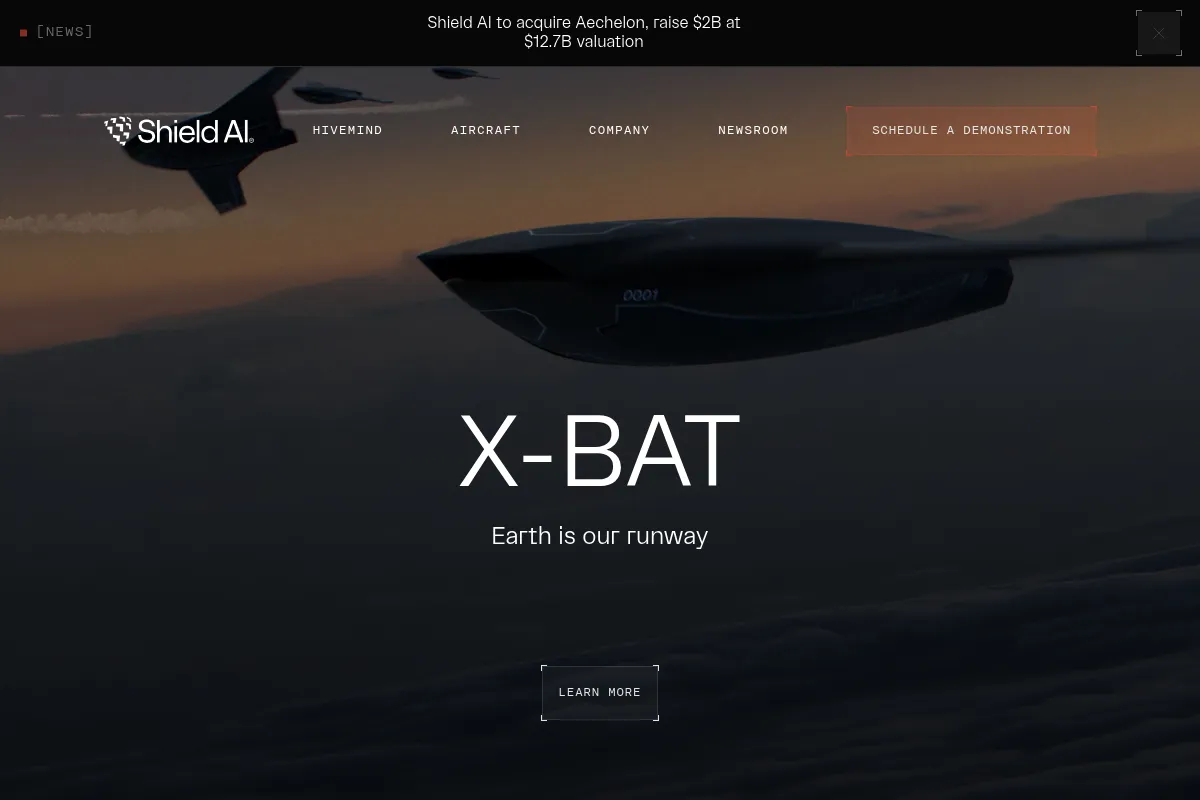
Shield AI develops Hivemind, an autonomous 'AI pilot' designed to operate aircraft without human intervention, GPS, or data links. It is built to solve the problem of drone vulnerability in modern electronic warfare by moving decision-making to the edge.
What it actually does
The software enables aircraft to navigate using computer vision and pre-loaded maps rather than satellites. It allows fleets of drones to coordinate maneuvers autonomously, reacting to threats and obstacles in real-time without waiting for instructions from a ground station.
What makes it different
Unlike most autonomous systems that rely on 'if-then' logic or remote pilots, Shield AI uses reinforcement learning to train its AI on complex maneuvers like dogfighting and building clearance. Its architecture is hardware-agnostic, meaning the same 'brain' can pilot a small quadcopter or a full-sized fighter jet.
Key Features
Hivemind
The core AI pilot software that replaces the human operator for tactical flight.
V-BAT Integration
Specialized support for long-endurance VTOL drones that don't require runways.
GPS-Denied Navigation
Uses visual sensors to determine location when satellite signals are blocked.
Comms-Contested Operation
Executes missions even when radio and satellite links are severed.
Collaborative Combat Aircraft (CCA)
Software designed to turn standard jets into autonomous 'wingmen'.
Modular Open Systems Approach (MOSA)
Allows the software to be integrated into various third-party airframes.
Pricing
Government/Defense Contract
- Hivemind AI Pilot license
- V-BAT hardware procurement
- On-site training and support
- Custom mission set development
- Classified data handling
Pricing checked 4 months ago
Pricing guidance
- Scaling fleet size for swarm operations
- Integrating Hivemind into new airframe types
- Requiring higher levels of mission-specific autonomy
- ITAR restrictions on international sales
- Strict security clearance requirements for personnel
- Hardware-specific maintenance cycles for V-BAT units
Premium defense-tier pricing justified by unique capabilities in contested environments.
Pros & Cons
Strengths
-
Resilience to Electronic Warfare
By removing the dependency on GPS and constant comms, the system remains operational in high-threat environments where other drones fail.
-
Reduced Cognitive Load
One operator can manage a swarm of aircraft because the AI handles the flight mechanics and tactical positioning autonomously.
-
High-Performance Validation
The software has been successfully tested in F-16s for autonomous dogfighting, proving it can handle high-G, high-speed tactical scenarios.
-
Runway Independence
The V-BAT hardware powered by Hivemind can launch and land in small, confined spaces, making it ideal for maritime or expeditionary use.
Weaknesses
-
Extreme Barrier to Entry
This is not a software-as-a-service; it requires government-level contracts and rigorous security clearances to access.
Affects: Small startups or non-defense entities
-
Hardware Lock-in for V-BAT
While the software is 'agnostic,' the most mature implementation is tied to their proprietary V-BAT hardware, which may limit fleet flexibility.
Affects: Operators with existing non-compatible drone fleets
-
Opaque Pricing and Procurement
Costs are buried in multi-year defense contracts, making it impossible for mid-market buyers to evaluate ROI without a formal RFP process.
Affects: Procurement teams and budget planners
Real User Sentiment
Highly respected within the defense tech community for delivering functional autonomy rather than just 'remote control' drones.
Users tend to like
- The ability to fly without GPS
- The vertical take-off capability of the V-BAT
- Successful real-world testing on high-performance jets
- The 'swarm' logic that actually works in the field
Users commonly complain about
- Slow procurement cycles typical of defense
- High cost compared to 'expendable' commercial drones
- Limited transparency on software limitations
Recurring tradeoffs
- Users trade human-in-the-loop control for mission resilience in jammed environments.
Happiest users
Military commanders needing ISR in areas where traditional drones are easily jammed.
Often frustrated
Commercial drone operators who want advanced autonomy but cannot clear the defense-only hurdle.
Use Cases
Maritime Surveillance
Launching V-BAT drones from ships to monitor large areas without needing a runway.
GPS-Denied Reconnaissance
Sending drones into urban or mountainous areas where satellite signals are unreliable.
Autonomous Wingman
Pairing autonomous F-16s with manned aircraft to increase combat mass.
Swarm Attacks
Deploying dozens of drones to overwhelm enemy air defenses simultaneously.
Building Clearance
Using small Hivemind-enabled drones to map and clear indoor structures autonomously.
Frequently Asked Questions
How much does a Shield AI V-BAT cost?
Pricing is not public, but typical defense contracts for small-to-medium UAS fleets range from several million to tens of millions of dollars depending on the number of airframes and the level of software integration.
Does Shield AI compete with Anduril?
Yes, Shield AI and Anduril are the two primary 'new-age' defense tech companies. While Anduril focuses heavily on the Lattice operating system for broad situational awareness, Shield AI specializes more deeply in the 'AI pilot' software for specific aircraft maneuvers.
Can Hivemind be installed on any drone?
Shield AI uses an open architecture, meaning it can be integrated into various airframes. However, this requires a deep engineering partnership and is currently limited to military-grade hardware like the V-BAT and the F-16.
Does it require a constant internet or satellite connection?
No. The core value proposition of Hivemind is that it operates entirely at the edge. Once a mission is launched, the aircraft can complete its objectives even if all external communications are lost.
Is Shield AI's software used in the Ukraine conflict?
While Shield AI has expressed support for Ukraine and its technology is designed for exactly that type of contested environment, specific operational deployments are generally classified or managed through official DoD channels.
What is the difference between Hivemind and a standard autopilot?
Standard autopilots follow pre-set waypoints and require GPS. Hivemind uses reinforcement learning to make tactical decisions, avoid obstacles, and navigate using visual cues, similar to how a human pilot thinks.
Why trust this page?
This evaluation combines product positioning, pricing analysis, traffic and market signals, and public user sentiment into a single decision-support page. Content is generated editorially — not copied from the vendor's website.
Funding & Company
Founded
2015
Stage
Late stage
Total Raised
$3.52B
Latest Round
Series G (Mar 2026)
Notable Investors
Shield AI has raised over $3.5 billion, culminating in a massive $2 billion round in March 2026, valuing the company at $12.7 billion. This significant and recent capital infusion from top-tier investors like Advent International, JPMorgan Chase, and Blackstone signals strong market confidence and provides substantial runway for product development and scaling operations.
Market Signals & Traffic
Estimated visits, global rank, geography, traffic sources, monthly visit trends, and organic search keywords (Similarweb)—on a dedicated page built for depth and search.
- Estimated visits
- 187,617
- Global rank
- #209,196
- Snapshot
- Apr 2026
- Traffic trend
- Surging
Estimated monthly visits
Alternatives to Shield AI
View all alternatives
Similar Tools
StackOne
Developer Tools, Automation, Marketing Automation

Unified API for HRIS, ATS, CRM, and marketing integrations.
MailerLite
Email Marketing, Marketing Automation, Website Builder

Email marketing and automation platform for creators and businesses.
DagsHub
Developer Tools, Workflow, Research

Collaboration platform for data science and machine learning teams
Setmore
Productivity, Automation, Communication

Online appointment scheduling and booking management for businesses.
Mem AI
Productivity, AI Assistant

AI-powered note-taking and knowledge management app.
Figure
Automation & Agents, Workflow

General-purpose humanoid robots designed for manual labor and automation.