Anduril
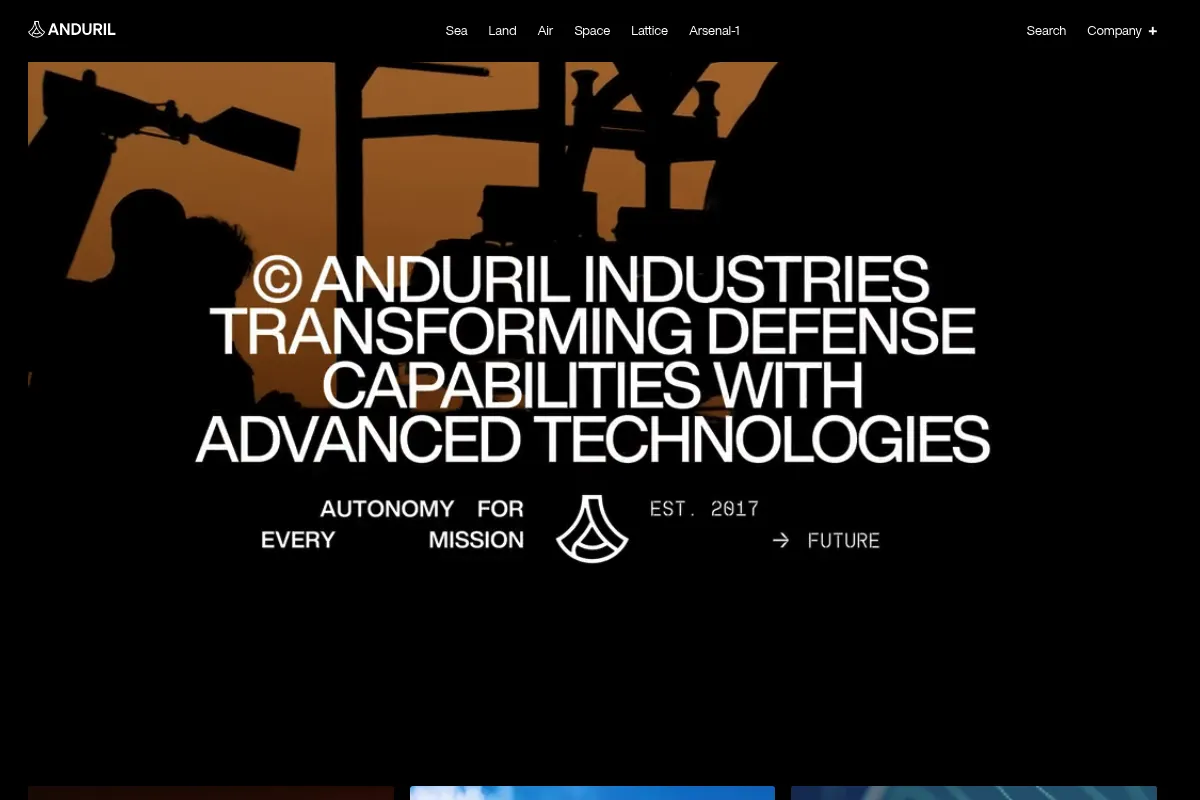
A software-first defense contractor that integrates autonomous hardware with a unified AI operating system for high-stakes military and border security operations.
Excellent for tactical sensor fusion and autonomous mission execution, but restricted strictly to government and national security entities.
Analysis based on product data, pricing structure, traffic signals, and public user sentiment.
Who Should Use Anduril?
Typical users
Defense procurement officers, border security agencies, and military command structures requiring real-time situational awareness.
Maturity fit
advanced
Choose this if…
- Your priority is reducing operator cognitive load through autonomous target identification.
- You need to unify data from disparate sensors (drones, towers, satellites) into a single tactical view.
- You require rapid deployment of hardware that iterates at the speed of software.
Skip this if…
- You are a commercial or civilian enterprise without a government mandate.
- Your organization has ethical or policy restrictions against the use of autonomous systems in defense.
- You lack the multi-million dollar budget required for national security-grade procurement.
About Anduril
Anduril is a defense technology company that applies Silicon Valley software engineering to national security. It builds autonomous systems—from underwater vehicles to interceptor drones—all powered by a central AI operating system designed to automate the 'kill chain' and surveillance tasks.
Official profiles
What it actually does
The company provides a suite of autonomous hardware (Ghost, Altius, Roadrunner) that connects to Lattice, an AI platform. Lattice ingests data from every available sensor, uses computer vision to identify objects of interest, and alerts human operators to make decisions.
What makes it different
Unlike traditional defense contractors that build to government specifications over decades, Anduril uses private capital to build finished products first. Their architecture is software-defined, meaning the hardware is secondary to the AI that controls it, allowing for faster updates and better interoperability than legacy systems.
Key Features
Lattice OS
The central software brain that automates data processing across all connected devices.
Roadrunner
A vertical takeoff and landing (VTOL) autonomous interceptor that is reusable if it doesn't engage.
Ghost Drone
A man-portable, silent sUAS that performs autonomous reconnaissance without a dedicated pilot.
Sentry Towers
Autonomous surveillance units that use AI to detect and track movement at borders.
Dive-LD
An autonomous underwater vehicle (AUV) designed for long-endurance maritime missions.
Altius
A family of agile, launched effects drones for intelligence, surveillance, and kinetic strikes.
Menace
A mobile command and control center for distributed operations in contested environments.
Pricing
Government & Defense Contracts
- Full Lattice OS deployment
- Custom hardware configurations (Ghost, Roadrunner, etc.)
- On-site support and training
- Classified data handling and security
- Continuous software and AI model updates
Pricing checked 4 months ago
Pricing guidance
- When expanding mission scope from surveillance to kinetic interception
- When requiring underwater or long-range aerial capabilities
- When scaling from a single site to national border coverage
- Export controls (ITAR) limit which countries can purchase specific hardware
- Hardware maintenance requires specialized Anduril technicians
- Integration with certain legacy systems may require additional custom engineering fees
Premium defense positioning where value is measured in mission success and reduced human risk rather than seat-based costs.
Pros & Cons
Strengths
-
Superior operator interface
Unlike legacy green-screen defense systems, Anduril's UI is intuitive, reducing the training time required for soldiers to manage complex autonomous fleets.
-
Rapid iteration cycles
Software updates are pushed frequently to hardware in the field, allowing the systems to adapt to new threats faster than traditional hardware-heavy platforms.
-
Hardware-agnostic integration
Lattice can ingest data from third-party sensors and legacy military equipment, preventing vendor lock-in for the entire sensor ecosystem.
-
Reduced personnel requirements
Automation allows a single operator to manage multiple autonomous assets, effectively acting as a force multiplier for small teams.
Weaknesses
-
Strictly limited market
The tool is unavailable for commercial use, meaning its high-end computer vision and sensor fusion cannot be applied to civilian logistics or security.
Affects: Commercial enterprises and private security firms
-
High ethical and political scrutiny
The use of AI in kinetic (lethal) contexts brings significant reputational risk and regulatory hurdles that traditional software does not face.
Affects: Policy makers and international partners
-
Opaque pricing and procurement
There is no standardized pricing; costs are tied to massive government contracts, making it impossible for smaller agencies to estimate budget needs without formal engagement.
Affects: Smaller government agencies or local law enforcement
Real User Sentiment
Generally viewed as the leader in the 'Defense Tech' movement, blending Silicon Valley speed with military-grade reliability.
Users tend to like
- Modern, video-game-like user interfaces
- Speed of delivery compared to Raytheon or Lockheed
- Effectiveness of autonomous target tracking
- The 'build first, sell later' business model
Users commonly complain about
- Ethical concerns regarding autonomous weapons
- High cost of specialized hardware
- Perceived 'black box' nature of some AI decision-making
Recurring tradeoffs
- Users trade manual control for autonomous speed, which requires high trust in the AI's classification accuracy.
Happiest users
Field operators who need to monitor large areas with minimal staff and modern software interfaces.
Often frustrated
Ethical watchdogs and procurement officers accustomed to the traditional, slow, and highly documented cost-plus contracting model.
Use Cases
Border Surveillance
Using Sentry Towers to automatically detect and classify cross-border activity.
Counter-Drone Defense
Deploying Roadrunner to intercept and destroy hostile UAS threats autonomously.
Maritime Domain Awareness
Utilizing Dive-LD for long-range underwater scouting and mine detection.
Special Operations Recon
Using Ghost drones for silent, autonomous overwatch during tactical missions.
Integrated Air Defense
Connecting multiple radar and sensor feeds into Lattice to coordinate missile defense.
Frequently Asked Questions
Can I buy an Anduril drone for private security?
No. Anduril currently only sells to government agencies, military branches, and authorized national security partners. Their products are subject to strict export and usage regulations (ITAR) and are not available for civilian or commercial purchase.
How does Anduril Lattice compare to Palantir Gotham?
While both are AI-driven platforms for defense, Palantir Gotham focuses more on data analytics, intelligence, and 'big picture' investigative links. Anduril Lattice is more tactical and 'edge' focused, directly controlling hardware like drones and sensors to provide real-time situational awareness on the battlefield.
Is Anduril's AI fully autonomous in lethal situations?
Anduril systems are designed to automate the detection and tracking of targets, but the company maintains that a 'human-in-the-loop' is required for lethal decisions. The AI identifies the threat, but a human operator must authorize the use of force.
What is the price of a Ghost drone?
Anduril does not publish a price list. Costs are typically bundled into larger service or procurement contracts that include the Lattice software, maintenance, and support. These contracts often range from millions to hundreds of millions of dollars.
Does Anduril integrate with existing military hardware?
Yes, one of the core strengths of the Lattice OS is its ability to integrate with third-party and legacy sensors, cameras, and communication networks, allowing it to act as a unifying layer for existing defense infrastructure.
Where is Anduril hardware manufactured?
Anduril designs and manufactures much of its hardware in the United States, specifically at its headquarters in Costa Mesa, California, to ensure supply chain security for its government clients.
Why trust this page?
This evaluation combines product positioning, pricing analysis, traffic and market signals, and public user sentiment into a single decision-support page. Content is generated editorially — not copied from the vendor's website.
Funding & Company
Founded
2017
Stage
Late stage
Total Raised
$11.35B
Latest Round
Series D+ (May 2026)
Notable Investors
Anduril has raised over $11.3 billion, positioning it as one of the most well-capitalized private defense technology firms globally. Its massive, successive funding rounds, including a $5 billion Series H in May 2026, signal strong investor confidence and provide substantial capital for long-term R&D and large-scale manufacturing.
Market Signals & Traffic
Estimated visits, global rank, geography, traffic sources, monthly visit trends, and organic search keywords (Similarweb)—on a dedicated page built for depth and search.
- Estimated visits
- 554,667
- Global rank
- #80,154
- Snapshot
- Apr 2026
- Traffic trend
- Cooling
Estimated monthly visits
Alternatives to Anduril
View all alternatives
Similar Tools
Sanctuary AI
Automation & Agents, Research

General-purpose humanoid robots designed to perform diverse physical tasks.
Visme
Content Creation, Design, Productivity

All-in-one platform for creating presentations, infographics, and visual content.
Alpha Drive AI
Developer Tools, Research, Automation

Cloud-based testing and validation platform for autonomous driving algorithms.
Doubao
AI Assistant, Content Creation, Search

Versatile personal assistant for chat, content creation, and image generation.
Surfer SEO
Content Creation, Productivity

AI-powered tool for data-driven content optimization and SEO.
mixedbread ai
Developer Tools, Search

High-performance embedding and reranking models for semantic search.