

An enterprise-grade PIM that manages the full product lifecycle from sourcing to circularity, best for global manufacturers with complex data models but overkill for simple e-commerce operations.
Excellent for complex multi-channel manufacturers needing regulatory compliance, weaker for small teams seeking a low-cost, plug-and-play solution.
Analysis based on product data, pricing structure, traffic signals, and public user sentiment.
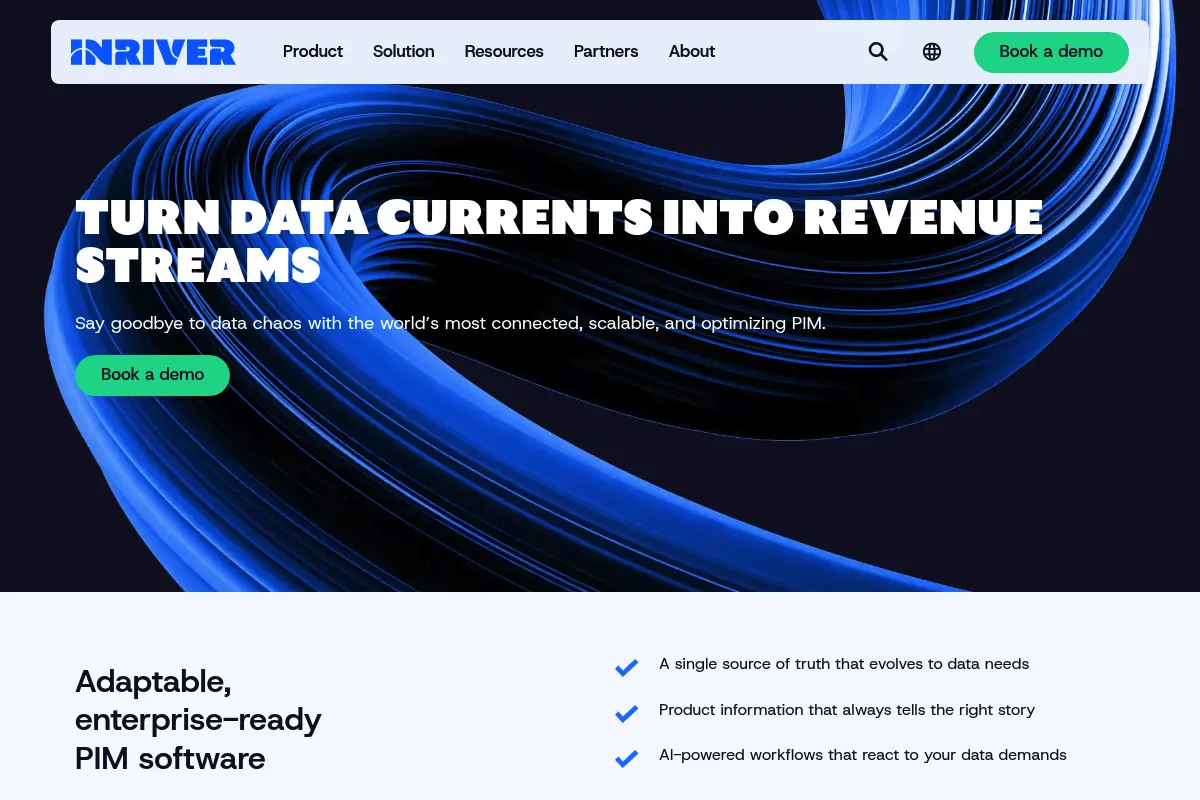
Who Should Use inriver?
Typical users
Enterprise-level product managers, e-commerce directors, and sustainability officers at global manufacturing or retail firms with thousands of SKUs.
Maturity fit
advanced
Choose this if…
- You manage complex product relationships and parent-child hierarchies
- Your priority is regulatory compliance like the EU Digital Product Passport
- You need built-in digital shelf analytics to monitor channel performance
- You require a highly flexible, entity-agnostic data model
Skip this if…
- You have a small SKU count (under 5,000) and simple data needs
- You lack the budget for a high five-figure annual license fee
- Your team cannot commit to a 6-9 month implementation project
- You need a tool that functions without an external implementation partner
About inriver
inriver is a multi-tenant SaaS Product Information Management (PIM) platform designed for large-scale enterprises. It centralizes product data to ensure consistency across global sales channels and regulatory filings. The platform focuses on the 'product journey,' extending beyond marketing to include sourcing and end-of-life sustainability data.
Official profiles
What it actually does
It provides a centralized hub for onboarding, enriching, and distributing product information to marketplaces, retailers, and print catalogs. The software automates data validation and uses AI to generate descriptions and translations. It also monitors how products appear on external sites to ensure brand consistency and pricing accuracy.
What makes it different
Unlike retail-centric PIMs, inriver uses an elastic, relation-based data model that allows users to link any entity to another without rigid schema constraints. It is also one of the few platforms explicitly building features for the EU Digital Product Passport (DPP), making it a strategic choice for companies facing new sustainability regulations.
Ratings across the web


Ratings aggregated from independent review platforms.
Key Features
Elastic Data Model
Allows for complex product relations and non-standard attributes without database re-structuring.
Inspire AI
Generates product descriptions and translations directly within the enrichment workflow.
Syndicate Advance
Distributes formatted product data to retailers and marketplaces via API or file-based transfers.
Evaluate (Digital Shelf Analytics)
Tracks stock levels, pricing, and content accuracy on third-party retail sites.
Brand Store
Creates self-service digital storefronts for distributors to access approved assets and data.
Content Onboarding
Uses AI to map and clean incoming data from suppliers, reducing manual entry errors.
Digital Product Passport
Structures data to meet EU sustainability and traceability requirements.
Print & Publishing
Automates the creation of technical data sheets and high-quality print catalogs.
Pricing
Foundation
- Entry-level PIM capabilities
- Single source of truth for product info
- Basic user workflows
- Standard data quality tools
Core
- Single-click syndication
- Self-serve digital Brand Store
- Standard API access
- Enhanced collaboration tools
Professional
- Digital Shelf Analytics (Evaluate)
- Advanced product relations and bundling
- AI-powered enrichment
- Expanded connectivity options
Enterprise
- Full global scalability
- Unlimited business units
- Premium support and service package
- Advanced performance capabilities
Pricing checked 5 months ago
Pricing guidance
- When you need to track real-time performance on the digital shelf
- When managing complex product bundles or cross-sell relations
- When expanding into multiple global regions with distinct business units
- Implementation fees often equal 1x the annual license cost
- Additional 'scalers' or add-ons may be required for high-volume syndication
- Reliance on third-party consultants for initial setup and major changes
Premium enterprise positioning with high entry costs justified by deep functionality and regulatory readiness.
Pros & Cons
Strengths
-
Highly flexible data architecture
The relation-based model handles complex B2B product structures that flatter PIMs struggle to represent accurately.
-
Strong focus on circularity and compliance
Built-in support for Digital Product Passports helps manufacturers stay ahead of upcoming EU environmental regulations.
-
Integrated digital shelf monitoring
Combining PIM with analytics means you can see exactly where product data is failing on Amazon or Walmart and fix it immediately.
-
Scalable for global operations
Handles multi-language, multi-region, and multi-brand requirements within a single instance effectively.
Weaknesses
-
High total cost of ownership
Between high annual license fees and the necessity of implementation partners, it is a major financial commitment.
Affects: Mid-market companies with tight budgets
-
Steep learning curve
The flexibility of the system makes it complex to configure and requires specialized knowledge to maintain.
Affects: Teams without dedicated PIM managers or IT support
-
Dated UI/UX in certain modules
While recent updates have improved the interface, some legacy areas feel clunky compared to modern SaaS tools like Akeneo.
Affects: Daily power users and content editors
Real User Sentiment
Users generally view inriver as a powerful, highly flexible system that solves complex data silos, though they frequently cite high costs and implementation difficulty.
Users tend to like
- The flexibility of the elastic data model
- Reliability and high uptime
- Centralized 'single source of truth' for all assets
- Responsive customer support
Users commonly complain about
- High price point compared to competitors
- Complexity of initial implementation
- Occasional system glitches during bulk updates
- UI can feel unintuitive for non-technical users
Recurring tradeoffs
- You trade ease of use for extreme data modeling flexibility; it takes longer to set up but can handle almost any product structure.
Happiest users
Large manufacturers with complex, multi-layered product catalogs and global distribution needs.
Often frustrated
Small marketing teams who expected a simple tool and found themselves overwhelmed by the configuration requirements.
Use Cases
Global Manufacturer
Managing 100,000+ SKUs across 30 languages and 50 markets.
Footwear Brand
Preparing for EU Digital Product Passport compliance by tracking material origins.
Industrial Equipment Maker
Managing complex parent-child relationships for machinery and spare parts.
Omnichannel Retailer
Syncing product data across Magento, Amazon, and print catalogs simultaneously.
Sustainability Officer
Auditing the environmental impact of product lines from sourcing to end-of-life.
Frequently Asked Questions
How much does inriver actually cost?
inriver does not publish pricing, but industry benchmarks and user reports suggest annual licenses start around $25,000 to $50,000 for mid-market configurations, with enterprise contracts often exceeding $90,000. Implementation costs are typically an additional one-time fee of similar magnitude.
How does inriver compare to Akeneo?
Akeneo is often seen as more user-friendly with a modern UI and offers a free Community Edition, making it popular for retail. inriver is more complex but offers a more flexible 'elastic' data model and built-in digital shelf analytics, making it better for complex B2B manufacturing.
Does inriver include a Digital Asset Management (DAM) system?
Yes, inriver includes integrated DAM capabilities, allowing you to manage images, videos, and documents alongside your product data, though some enterprises still choose to integrate dedicated third-party DAMs for advanced creative workflows.
How long does it take to implement inriver?
A typical implementation takes between 6 and 9 months. This includes data modeling, integration with ERP/PLM systems, and training. It almost always requires a certified implementation partner.
Is inriver a good fit for a small Shopify store?
No. For a small store with a few hundred SKUs, inriver is significantly over-engineered and too expensive. Tools like Plytix or the basic version of Akeneo are better suited for that scale.
What are the main integrations supported?
inriver has standard connectors for major ERPs (SAP, Microsoft Dynamics), E-commerce platforms (Shopify Plus, Salesforce Commerce Cloud, Adobe Commerce/Magento), and various marketplaces via its syndication engine.
Why trust this page?
This evaluation combines product positioning, pricing analysis, traffic and market signals, and public user sentiment into a single decision-support page. Content is generated editorially — not copied from the vendor's website.
Funding & Company
Founded
2007
Stage
Acquired
Total Raised
$44.4M
Latest Round
Private Equity (May 2022)
Notable Investors
Inriver was venture-backed by European investors for much of its history, raising at least $42M. In May 2022, the company's trajectory shifted significantly when it received a majority-stake growth investment from Thomas H. Lee Partners (THL), a major US private equity firm. This event provides substantial long-term stability and financial backing, moving it beyond the typical startup lifecycle.
Market Signals & Traffic
Estimated visits, global rank, geography, traffic sources, monthly visit trends, and organic search keywords (Similarweb)—on a dedicated page built for depth and search.
- Estimated visits
- 0
- Global rank
- —
- Snapshot
- May 2026
- Traffic trend
- Rising
Estimated monthly visits
Alternatives to inriver
View all alternatives
Similar Tools
Supaboard
Website Builder, SEO, Automation

Launch and monetize professional job boards with automated management tools.
BHuman
Video Creation, Sales, Marketing Automation

Generate personalized video messages at scale for sales and marketing.
Not Diamond
Developer Tools, Automation & Agents, Productivity

Intelligent model router selecting the best LLM for every prompt.
Rytr
Content Creation, AI Assistant

AI-powered writing assistant for generating high-quality content quickly.
ChatGPT
AI Assistant, Content Creation

AI-powered conversational chatbot for generating text and assisting with various tasks.
Cal.com
AI Assistant

An open-source scheduling platform for individuals and businesses to manage appointments.