

A structured product information management hub that replaces messy spreadsheets with a centralized source of truth for multi-channel retail.
Excellent for mid-market brands managing complex catalogs across multiple regions, weaker for small teams with simple product structures.
Analysis based on product data, pricing structure, traffic signals, and public user sentiment.
Who Should Use Akeneo?
Typical users
E-commerce managers, catalog specialists, and marketing teams at companies managing 500+ SKUs across multiple storefronts or marketplaces.
Maturity fit
scaling to advanced
Choose this if…
- Your product data is scattered across multiple spreadsheets and legacy systems
- You need to localize product descriptions and attributes for different geographic markets
- Your priority is data governance and ensuring consistent product stories across Shopify, Amazon, and print
- You want an open-source core with the option to move to a managed SaaS environment
Skip this if…
- You have a small catalog that is easily managed within your e-commerce platform's native CMS
- You need a full-scale Digital Asset Management (DAM) system for video editing and complex versioning
- Your budget cannot accommodate the high jump from the free Community edition to the paid SaaS tiers
About Akeneo
Akeneo is a Product Information Management (PIM) platform designed to centralize and enrich technical and marketing product data. It exists to solve the 'spreadsheet chaos' that occurs when brands try to sync product details across various sales channels and languages. It provides a structured environment for teams to collaborate on product descriptions, attributes, and media before distribution.
What it actually does
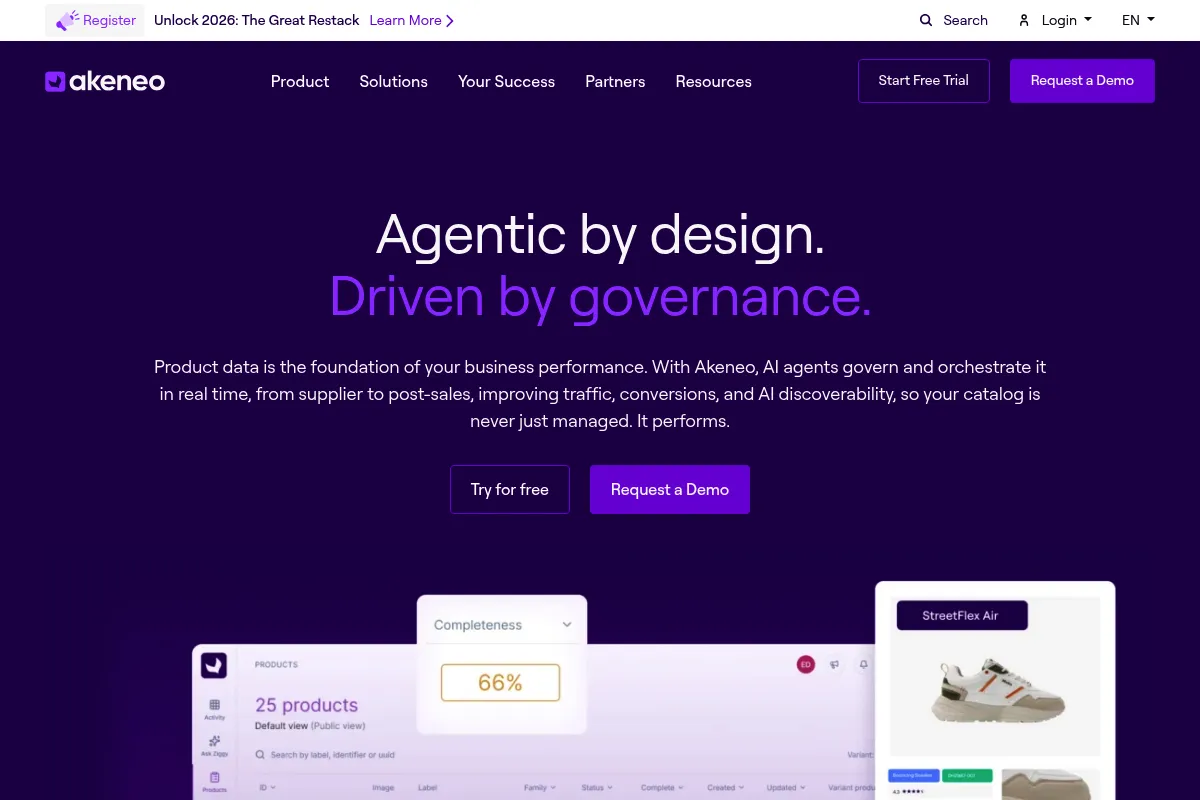
It acts as a central repository where users import raw product data, enrich it with marketing copy and media, and then export it to various channels. The platform tracks the 'completeness' of product information, ensuring no item goes live with missing details. It also handles complex product relationships, such as bundles, variants, and cross-sell associations.
What makes it different
Unlike many enterprise PIMs that feel like 90s database software, Akeneo prioritizes a modern UI that marketing teams can actually use without constant IT help. It offers a unique 'Community Edition' which is open-source, allowing developers to test the architecture before committing to the expensive SaaS versions. Its focus is strictly on the 'enrichment' phase of the product lifecycle rather than trying to be an ERP or a full DAM.
Ratings across the web

Ratings aggregated from independent review platforms.
Key Features
Product Completeness Widget
Shows exactly which attributes are missing before a product can be published.
Attribute Management
Allows creation of custom fields like color, material, or technical specs that vary by product type.
Validation Workflows
Ensures that changes made by junior staff are reviewed by managers before going live.
Asset Manager
Links images and documents to specific products, though it is not a replacement for a dedicated DAM.
Association Management
Defines relationships between products for up-selling, cross-selling, or replacement parts.
Tailored Exports
Filters and formats data specifically for the requirements of different marketplaces like Amazon or eBay.
Akeneo App Store
Provides pre-built connectors for platforms like Magento, Shopify, and BigCommerce.
Pricing
Community Edition
- Open-source self-hosted
- Basic PIM features
- Product enrichment
- Export to CSV/Excel
- Community support only
Growth Edition
- SaaS hosting
- Essential PIM features
- Standard connectors
- Basic support
- Automatic updates
Business Edition
- Advanced attribute types
- Asset Manager
- Validation workflows
- Product proposals
- SLA-backed support
Enterprise Edition
- AI-driven data enrichment
- Advanced rights management
- Shared catalogs
- Dedicated success manager
- Full scalability for millions of SKUs
Pricing checked 6 months ago
Pricing guidance
- When you need to manage user permissions and approval workflows
- When you require the automated Asset Manager to handle thousands of images
- When you want to stop managing your own server infrastructure
- The Community Edition lacks the 'Asset Manager' entirely
- API rate limits apply to SaaS tiers
- Implementation costs from certified partners can often exceed the annual software license fee
Premium enterprise positioning with a high entry price for SaaS, justified by its depth of features and market reputation.
Pros & Cons
Strengths
-
Intuitive user interface
The dashboard is designed for marketers, not just database admins, which significantly lowers the barrier to adoption for non-technical staff.
-
Flexible data modeling
It handles complex product hierarchies and variants better than most e-commerce platforms, making it ideal for technical or highly categorized industries.
-
Strong open-source community
The Community Edition allows for extensive customization and has a large ecosystem of developers building third-party plugins.
-
Centralized localization
Managing translations within the same interface as the master data reduces errors and speeds up time-to-market for international expansion.
Weaknesses
-
Expensive jump to SaaS
The price gap between the free Community Edition and the paid Growth/Enterprise tiers is massive, often pricing out small-to-mid-sized businesses.
Affects: Scaling SMBs
-
Limited Community Edition features
The free version lacks essential features like validation workflows, advanced permissions, and the asset manager, making it a 'teaser' for the paid versions.
Affects: Teams on a budget
-
Basic Asset Management
While it handles images, it lacks the advanced versioning, rights management, and editing capabilities of a dedicated DAM like Cloudinary or Bynder.
Affects: Content-heavy brands
Real User Sentiment
Users generally praise the interface and the logical way it organizes data, though there is significant frustration regarding the cost of the Enterprise tier.
Users tend to like
- Clean and modern user interface
- Ease of creating and managing product attributes
- The 'Completeness' score which gamifies data entry
- Robust API for developers
Users commonly complain about
- The high cost of the SaaS versions
- Difficulty of upgrading from Community to Enterprise
- The lack of advanced features in the free version
- Steep learning curve for initial data modeling
Recurring tradeoffs
- You trade the flexibility of a spreadsheet for a rigid structure that prevents errors but takes longer to set up initially.
Happiest users
E-commerce managers at mid-sized retailers who have outgrown Excel and need a reliable way to sync data to Shopify or Magento.
Often frustrated
Small business owners who find the Community Edition too limited and the Growth Edition too expensive.
Use Cases
International Expansion
Using Akeneo to manage product translations and regional attributes for a brand launching in five new countries.
Omnichannel Consistency
Ensuring that technical specs for a power tool are identical on the brand's website, Amazon, and Home Depot's portal.
Catalog Consolidation
Merging product data from three different acquired brands into a single, unified database.
Print Catalog Production
Exporting structured data from the PIM to Adobe InDesign for creating seasonal paper catalogs.
Reducing Returns
Using the completeness and validation tools to ensure customers have all the info they need, reducing 'not as described' returns.
Frequently Asked Questions
How much does Akeneo actually cost?
Akeneo does not publish SaaS pricing, but industry reports and user feedback suggest the Growth tier starts around $25,000/year, while Enterprise can easily exceed $50,000-$100,000/year depending on SKU count and users. The Community Edition is free but requires you to pay for your own hosting and maintenance.
What is the difference between Akeneo and a DAM?
A PIM like Akeneo manages product data (specs, descriptions, prices), while a DAM (Digital Asset Management) manages the files themselves (high-res video, raw images, brand guidelines). Akeneo has basic asset management, but it is not a replacement for a dedicated DAM if you need advanced media workflows.
Can I use Akeneo with Shopify?
Yes, Akeneo has a popular Shopify connector available in their App Store. It allows you to map Akeneo attributes to Shopify fields, ensuring that when you update a description in the PIM, it automatically syncs to your Shopify store.
Is the Community Edition worth it?
Only if you have an in-house developer. It is a powerful tool, but without the validation workflows and asset manager found in the paid versions, it requires a lot of manual oversight. It is best used as a 'proof of concept' before upgrading.
How does Akeneo compare to Salsify?
Salsify is often considered more 'channel-centric' with stronger tools for syndication to retailers like Walmart and Target, whereas Akeneo is more 'product-centric,' focusing on the internal enrichment process. Salsify is generally more expensive and aimed at the very high-end enterprise market.
Does Akeneo have AI features?
Yes, Akeneo recently introduced 'Akeneo Genesis' and other AI-driven features in their higher tiers that help generate product descriptions, translate content, and automatically map attributes from supplier files.
Why trust this page?
This evaluation combines product positioning, pricing analysis, traffic and market signals, and public user sentiment into a single decision-support page. Content is generated editorially — not copied from the vendor's website.
Funding & Company
Founded
2013
Stage
—
Total Raised
$196.77M
Latest Round
Series D (Mar 2022)
Notable Investors
Akeneo has raised a total of nearly $197 million across five funding rounds, culminating in a significant $135 million Series D in March 2022. This substantial late-stage funding from growth equity firm Summit Partners indicates strong investor confidence and provides a long operational runway, ensuring stability for customers.
Market Signals & Traffic
Estimated visits, global rank, geography, traffic sources, monthly visit trends, and organic search keywords (Similarweb)—on a dedicated page built for depth and search.
- Estimated visits
- 271,948
- Global rank
- #125,874
- Snapshot
- Apr 2026
- Traffic trend
- Surging
Estimated monthly visits
Alternatives to Akeneo
View all alternatives
Similar Tools
Employers
Automation & Agents, AI Assistant, Workflow

Automate candidate sourcing, screening, and scheduling for recruitment teams.
Mailsoftly
Email Marketing, Marketing Automation, Communication

Email marketing and automation platform for personalized customer campaigns
Lovable
Developer Tools, Website Builder, Productivity

AI platform to build full-stack web apps and websites from natural language prompts.
Liquid AI
Developer Tools, Research

High-performance foundation models for long-context data and edge computing
Superhuman
Communication, Productivity, AI Assistant

High-speed email client designed for professional productivity and focus.
Chorus
Sales, Communication, Training & Onboarding

Conversation intelligence platform for capturing and analyzing sales interactions.