

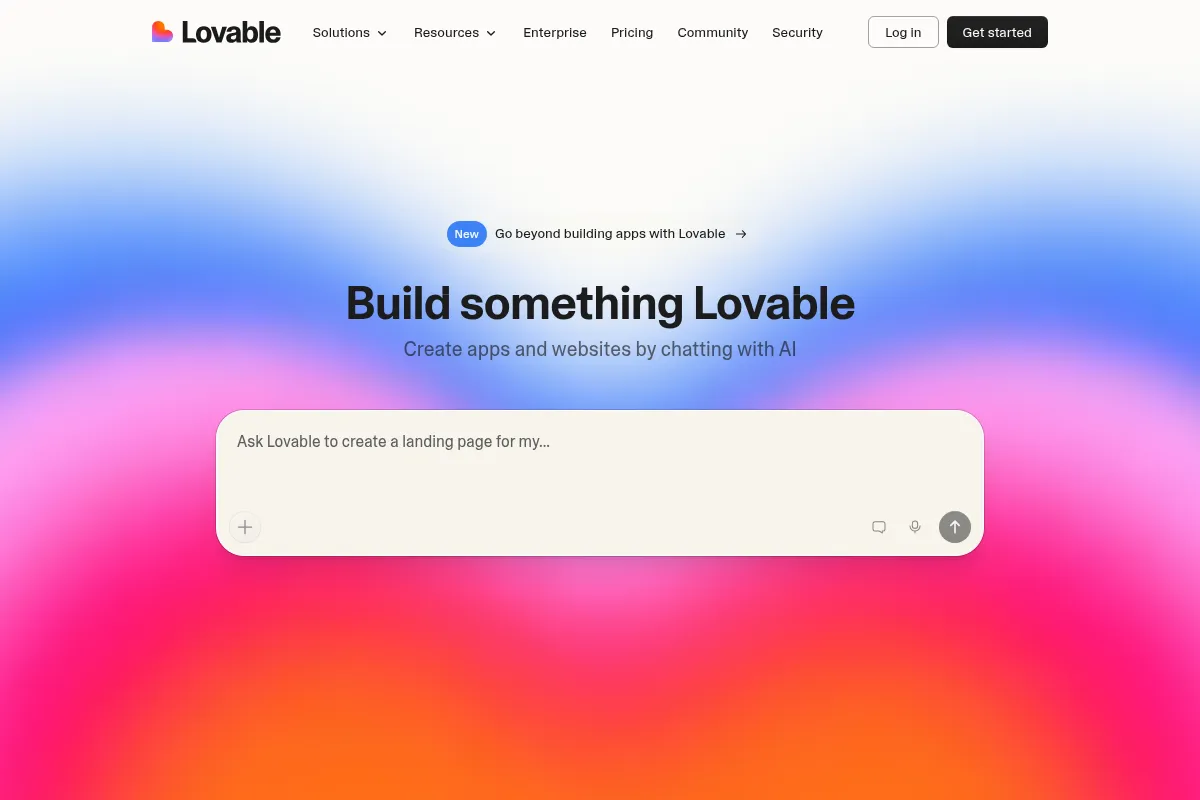
Lovable is an AI-powered platform that generates full-stack web applications from natural language prompts, best suited for rapid prototyping and validating ideas.
Excellent for quickly building MVPs and prototypes, weaker for complex, production-ready applications.
Analysis based on product data, pricing structure, traffic signals, and public user sentiment.
Who Should Use Lovable?
Typical users
Founders, product managers, designers, and developers looking to accelerate the creation of web applications and prototypes. It's particularly useful for those with limited coding experience or teams needing to quickly validate concepts.
Maturity fit
beginner to scaling
Choose this if…
- You need to build an MVP or prototype rapidly.
- You want to validate a product idea quickly without extensive coding.
- You are a non-technical founder or designer who needs to visualize an app concept.
- You want to quickly generate frontend code and basic backend structure.
Skip this if…
- You require complex backend logic or advanced security features.
- Your project needs to be highly scalable and production-ready from the outset.
- You prefer a traditional development workflow with full code control.
- You anticipate significant debugging or customization beyond AI capabilities.
About Lovable
Lovable is an AI platform designed to build full-stack web applications and websites from natural language prompts. It aims to significantly reduce development time, enabling users to create functional prototypes and MVPs quickly. The tool is positioned for founders, product teams, designers, and developers who prioritize speed and accessibility in the development process.
Official profiles
What it actually does
Lovable translates natural language descriptions into production-ready code, including frontend UI, backend logic, database setup, and authentication. It allows users to describe their app idea and have the AI generate a functional web application, streamlining the process from concept to a deployable prototype.
What makes it different
Lovable differentiates itself by focusing on generating full-stack applications directly from natural language prompts, aiming to be a "superhuman full stack engineer." It integrates frontend (React, Tailwind CSS) and backend (Supabase) generation, offering a more complete solution than tools that focus solely on UI or frontend code. The platform also emphasizes speed and accessibility for non-technical users.
Ratings across the web
Ratings aggregated from independent review platforms.
Key Features
Prompt-Based Full-Stack Generation
Translates natural language into functional frontend, backend, database, and authentication code, enabling rapid app creation.
Supabase Integration
Seamlessly integrates with Supabase for authentication, PostgreSQL storage, and real-time analytics, simplifying backend setup.
Visual Editor and Chat Interface
Allows for iterative refinement of generated code and UI through a conversational AI and visual editing tools.
Code Export and Ownership
Users own the generated code, allowing for export and further customization with traditional development tools.
Team Collaboration
Enables multiple users to work together on projects within a shared workspace.
Custom Domain Support
Allows users to connect their own domain names to deployed applications.
Rapid Deployment
Facilitates quick deployment of generated applications.
GitHub Integration
Syncs code with GitHub for version control and local editing.
Pricing
Free
- 5 credits daily (up to 30/month)
- Public projects hosted on Lovable's domain
- Unlimited team members
- Basic cloud access
Pro
- 100 monthly credits + 5 daily credits (up to ~150/month)
- Private projects
- Custom domains
- Remove Lovable branding
- User roles and permissions
- Credit rollover
Business
- All Pro features
- SSO
- Data opt-out option
- Design templates
- Personal workspaces
- Internal publishing
Enterprise
- Dedicated support and onboarding
- Custom integrations
- Advanced security features
- Custom pricing
Pricing checked 6 months ago
Pricing guidance
- You need to build private projects.
- You require custom domains for your application.
- You consistently hit the daily credit limit on the free plan.
- You need to remove Lovable branding from your application.
- Credit consumption can be unpredictable and lead to higher-than-expected costs.
- The platform may struggle with complex logic, requiring manual code fixes that consume additional credits.
- While code is exportable, the generated code may require significant refactoring for production use.
- Backend services (Lovable Cloud) have separate usage-based costs beyond the subscription plan.
Affordable for individuals and small teams, with tiered pricing that scales with features and usage needs.
Pros & Cons
Strengths
-
Exceptional Speed for Prototyping
Lovable can generate functional web applications from prompts in minutes, drastically reducing the time from idea to a clickable prototype. This is invaluable for rapid ideation and validation.
-
Accessible to Non-Coders
The natural language interface lowers the barrier to entry for app development, allowing founders, designers, and product managers without extensive coding knowledge to build functional applications.
-
Full-Stack Capabilities
It generates both frontend and backend code, including database and authentication, providing a more complete solution than many UI-focused AI tools.
-
Code Ownership and Export
Users own the generated code, which can be exported for further development or customization, offering flexibility beyond the platform itself.
-
Integrated Supabase Backend
The built-in Supabase integration simplifies the setup of essential backend services like authentication and data storage, streamlining the development process.
Weaknesses
-
Limited for Complex Projects
Lovable struggles with complex logic, advanced features, and intricate backend requirements, often requiring significant manual intervention or code cleanup.
Affects: Teams building sophisticated applications
-
Credit System Can Be Costly and Unpredictable
The message-based credit system can lead to unexpected costs, especially during debugging or iterative refinement, making budgeting difficult.
Affects: Users requiring extensive iteration or complex builds
-
Debugging Can Be Frustrating
Users report getting stuck in repetitive error loops and finding the AI-generated code challenging to debug, leading to wasted credits and time.
Affects: Users encountering bugs or needing significant customization
-
Not Production-Ready for Critical Apps
While good for prototypes, Lovable's generated code and infrastructure may not be robust or secure enough for mission-critical, long-term production applications.
Affects: Businesses requiring high reliability and security
Real User Sentiment
Generally positive, with users praising its speed and ease of use for prototyping, but with significant concerns about its limitations for complex projects and pricing predictability.
Users tend to like
- Incredible speed for building MVPs and prototypes.
- Ease of use for non-technical users.
- Full-stack code generation from prompts.
- Useful for validating ideas quickly.
- Good starting point for developers to export code.
Users commonly complain about
- Struggles with complex logic and advanced features.
- Debugging can be frustrating and lead to repetitive error loops.
- Credit system can be unpredictable and expensive.
- Generated code may not be production-ready without significant refactoring.
- Limited UI design options compared to dedicated design tools.
Recurring tradeoffs
- Speed vs. complexity: It's fast for simple apps but struggles with complexity.
- Ease of use vs. control: Offers simplicity but less granular control than traditional coding.
- Prototyping vs. production: Excellent for initial builds, but not ideal for critical production apps.
Happiest users
Founders, designers, and developers focused on rapid prototyping, idea validation, and building simple MVPs.
Often frustrated
Users attempting to build complex, production-grade applications or those who underestimate the credit consumption and potential for debugging challenges.
Use Cases
Building MVPs for startups to validate product ideas.
Creating interactive prototypes for investor pitches or stakeholder reviews.
Developing landing pages and microsites for marketing campaigns.
Enabling non-technical team members to contribute to app development.
Generating initial frontend code structures for developers to build upon.
Quickly creating internal tools or dashboards for business processes.
Validating UI/UX concepts and design flows rapidly.
Frequently Asked Questions
What is Lovable.dev?
Lovable.dev is an AI-powered platform that allows users to build full-stack web applications and websites by describing their ideas in natural language. It generates production-ready code, including frontend UI, backend, database, and authentication, aiming to accelerate prototyping and development without extensive coding knowledge. It's designed for founders, product teams, designers, and developers.
How does Lovable.dev pricing work?
Lovable.dev uses a credit-based system for AI interactions, in addition to monthly subscription plans. The Free plan offers limited daily credits. Paid plans like Pro ($25/month) and Business ($50/month) provide more credits, private projects, custom domains, and team features. Backend services (Lovable Cloud) have separate usage-based costs. Unused monthly credits may roll over on paid plans, but daily credits do not. It's important to monitor credit usage as it can become unpredictable, especially during extensive debugging or iteration.
Is Lovable.dev suitable for complex, production-ready applications?
Lovable.dev is generally not suitable for complex, mission-critical, or highly scalable production applications. While it excels at rapid prototyping and generating initial code structures, users often find that the generated code requires significant manual refactoring, debugging, and customization to meet production standards. Its limitations in handling intricate logic, advanced security, and long-term reliability make it better suited for MVPs and proof-of-concepts rather than core business systems.
What are Lovable.dev's main limitations compared to traditional development?
Lovable.dev's primary limitations compared to traditional development include its struggle with complex logic and advanced features, which often necessitate manual intervention. Debugging AI-generated code can be time-consuming and frustrating, potentially leading to unexpected costs due to its credit system. The platform's output may not be production-ready without substantial post-generation work, and its security and data handling capabilities might be less robust than dedicated development environments for highly sensitive applications. Furthermore, while code can be exported, extensive customization might negate the initial time savings.
What are some alternatives to Lovable.dev?
Alternatives to Lovable.dev depend on your specific needs. For rapid prototyping and full-stack generation, tools like Bolt.new and Base44 offer similar prompt-to-app capabilities. For developers seeking AI assistance within their IDE, Cursor and Replit provide AI coding support and environments. If the focus is more on UI generation and iteration within an existing codebase, platforms like Builder.io offer a different approach. For simpler wireframing and idea clarity, Balsamiq is an option. For internal tools, UI Bakery is a strong contender. Each alternative offers a different balance of speed, control, and production readiness.
Can I integrate Lovable.dev with other tools?
Yes, Lovable.dev integrates with essential tools to expand its ecosystem. It features Supabase integration for authentication, data persistence, and edge functions. It also integrates with GitHub for version control. Additionally, it supports integrations with tools like Clerk for authentication flows and Resend for email workflows, enabling more comprehensive application development.
How does Lovable.dev handle data and security?
Lovable.dev integrates with Supabase, which provides backend services including authentication and data storage. For its Business plan, Lovable offers features like Single Sign-On (SSO) and an option to opt out of data training, which are important for teams and enterprises concerned with security and privacy. However, for highly sensitive applications, users may need to exercise caution and ensure that the generated code and infrastructure meet their specific security requirements, potentially requiring manual review and hardening.
What is the credit system in Lovable.dev?
Lovable.dev uses a credit system to manage interactions with its AI. Each message or generation task consumes credits, with the cost varying based on the complexity of the request. The Free plan provides a limited number of daily credits, while paid plans offer larger monthly allowances. This system is designed to provide cost transparency but can lead to unpredictable expenses, especially during iterative development or debugging, as every AI interaction consumes credits.
Why trust this page?
This evaluation combines product positioning, pricing analysis, traffic and market signals, and public user sentiment into a single decision-support page. Content is generated editorially — not copied from the vendor's website.
Funding & Company
Founded
2023
Stage
Series b
Total Raised
$562.5M
Latest Round
Series B (Dec 2025)
Notable Investors
Lovable has raised a total of $552.5 million over four rounds, reaching a $6.6 billion valuation with its $330 million Series B in December 2025. This aggressive funding from top-tier investors like CapitalG and Accel provides substantial runway and validates its position in the AI-driven software development market, signaling long-term stability.
Market Signals & Traffic
Estimated visits, global rank, geography, traffic sources, monthly visit trends, and organic search keywords (Similarweb)—on a dedicated page built for depth and search.
- Estimated visits
- 33,568,593
- Global rank
- #1,421
- Snapshot
- Apr 2026
- Traffic trend
- Rising
Estimated monthly visits
Alternatives to Lovable
View all alternativesReplit
Developer Tools, AI Assistant

An AI-powered platform for building and deploying software applications directly from a browser.
Bolt.new
Developer Tools, Automation, Website Builder

AI-powered platform to build websites and apps from natural language prompts.
Similar Tools
Create
Developer Tools, Website Builder, Productivity

Build web applications and components using natural language prompts.
Bloomreach
Marketing Automation, SEO, Automation & Agents

Personalization platform for e-commerce search, marketing, and content management.
Friend
AI Assistant, Communication, Health & Wellness

Wearable companion that listens and interacts through your phone.
ElevenLabs
Content Creation, AI Assistant

AI-powered platform for realistic speech, voice cloning, and audio generation.
WitnessAI
Privacy & Compliance, Security, Developer Tools

Governance and security platform for enterprise generative model usage
Lumen5
Content Creation, Video Creation

AI-powered platform to create engaging videos from text content.