
Lyzr is a Python-based agentic framework that prioritizes rapid deployment and data privacy, offering a more structured, 'low-code' SDK alternative to the complexity of LangChain.
Excellent for enterprise developers building private RAG-based agents, weaker for those requiring the massive integration ecosystem of LangChain or CrewAI.
Analysis based on product data, pricing structure, traffic signals, and public user sentiment.
Who Should Use Lyzr?
Typical users
Python developers and AI engineers in enterprise environments who need to build multi-agent systems with strict data privacy requirements.
Maturity fit
scaling to advanced
Choose this if…
- You need to deploy autonomous agents within a private cloud or on-premise environment.
- Your priority is reducing the lines of code required to set up RAG (Retrieval-Augmented Generation) pipelines.
- You want a framework that provides pre-defined agent roles and structured task management out of the box.
- You find LangChain's abstractions too fragmented and want a more cohesive SDK experience.
Skip this if…
- You are a non-technical user looking for a no-code drag-and-drop agent builder.
- Your project requires a JavaScript or TypeScript SDK, as Lyzr is currently Python-centric.
- You need the largest possible community and third-party plugin library for niche integrations.
About Lyzr
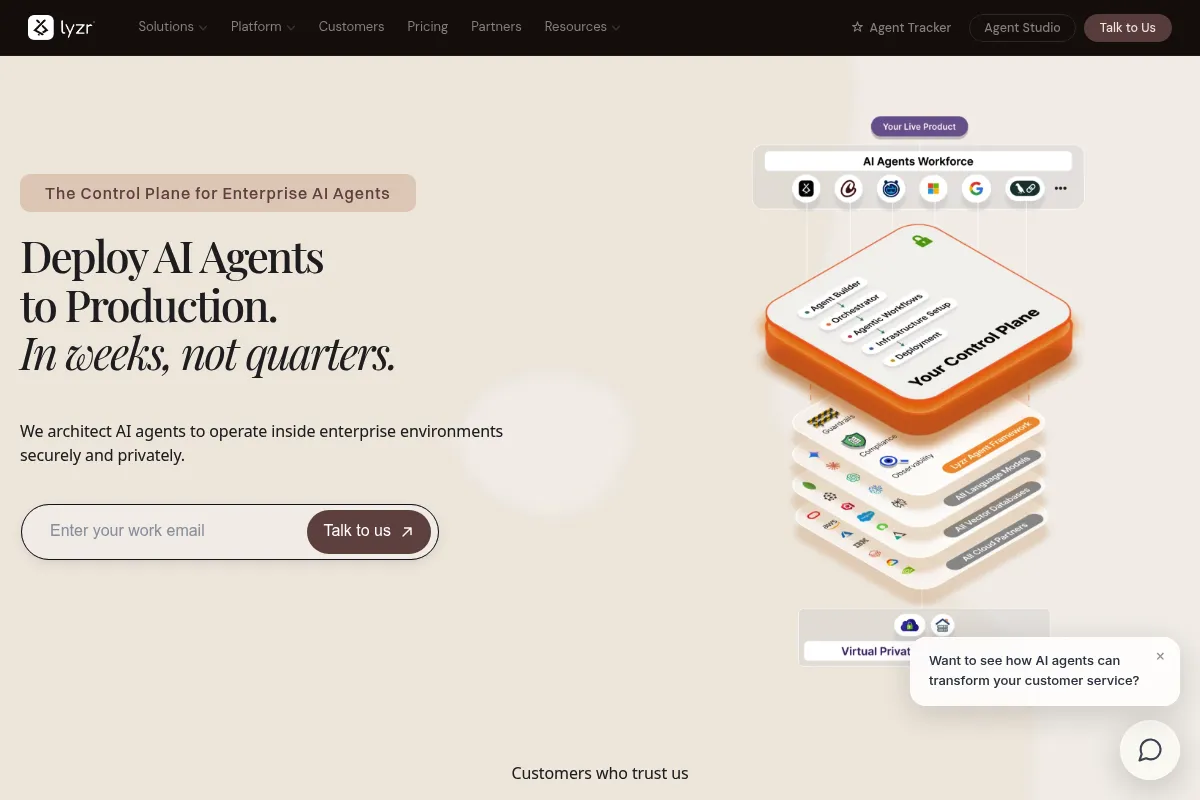
Lyzr is an enterprise-grade agentic framework designed to simplify the creation of autonomous multi-agent systems. It focuses on 'low-code' Python SDKs that allow developers to build complex AI workflows with minimal boilerplate. The platform is built with a privacy-first architecture, enabling organizations to run agents entirely within their own secure infrastructure.
Official profiles
What it actually does
Lyzr provides a suite of specialized SDKs—such as Lyzr Automata for task orchestration and Lyzr Core for RAG—that developers use to build agents capable of executing multi-step business processes. It handles the underlying complexity of memory management, vector database connections, and LLM prompting through high-level classes. Users can deploy these agents as microservices that interact with existing enterprise data and tools.
What makes it different
Unlike general-purpose frameworks that offer infinite flexibility at the cost of complexity, Lyzr uses a 'Lego-block' approach with pre-built modules for specific functions like data analysis or sales. Its primary differentiator is the 'Private-by-Design' focus, specifically targeting enterprises that cannot use shared-cloud AI platforms due to compliance or security constraints.
Ratings across the web
Ratings aggregated from independent review platforms.
Key Features
Lyzr Automata
Orchestrates complex workflows by defining specific agents, tasks, and linear or concurrent pipelines.
Lyzr Core
A RAG-focused SDK that simplifies connecting documents to LLMs with built-in chunking and embedding logic.
Private Cloud Deployment
Allows the entire agent stack to run within a company's VPC (AWS/Azure/GCP) to ensure data never leaves the perimeter.
Pre-built Agent Blueprints
Provides templates for common roles like 'Researcher', 'Data Analyst', or 'SDR' to speed up development.
Lyzr Jazon
An autonomous AI sales representative that handles prospecting and outreach without manual intervention.
Lyzr Skyla
A specialized agent for conversational data science that queries databases and generates visual insights.
Agent Monitoring
Tools to track agent performance, token usage, and execution logs in production environments.
Pricing
Open Source
- Access to Lyzr SDKs on GitHub
- Community support
- MIT Licensed components
- Local development use
Lyzr Cloud / Enterprise
- Private cloud deployment (VPC)
- Enterprise-grade security and compliance
- Priority technical support
- Advanced agent monitoring and analytics
- Custom agent development services
Pricing checked 5 months ago
Pricing guidance
- When you need to deploy agents in a secure, private cloud environment
- When you require dedicated technical support for complex agent architectures
- When you need centralized monitoring for multiple production agents
- The open-source version requires you to manage your own infrastructure and LLM API costs.
- Some advanced pre-built agents like Jazon may have separate licensing or usage fees.
Lyzr follows an open-core model, making the framework accessible to developers while charging a premium for enterprise deployment and managed services.
Pros & Cons
Strengths
-
Reduced boilerplate code
Lyzr's SDK design allows developers to initialize RAG pipelines and multi-agent workflows in significantly fewer lines of code than LangChain or AutoGen.
-
Enterprise-ready privacy
The ability to run locally or in a private VPC is a major advantage for healthcare, finance, or legal sectors with strict data residency requirements.
-
Modular architecture
Because the framework is split into specialized SDKs (Core, Automata, ChatBot), developers only need to import the specific components their project requires.
Weaknesses
-
Documentation fragmentation
As the framework evolves rapidly, documentation for specific sub-modules can sometimes lag behind the latest code updates, leading to trial-and-error.
Affects: Developers during initial setup
-
Smaller community ecosystem
Compared to LangChain, there are fewer community-contributed tutorials, third-party integrations, and StackOverflow answers available.
Affects: Teams needing to solve highly niche or custom integration problems
-
Python dependency
The lack of a robust JavaScript/TypeScript SDK limits its use for front-end heavy teams or those operating in Node.js environments.
Affects: Full-stack developers and JS-centric engineering teams
Real User Sentiment
Users generally appreciate Lyzr for its simplicity and the speed at which they can get a RAG agent running compared to more complex frameworks.
Users tend to like
- Ease of use for Python developers
- Clean separation of concerns between different SDK modules
- Strong focus on data privacy and local execution
- Effective pre-built templates for common use cases
Users commonly complain about
- Occasional bugs in newer SDK releases
- Documentation can be sparse for advanced customization
- Limited support for non-Python languages
Recurring tradeoffs
- You trade the infinite flexibility and massive integration list of LangChain for a faster, more opinionated development experience.
Happiest users
Enterprise AI engineers who need to move from prototype to a secure, private production environment quickly.
Often frustrated
Developers who want a highly customized, low-level control over every single step of the LLM chain.
Use Cases
Enterprise Knowledge Management
Building a private RAG agent that answers employee questions based on internal PDFs and wikis.
Automated Data Analysis
Using Lyzr Skyla to allow non-technical staff to query SQL databases using natural language.
AI Sales Outreach
Deploying Lyzr Jazon to automate lead research and personalized email drafting within a CRM.
Customer Support Automation
Creating a multi-agent system where one agent triages tickets and another drafts technical resolutions.
Content Generation Pipelines
Setting up a sequence of agents to research a topic, draft a blog post, and check it for SEO compliance.
Frequently Asked Questions
Is Lyzr free to use?
Lyzr offers its core SDKs, including Lyzr Automata and Lyzr Core, as open-source software under the MIT license. You can download and use these for free from GitHub. However, enterprise features like private cloud hosting, managed services, and specialized agents like Jazon typically require a paid enterprise contract.
How does Lyzr compare to CrewAI?
CrewAI is highly popular for its simple, collaborative agent model and has a large community. Lyzr is more focused on the enterprise 'full-stack' experience, offering specialized SDKs for RAG, data analysis, and private cloud deployment that are often more 'plug-and-play' for corporate environments.
Does Lyzr support local LLMs?
Yes, Lyzr integrates with LiteLLM, which allows it to connect to a wide variety of local LLM providers like Ollama or vLLM, as well as proprietary APIs like OpenAI, Anthropic, and Cohere.
What are the main limitations of Lyzr?
The primary limitation is its Python-only focus, which excludes developers using other languages. Additionally, while it is easier to use than LangChain, it has a smaller ecosystem of pre-built integrations for third-party SaaS tools, meaning you may have to write more custom code for niche integrations.
Can I run Lyzr on my own servers?
Yes, one of Lyzr's core value propositions is its 'Private-by-Design' approach. You can run the SDKs on your local machine, on-premise servers, or within your own Virtual Private Cloud (VPC) to ensure data privacy.
What databases does Lyzr support for RAG?
Lyzr Core supports popular vector databases including Weaviate, Pinecone, and ChromaDB. It is designed to be database-agnostic, allowing you to swap vector stores with minimal configuration changes.
Why trust this page?
This evaluation combines product positioning, pricing analysis, traffic and market signals, and public user sentiment into a single decision-support page. Content is generated editorially — not copied from the vendor's website.
Funding & Company
Founded
2023
Stage
Series a
Total Raised
$25.2M
Latest Round
Series A (Mar 2026)
Notable Investors
Lyzr has raised a total of $25.2 million, culminating in a $14.5 million Series A+ round in March 2026 led by strategic investor Accenture. This rapid fundraising trajectory, including a significant valuation jump to $250 million, signals strong market validation and provides substantial runway for product development and expansion.
Market Signals & Traffic
Estimated visits, global rank, geography, traffic sources, monthly visit trends, and organic search keywords (Similarweb)—on a dedicated page built for depth and search.
- Estimated visits
- 202,225
- Global rank
- #216,559
- Snapshot
- Apr 2026
- Traffic trend
- Surging
Estimated monthly visits
Alternatives to Lyzr
View all alternatives
Similar Tools
Aspect
Automation & Agents, Developer Tools, Workflow

Build and deploy agents that automate tasks in the browser.
CVector
Automation & Agents, Developer Tools, Workflow

Build and deploy autonomous agents with advanced tool-use capabilities.
Simplex
Automation & Agents, Developer Tools, Workflow

Platform for building and deploying autonomous task-oriented agents
AgentSpace
Automation & Agents, Developer Tools, Workflow

Build, deploy, and manage autonomous agent workflows for business automation.
Emergence
Automation & Agents, Developer Tools, Workflow

Platform for building and deploying autonomous agentic AI workflows.
You.ai
Automation & Agents, Developer Tools, Workflow
No-code platform for building and deploying custom AI agents.