

A robotics company transitioning from industrial wheeled humanoids to bipedal home assistants using end-to-end neural networks and human-safe hardware.
Excellent for enterprise security and logistics firms needing safe human-robot collaboration, while NEO remains a high-beta prospect for early adopters.
Analysis based on product data, pricing structure, traffic signals, and public user sentiment.
Who Should Use 1X?
Typical users
Logistics managers, security firm operators, and R&D labs testing autonomous agents in physical environments.
Maturity fit
advanced
Choose this if…
- Your priority is physical safety in human-populated environments over high-speed movement.
- You need a robot capable of teleoperation via VR for complex tasks.
- You are an enterprise looking to pilot OpenAI-integrated hardware for security or light logistics.
Skip this if…
- You require a finished consumer product for immediate home use.
- Your budget is limited to off-the-shelf automation software rather than experimental hardware.
- You need high-speed, high-torque industrial performance where human safety is not a factor.
About 1X
1X, formerly Halodi Robotics, designs humanoid robots built with a safety-first philosophy. The company focuses on 'soft' robotics—using low-gear-ratio motors that allow humans to interact with the machines without risk of injury.
Official profiles
What it actually does
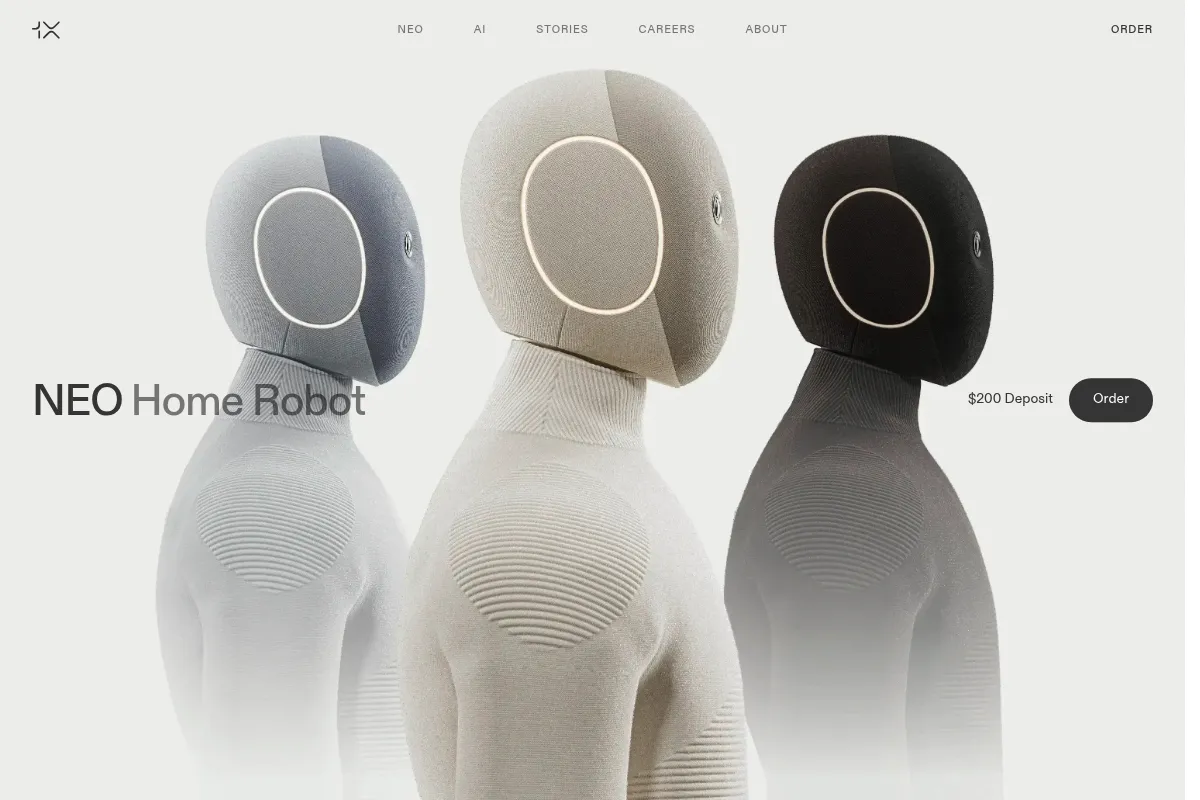
1X provides the EVE model for commercial security and logistics, capable of patrolling and basic manipulation. Their upcoming NEO model is a bipedal humanoid designed for domestic tasks, trained using end-to-end neural networks to learn from human demonstration.
What makes it different
Unlike competitors using high-torque rigid actuators, 1X uses revertible motors that make the robot 'squishy' and safe to touch. Their partnership with OpenAI allows them to bypass traditional robotics coding in favor of end-to-end learning from video and teleoperation data.
Ratings across the web

Ratings aggregated from independent review platforms.
Key Features
Revertible Actuators
Allows the robot to be moved by hand without damage, ensuring safety around humans.
End-to-End Learning
Uses video and sensor data to train behaviors directly, reducing the need for manual programming.
VR Teleoperation
Enables human operators to take control for tasks the AI hasn't mastered yet.
Wheeled Base (EVE)
Provides 12+ hours of battery life and high stability for security applications.
Bipedal Design (NEO)
Engineered to navigate stairs and narrow home environments.
OpenAI Integration
Leverages advanced AI models for natural language processing and task planning.
Soft Exterior
NEO features a padded suit to further minimize impact risks in domestic settings.
Pricing
EVE Enterprise
- Wheeled humanoid hardware
- Security and logistics software suite
- Teleoperation interface
- Maintenance and support
NEO Early Access
- Bipedal humanoid hardware
- Home-optimized AI models
- Early adopter feedback program
Pricing checked 5 months ago
Pricing guidance
- When transitioning from pilot to full-scale security patrolling
- When moving from wheeled environments to bipedal-required spaces (stairs)
- Maintenance contracts are typically required
- Battery life varies significantly based on task intensity
- Teleoperation requires high-bandwidth, low-latency internet
Premium enterprise positioning with a focus on long-term R&D value.
Pros & Cons
Strengths
-
Inherent physical safety
The low-gear-ratio motors mean the robot cannot exert dangerous force against a human, making it viable for crowded workspaces.
-
Proven industrial deployment
EVE is already deployed in security roles, proving the hardware can handle real-world shifts and charging cycles.
-
Advanced teleoperation
The VR interface is highly responsive, allowing a single human to manage a fleet of robots from a remote location.
Weaknesses
-
High hardware cost
Humanoid hardware remains significantly more expensive than specialized automation, making ROI difficult for simple tasks.
Affects: Small to medium enterprises
-
NEO is still in development
The bipedal home-focused model is not yet available for general purchase, limiting current options to the wheeled EVE.
Affects: Consumer and domestic users
-
Limited payload capacity
Designed for safety rather than strength, these robots cannot lift heavy industrial loads compared to traditional robotic arms.
Affects: Heavy manufacturing and warehouse logistics
Real User Sentiment
Generally positive among tech enthusiasts and robotics researchers, though some skepticism remains regarding the timeline for home adoption.
Users tend to like
- The safety-first motor design
- High-quality teleoperation demos
- The aesthetic and non-threatening design of NEO
Users commonly complain about
- Lack of public pricing
- Long wait times for NEO
- Uncertainty about real-world battery performance in complex tasks
Recurring tradeoffs
- Safety vs. Strength: The robot is safe because it is relatively weak compared to industrial arms.
Happiest users
Enterprise security managers looking to augment human guards with 24/7 robotic patrols.
Often frustrated
Early adopters wanting a 'Rosie the Robot' for their home today.
Use Cases
Security Patrol
EVE monitors facilities and provides a remote presence for human guards.
Light Logistics
Moving small parts or mail between offices in a corporate campus.
Robotics Research
Labs using 1X hardware to test new end-to-end AI models.
Healthcare Assistance
Assisting with non-clinical tasks like moving linens or supplies in hospitals.
Remote Inspection
Using VR teleoperation to inspect hazardous or distant sites without travel.
Frequently Asked Questions
How much does a 1X robot cost?
1X does not publish flat pricing for EVE or NEO. EVE is typically sold or leased via enterprise contracts that include software and maintenance. NEO is currently in a pre-order/waitlist phase with pricing expected to target the cost of a mid-range car upon mass production.
What is the relationship between 1X and OpenAI?
OpenAI is a lead investor in 1X. The companies collaborate on integrating large-scale AI models into physical hardware, specifically focusing on end-to-end learning where the robot learns tasks by watching humans rather than being programmed.
Can NEO do laundry or clean my house?
While NEO is designed for domestic tasks, it is currently in the beta/testing phase. It has demonstrated the ability to handle soft objects and perform basic cleaning in controlled demos, but it is not yet a 'plug-and-play' appliance for the average home.
How does 1X compare to Tesla Optimus?
Tesla Optimus focuses on high-volume manufacturing and vertical integration with Tesla's supply chain. 1X focuses on 'soft' robotics and safety-first actuators, making their robots arguably better suited for immediate interaction with humans in non-factory settings.
Is the robot fully autonomous?
It depends on the task. 1X robots can navigate and perform simple tasks autonomously, but they rely on human teleoperation for complex or novel situations. The goal is to increase the 'autonomy ratio' over time as the AI models learn.
What happens if the robot hits someone?
Because 1X uses low-gear-ratio actuators and 'revertible' motors, the robot yields to external force. If it hits a person, the limb will move back easily, significantly reducing the risk of injury compared to traditional rigid robots.
Why trust this page?
This evaluation combines product positioning, pricing analysis, traffic and market signals, and public user sentiment into a single decision-support page. Content is generated editorially — not copied from the vendor's website.
Funding & Company
Founded
2014
Stage
Series b
Total Raised
$123.5M
Latest Round
Series B (Jan 2024)
Notable Investors
1X has raised over $123.5 million, primarily through two significant rounds in less than a year, indicating strong investor confidence. The backing by strategic investors like OpenAI and established VCs like EQT Ventures and Tiger Global suggests the company is well-capitalized to pursue its ambitious goal of commercializing humanoid robots.
Market Signals & Traffic
Estimated visits, global rank, geography, traffic sources, monthly visit trends, and organic search keywords (Similarweb)—on a dedicated page built for depth and search.
- Estimated visits
- 303,747
- Global rank
- #164,319
- Snapshot
- Apr 2026
- Traffic trend
- Falling
Estimated monthly visits
Alternatives to 1X
View all alternativesFigure
Automation & Agents, Workflow

General-purpose humanoid robots designed for manual labor and automation.
Unitree
Automation & Agents, Developer Tools, Research

High-performance quadruped and humanoid robots for consumer and industrial applications.
Similar Tools
WorkBeaver
Automation & Agents, Productivity

Automate repetitive computer tasks by demonstrating workflows or using text instructions.
ServiceNow
Automation & Agents, Productivity

Enterprise platform for digital workflows and business process automation.
Gumloop
Automation & Agents, Productivity

No-code platform for building AI agents and automating complex workflows.
Aspect
Automation & Agents, Developer Tools, Workflow

Build and deploy agents that automate tasks in the browser.
Unsloth
Developer Tools, Research

Lightweight framework for faster and memory-efficient LLM fine-tuning.
AgentSpace
Automation & Agents, Developer Tools, Workflow

Build, deploy, and manage autonomous agent workflows for business automation.