

An agent-native development platform that shifts AI from a coding assistant to an autonomous task-runner, best for teams with high-volume maintenance and clear ticket specifications.
Excellent for automating the ticket-to-PR pipeline, weaker for high-level architectural design or teams with low test coverage.
Analysis based on product data, pricing structure, traffic signals, and public user sentiment.
Who Should Use Factory?
Typical users
Engineering teams at scaling startups or enterprises with established CI/CD pipelines and a high volume of well-defined tickets.
Maturity fit
scaling to advanced
Choose this if…
- You want to delegate entire Jira/Linear tickets rather than just writing lines of code
- Your priority is clearing technical debt and maintenance backlogs autonomously
- You have strong test coverage that can validate agent-generated pull requests
Skip this if…
- You only need a lightweight autocomplete tool like GitHub Copilot
- Your codebase is undocumented or lacks automated testing
- You are a solo developer on a strict budget sensitive to token overages
About Factory
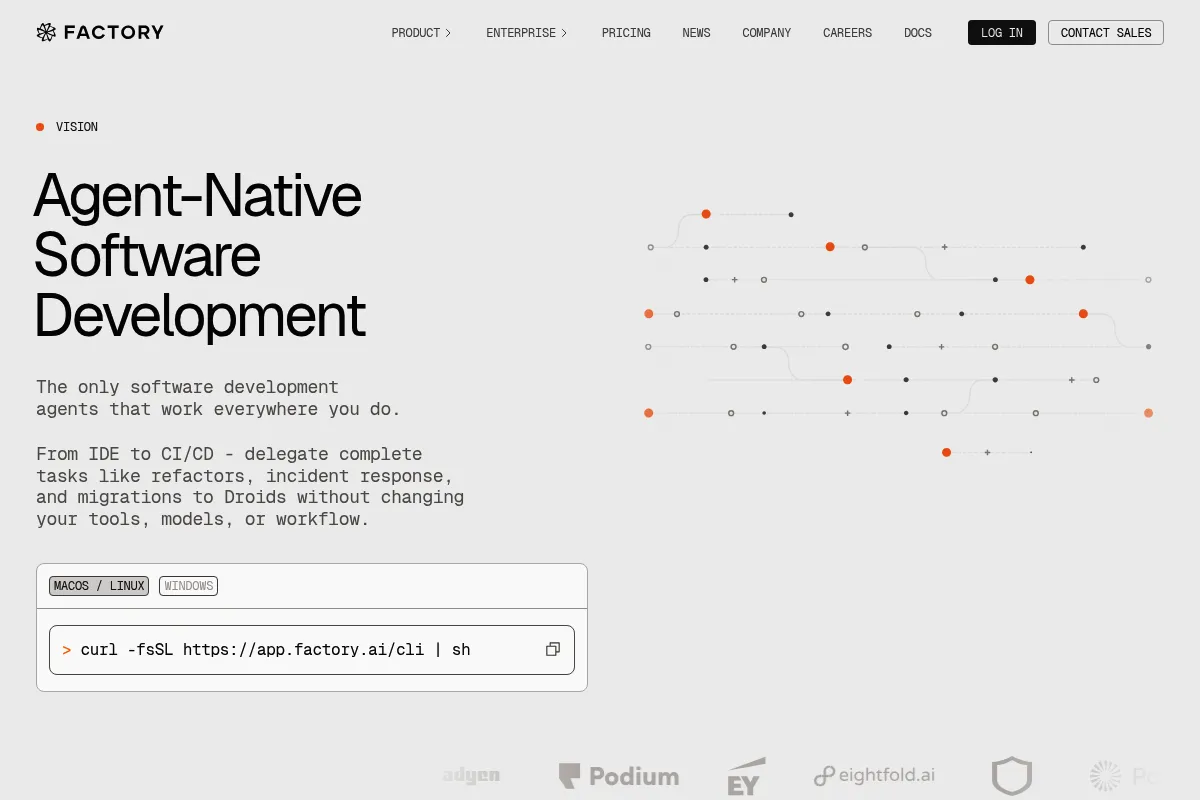
Factory is an agentic engineering platform that deploys specialized 'Droids' to automate the software development lifecycle. It moves beyond simple code suggestions by handling the planning, execution, and verification of entire engineering tasks.
Official profiles
What it actually does
It connects project management tools to your codebase to automate the transition from a ticket to a pull request. When a task is assigned, a Droid analyzes the repository, creates an execution plan, writes the code, and submits the changes for human review.
What makes it different
Unlike 'Copilots' that require constant human prompting, Factory is 'agent-native,' meaning it works asynchronously on background tasks. It indexes the entire repository and integrates with observability tools like Sentry to fix production bugs without manual intervention.
Ratings across the web
Ratings aggregated from independent review platforms.
Key Features
Code Droid
Handles feature implementation, refactoring, and bug fixes end-to-end.
Knowledge Droid
Indexes documentation and code to answer complex architectural questions.
Reliability Droid
Triages production incidents and suggests fixes based on error logs.
Product Droid
Drafts PRDs and breaks down high-level goals into actionable subtasks.
Factory CLI
Allows developers to script and parallelize agents within their local terminal.
Review Interface
A dedicated UI for humans to audit and approve agent plans before execution.
Knowledge Graph
Maps codebase dependencies to ensure context-aware changes across files.
Pricing
Free
- Bring Your Own Key (BYOK) support
- Basic Droid access
- Terminal UI
- Limited standard tokens
Pro
- 20M Standard Tokens included
- Web platform access
- Full integration suite (GitHub, Jira, Slack)
- Priority support
Max
- Higher token limits
- Team collaboration features
- Advanced Droid personas
- Bonus token allocations
Enterprise
- SSO and SAML authentication
- On-premise deployment options
- Custom Droid development
- Dedicated account management
Pricing checked 6 months ago
Pricing guidance
- When you hit the 20M token ceiling on the Pro plan
- When you need to share agent sessions across a team
- When you require SSO for security compliance
- Token multipliers vary by model (e.g., GPT-4o consumes tokens faster than Droid Core)
- Overage costs are billed at approximately $2.70 per 1M tokens
Premium positioning justified by its agentic capabilities, though token-based billing makes it more expensive than flat-rate copilots.
Pros & Cons
Strengths
-
True task delegation
Moves engineers from 'writing code' to 'reviewing plans,' which significantly reduces the time spent on repetitive maintenance tasks.
-
Deep repository context
By indexing the entire codebase, the agents can make accurate cross-file changes that simple chat-based LLMs often miss.
-
Workflow-agnostic operation
Operates across Slack, IDEs, and the web, allowing teams to trigger agents wherever they already work.
Weaknesses
-
Unpredictable token consumption
Complex tasks or failed attempts can burn through monthly token allowances rapidly, leading to unexpected costs.
Affects: Budget-conscious teams and solo developers
-
Variable code quality
Agents may occasionally ignore project-specific best practices or create bloated file structures that require manual refactoring.
Affects: Teams with strict style guides or complex architectures
-
High setup dependency
The tool's effectiveness is directly tied to the quality of your tickets and test suites; without them, agents struggle to verify their work.
Affects: Early-stage startups with 'messy' codebases
Real User Sentiment
Users are generally impressed by the 'fire and forget' vision but remain cautious about the reliability of fully autonomous code.
Users tend to like
- Asynchronous task execution
- Deep integration with Jira and Linear
- Ability to bring your own model keys
- Incident triaging via Sentry
Users commonly complain about
- High token burn rates
- Occasional 'hallucinated' file structures
- Need for manual refactoring of AI code
Recurring tradeoffs
- The time saved on coding is sometimes offset by the time spent reviewing and fixing agent output.
Happiest users
Engineering managers looking to automate 'drudge work' and developers who write detailed tickets.
Often frustrated
Developers expecting a perfect 'one-shot' solution for complex architectural changes.
Use Cases
Clearing technical debt
Assigning 'Code Droid' to refactor legacy modules or update dependencies.
Automating documentation
Using 'Knowledge Droid' to generate READMEs and onboarding guides from the codebase.
Triaging production errors
Connecting 'Reliability Droid' to Sentry to automatically suggest fixes for new incidents.
Migrating codebases
Running large-scale version upgrades or library migrations across multiple repositories.
Onboarding new devs
Providing a 'Knowledge Droid' to answer questions about internal systems and patterns.
Frequently Asked Questions
How does Factory.ai pricing work?
Factory uses a token-based model. The Pro plan ($20/mo) includes 20M tokens, while the Free plan allows you to 'Bring Your Own Key' (BYOK) to pay your model provider directly. Overages on paid plans are typically billed at $2.70 per 1M tokens.
Is Factory.ai better than Devin?
Factory focuses on integrating into existing enterprise workflows (Jira, Slack, GitHub), while Devin is often viewed as a standalone 'AI software engineer' in its own environment. Factory is generally more practical for teams that want to keep their existing tools.
Does Factory.ai replace GitHub Copilot?
Not necessarily. Copilot is best for real-time autocomplete while you type. Factory is designed for 'outer loop' tasks where you delegate an entire ticket and walk away while the agent works.
Is my code secure with Factory?
Factory is SOC 2 Type II, GDPR, and ISO 42001 compliant. They offer enterprise features like air-gapped deployments and the ability to use your own enterprise LLM gateways to ensure data privacy.
What integrations does Factory support?
It integrates with GitHub, GitLab, Jira, Linear, Slack, Notion, Sentry, and PagerDuty. It also supports major IDEs like VS Code and JetBrains via a dedicated bridge.
Can I use my own models with Factory?
Yes, Factory supports BYOK (Bring Your Own Key) for providers like OpenAI, Anthropic, and Google, as well as enterprise gateways like AWS Bedrock and Azure OpenAI.
Why trust this page?
This evaluation combines product positioning, pricing analysis, traffic and market signals, and public user sentiment into a single decision-support page. Content is generated editorially — not copied from the vendor's website.
Funding & Company
Founded
2023
Stage
Series c
Total Raised
$220M
Latest Round
Series C (Apr 2026)
Notable Investors
Factory has raised a total of $220 million, culminating in a $150 million Series C in April 2026 that valued the company at $1.5 billion. This substantial backing from elite investors like Khosla Ventures, Sequoia Capital, and NEA provides exceptional financial stability and a long runway for product development and enterprise expansion.
Market Signals & Traffic
Estimated visits, global rank, geography, traffic sources, monthly visit trends, and organic search keywords (Similarweb)—on a dedicated page built for depth and search.
- Estimated visits
- 0
- Global rank
- —
- Snapshot
- May 2026
- Traffic trend
- Surging
Estimated monthly visits
Alternatives to Factory
View all alternativesCursor
AI Assistant

An AI-powered code editor designed to help developers build software faster.
Claude
AI Assistant

A conversational AI assistant for writing, analysis, coding, and more.
GitHub Copilot
Developer Tools, AI Assistant

AI-powered coding assistant that suggests and generates code.
Similar Tools
Mem0
Developer Tools, Automation & Agents, Productivity

Persistent memory layer for personalized agents and applications.
Not Diamond
Developer Tools, Automation & Agents, Productivity

Intelligent model router selecting the best LLM for every prompt.
NoimosAI
Marketing Automation, Automation & Agents, SEO

Autonomous marketing platform for research, strategy, and campaign execution.
Serval
Automation & Agents, Developer Tools, Data Extraction

Build autonomous agents that navigate and automate web browser tasks.
LaVague
Automation & Agents, Developer Tools, Data Extraction

Open-source framework for building autonomous web agents and automation.
All Hands AI
Developer Tools, Automation & Agents

Open-source platform for autonomous software engineering agents.