

Baichuan Intelligence
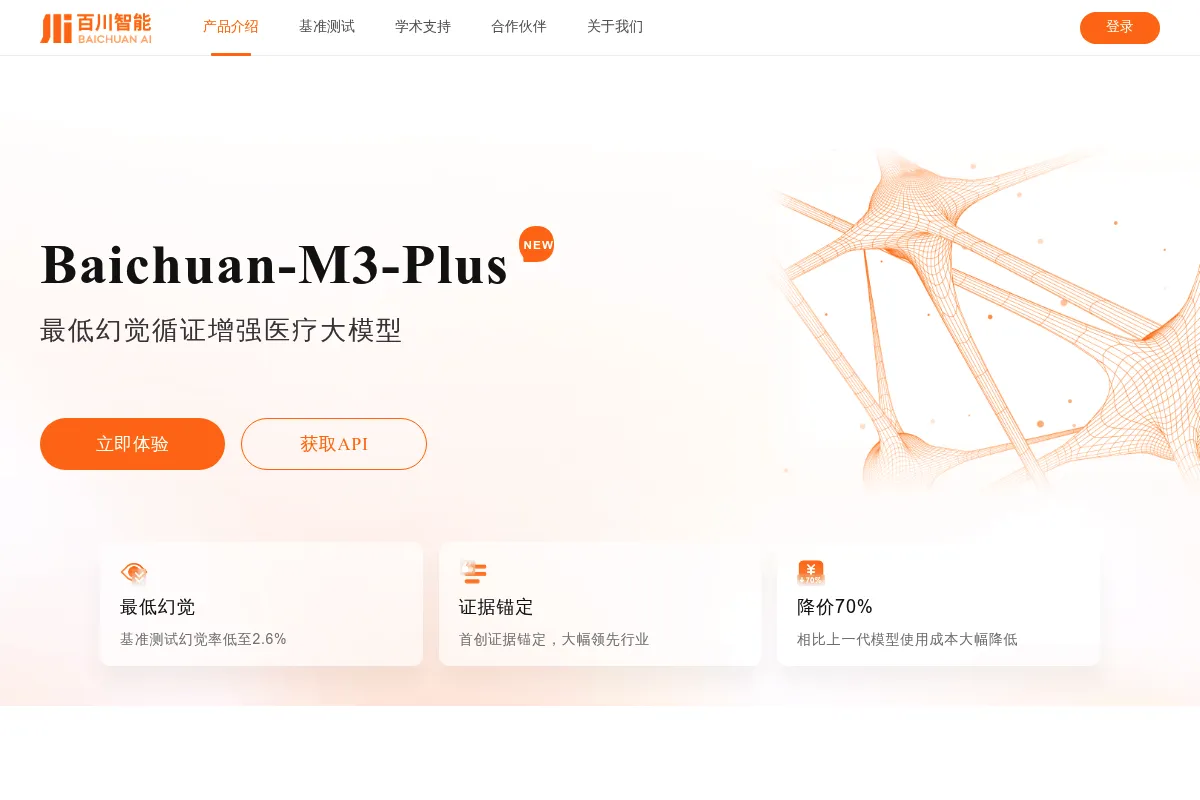
A high-performance LLM provider specializing in Chinese-English bilingual models, offering a mix of open-source weights for local deployment and a proprietary API for enterprise-grade reasoning.
Best for developers building applications for the Chinese market, weaker for those requiring deep integration with Western SaaS ecosystems.
Analysis based on product data, pricing structure, traffic signals, and public user sentiment.
Who Should Use Baichuan Intelligence?
Typical users
Developers, AI researchers, and enterprise product teams focused on the Chinese market or requiring high-accuracy Chinese linguistic processing.
Maturity fit
scaling to advanced
Choose this if…
- Your primary target audience is in China and requires native-level linguistic nuance.
- You need to fine-tune and self-host models using open-source weights (7B/13B).
- Your workflow involves processing massive Chinese documents that require a 192k context window.
Skip this if…
- Your application is English-only and can be served more easily by local providers like OpenAI or Anthropic.
- You require native integration with US-based cloud ecosystems like AWS Bedrock or Google Vertex AI.
- Your data residency policies prohibit using models governed by Chinese AI regulations.
About Baichuan Intelligence
Baichuan Intelligence is a Beijing-based AI firm founded by Wang Xiaochuan, the former CEO of Sogou. It develops large language models designed to match or exceed Western counterparts in Chinese language benchmarks while maintaining competitive performance in English.
Official profiles
What it actually does
The platform provides access to the Baichuan family of models through a web API and downloadable open-source weights. It enables text generation, complex logical reasoning, and long-form content analysis with specific optimizations for the Chinese regulatory and cultural environment.
What makes it different
Unlike many general-purpose models, Baichuan is built specifically to top Chinese benchmarks like C-Eval and CMMLU. It distinguishes itself by offering high-parameter open-source models (Baichuan2-7B/13B) that allow for commercial use, bridging the gap between private research and public API services.
Key Features
Baichuan-4
Proprietary model designed for high-level reasoning and complex instruction following.
Baichuan2-Turbo
Optimized API model for low-latency conversational applications.
192k Context Window
Allows the model to ingest and summarize entire books or technical manuals in one prompt.
Search Enhancement
Integrated retrieval capabilities to reduce factual hallucinations in real-time queries.
RLHF Optimization
Models are fine-tuned for human preference within specific regional cultural contexts.
Permissive Open Source
The 7B and 13B models are available for free commercial use under specific licensing terms.
Pricing
Baichuan-NPC-Lite
- Optimized for roleplay
- Low latency
- Ideal for gaming NPCs
Baichuan2-Turbo
- Balanced speed and intelligence
- Standard conversational use
- Search enhancement support
Baichuan-4
- Highest reasoning capability
- Complex problem solving
- Best for logical tasks
Pricing checked 5 months ago
Pricing guidance
- When moving from basic chat to complex logical reasoning (upgrade to Baichuan-4).
- When processing documents exceeding standard context limits.
- When trial credits are exhausted.
- Rate limits apply based on account tier.
- Commercial use of open-source models requires a license if user counts exceed certain thresholds.
Aggressively priced to compete with other major Chinese providers like Baidu and Alibaba.
Pros & Cons
Strengths
-
Superior Chinese language performance
Consistently outperforms global models in regional benchmarks, making it more reliable for local idioms and cultural references.
-
Flexible deployment options
The availability of open-source weights allows teams to host models on their own infrastructure, ensuring data privacy for sensitive enterprise tasks.
-
Competitive API pricing
Token costs are significantly lower than GPT-4 for comparable Chinese-language tasks, reducing overhead for high-volume applications.
Weaknesses
-
Regional ecosystem isolation
Lacks the extensive library of third-party plugins and integrations found in the OpenAI or Llama ecosystems.
Affects: Developers using standard Western AI orchestration frameworks.
-
Regulatory compliance overhead
Models are subject to strict Chinese content filtering and data handling laws, which may impact output neutrality.
Affects: Global companies with strict internal content policies.
-
English documentation gaps
While the models are bilingual, the most detailed technical documentation and community support are primarily in Chinese.
Affects: Non-Chinese speaking development teams.
Real User Sentiment
Generally positive, with users praising the model's ability to handle complex Chinese syntax better than GPT-3.5/4.
Users tend to like
- High-quality Chinese output
- Generous context window for RAG
- Ease of fine-tuning the 13B model
Users commonly complain about
- Strict content filtering
- Latency issues when accessed from outside China
- Limited English support documentation
Recurring tradeoffs
- Users trade global ecosystem compatibility for superior local language performance.
Happiest users
Chinese startups building localized AI assistants and researchers fine-tuning models for specific domains.
Often frustrated
Western developers looking for a direct, unfiltered alternative to OpenAI.
Use Cases
Chinese Customer Support
Automating responses for e-commerce platforms with high accuracy in local dialects.
Legal Document Analysis
Using the 192k context window to review and summarize long Chinese legal filings.
Gaming NPCs
Powering dynamic dialogue for characters in Chinese-developed RPGs using the NPC-specific models.
Academic Research
Utilizing open-source weights to study LLM behavior in bilingual environments.
Enterprise Knowledge Base
Implementing RAG to allow employees to query internal Chinese documentation.
Frequently Asked Questions
Is Baichuan AI free to use?
The open-source models (Baichuan2-7B and 13B) are free to download and use, including for commercial purposes with a license. However, the high-performance API services like Baichuan-4 are pay-as-you-go based on token consumption.
How does Baichuan-4 compare to GPT-4?
In Chinese language benchmarks and cultural reasoning, Baichuan-4 performs at a similar level to GPT-4. However, GPT-4 generally maintains an edge in complex coding tasks and English-centric logical reasoning.
What is the maximum context window?
Baichuan supports context windows up to 192k tokens in its specialized models, which is significantly larger than the standard 32k or 128k offered by many competitors, making it ideal for long-form document analysis.
Can I deploy Baichuan on my own servers?
Yes, you can download the weights for the Baichuan2-7B and 13B models from platforms like Hugging Face or GitHub and deploy them on your own hardware using frameworks like vLLM or TGI.
Does it support English language tasks?
Yes, Baichuan models are trained on a bilingual corpus and are highly capable in English, though their primary optimization and competitive advantage lie in Chinese language processing.
Are there any restrictions on commercial use?
For the open-source models, commercial use is permitted but requires a formal application and license if your application reaches a massive user base (typically over 100 million monthly active users).
Why trust this page?
This evaluation combines product positioning, pricing analysis, traffic and market signals, and public user sentiment into a single decision-support page. Content is generated editorially — not copied from the vendor's website.
Funding & Company
Founded
2023
Stage
Series a
Total Raised
$741M
Latest Round
Series A (Jul 2024)
Notable Investors
Baichuan Intelligence has raised approximately $741 million across two funding rounds since its founding in April 2023. The company is backed by China's largest technology corporations, including Alibaba, Tencent, and Xiaomi, providing it with substantial capital for long-term product development and stability.
Market Signals & Traffic
Estimated visits, global rank, geography, traffic sources, monthly visit trends, and organic search keywords (Similarweb)—on a dedicated page built for depth and search.
- Estimated visits
- 61,711
- Global rank
- #532,391
- Snapshot
- Apr 2026
- Traffic trend
- Falling
Estimated monthly visits
Alternatives to Baichuan Intelligence
View all alternativesClaude
AI Assistant

A conversational AI assistant for writing, analysis, coding, and more.
Mistral AI
AI Assistant, Developer Tools

Efficient large language models for developers and enterprise applications.
Alibaba Cloud (Qwen)
Developer Tools, Content Creation

Large language models for text generation, reasoning, and coding.
Similar Tools
Reflection
AI Assistant, Developer Tools, Research

Open-source language model that corrects its own reasoning errors.
vLLM
Developer Tools, Workflow

High-throughput serving engine for large language model inference
Wordware
Developer Tools, Automation & Agents, Workflow

IDE for building and deploying complex LLM applications
Labelbox
Developer Tools, Research, Automation

Platform for data labeling, management, and model evaluation workflows.
Back4App
Developer Tools, Automation & Agents, Workflow
Backend-as-a-Service platform for building and scaling applications.
Five9
Communication, Automation & Agents, Productivity

Cloud contact center platform for customer service and sales teams