

A high-end creative automation platform built for enterprise brands and agencies that need to scale thousands of ad variants across global markets without manual redesigns.
Excellent for high-volume display and social ad production, weaker for small teams with low-frequency creative needs.
Analysis based on product data, pricing structure, traffic signals, and public user sentiment.
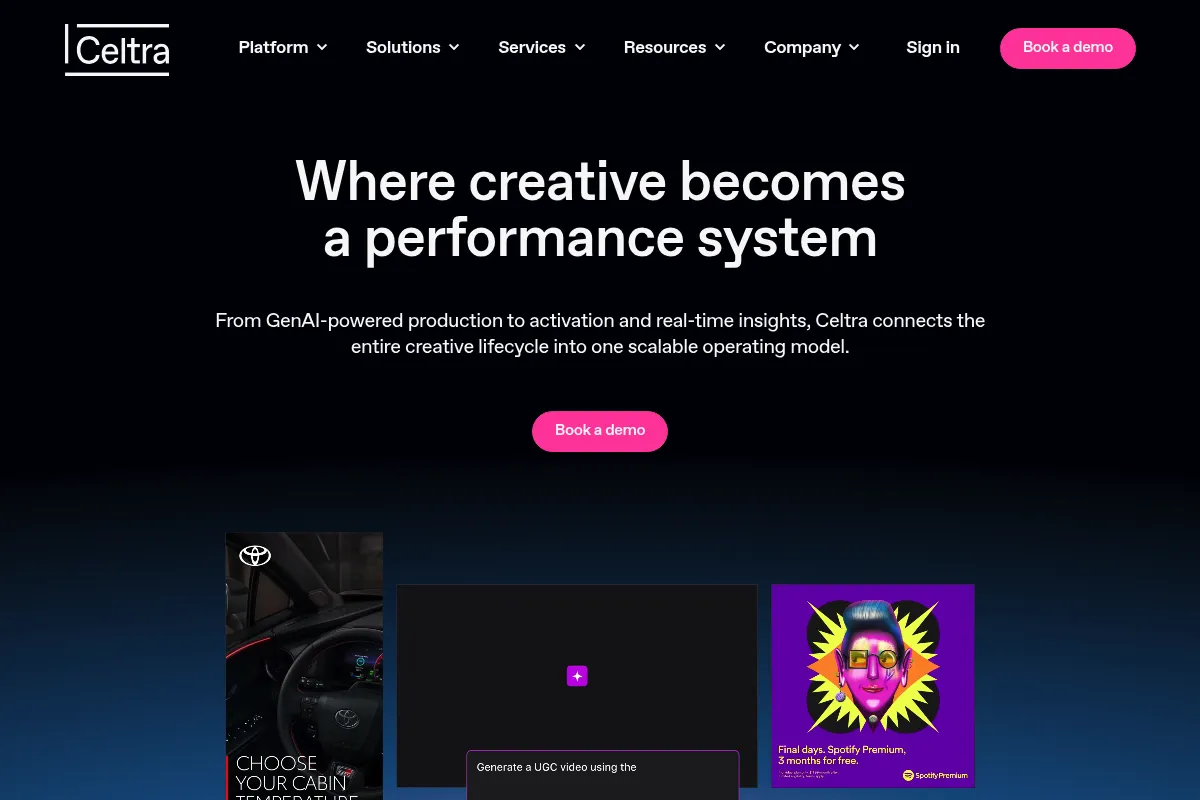
Who Should Use Celtra?
Typical users
Enterprise marketing teams, global creative agencies, and performance marketers managing multi-market digital campaigns.
Maturity fit
advanced
Choose this if…
- You need to produce 500+ ad variations per campaign across different sizes and languages
- Your priority is strict brand governance across decentralized global teams
- You want to automate the resizing and localization of video and display assets
- You require deep integration with DSPs and social platforms for dynamic creative optimization (DCO)
Skip this if…
- You are a small business running fewer than 10 ad variants per month
- You need a simple, low-cost Canva alternative for basic social posts
- Your workflow doesn't involve complex ad tech distribution or programmatic buying
About Celtra
Celtra is a cloud-based creative management platform (CMP) designed to solve the bottleneck of high-volume digital ad production. It centralizes the creative lifecycle, from template design to automated scaling and direct distribution to ad networks.
Official profiles
What it actually does
It allows designers to build 'master' templates that automatically generate thousands of versions for different aspect ratios, languages, and audience segments. The platform then pushes these assets directly to social and programmatic channels while tracking creative performance.
What makes it different
Unlike generic design tools, Celtra is purpose-built for the ad tech ecosystem. It combines a professional-grade design environment with automated versioning and direct API connections to major ad platforms, specifically focusing on the technical requirements of display and video advertising.
Ratings across the web

Ratings aggregated from independent review platforms.
Key Features
Creative Automation
Generates thousands of ad variants from a single master template to eliminate manual resizing.
Dynamic Creative
Serves different creative versions in real-time based on data triggers like weather, location, or audience behavior.
Cloud-based Ad Builder
A professional design environment specifically for interactive and rich media ad formats.
Brand Kits
Centralizes fonts, colors, and logos to ensure consistency across all automated outputs.
Direct Distribution
Push creative assets directly to Facebook, Instagram, and major DSPs without manual downloads.
Video Automation
Scalable video production using data-driven templates for social and pre-roll ads.
Review & Approval Workflow
Built-in commenting and version control for creative teams and stakeholders.
Pricing
Enterprise
- Full Creative Automation suite
- Dynamic Creative Optimization (DCO)
- Video and Social automation
- Dedicated account management
- Custom integrations
Pricing checked 6 months ago
Pricing guidance
- When manual ad production becomes a bottleneck for media spend
- When expanding into multiple international markets
- When implementing a DCO strategy
- Pricing is often tied to creative volume or media spend
- Implementation and onboarding can take several weeks
- Advanced features may require professional services fees
Premium enterprise positioning justified by significant labor savings in high-volume environments.
Pros & Cons
Strengths
-
Massive production efficiency
Reduces the time spent on manual resizing and localization by up to 80%, allowing designers to focus on the initial concept rather than repetitive tasks.
-
Strict brand control
Lockable template elements ensure that even when scaling thousands of ads, the core brand identity remains intact across all regions.
-
Deep ad tech integration
Direct connections to the programmatic ecosystem mean fewer errors during the trafficking process compared to manual asset uploads.
Weaknesses
-
High cost of entry
The pricing model is built for enterprise budgets, making it inaccessible for small businesses or solo creators.
Affects: Small businesses and startups
-
Steep learning curve
The builder is sophisticated and requires significant training for designers used to simpler tools like Canva or basic Photoshop.
Affects: Designers and junior operators
-
Overkill for static needs
If your strategy relies on a few high-quality static images rather than high-volume testing, the automation features won't provide ROI.
Affects: Boutique brands
Real User Sentiment
Users generally view Celtra as the gold standard for ad scaling, though they acknowledge the high price and technical complexity.
Users tend to like
- The ability to update live ads without re-trafficking
- Significant reduction in production turnaround times
- High-quality output for rich media and interactive formats
Users commonly complain about
- The UI can feel cluttered and non-intuitive for new users
- High cost compared to newer, lighter automation tools
- Occasional bugs in the previewer for complex interactive ads
Recurring tradeoffs
- You trade design flexibility for automation speed; templates must be built correctly to work at scale.
Happiest users
Global creative directors at Fortune 500 brands and production leads at large media agencies.
Often frustrated
Freelance designers or small marketing teams who find the platform too complex for simple banner needs.
Use Cases
Global Product Launches
Generating 2,000+ localized ad variants in 20 languages for a simultaneous worldwide release.
Dynamic Retargeting
Showing users the exact product they viewed on a website within a personalized display ad.
Social Video Scaling
Turning a single 15-second master video into dozens of different formats for TikTok, Reels, and YouTube.
A/B Testing at Scale
Rapidly creating variations of headlines and CTAs to find the highest-performing creative combinations.
Retail Promotions
Automatically updating pricing and offers across thousands of live banners during a holiday sale.
Frequently Asked Questions
How much does Celtra cost?
Celtra does not publish pricing. It is an enterprise-grade tool typically starting in the five-figure range annually, often scaling based on the volume of creative produced or the number of seats required.
How does Celtra compare to Bannerflow or Creatopy?
Celtra is more focused on the enterprise and ad tech integration (DCO) than Creatopy, which is more of a self-service design tool. Bannerflow is its closest competitor, but Celtra is often preferred for complex video automation and high-end interactive formats.
Does Celtra replace Adobe Creative Cloud?
No. Designers typically create core assets in Photoshop or After Effects and then import them into Celtra to build the smart templates used for automation and scaling.
Can I use Celtra for social media ads?
Yes, Celtra has deep integrations with Facebook, Instagram, Snapchat, and Pinterest, allowing for automated versioning and direct publishing to these platforms.
Is there a free trial for Celtra?
No, Celtra does not offer a public free trial. Access is usually granted through a guided demo and a structured pilot program for enterprise customers.
What are the main limitations of Celtra?
The primary limitations are its high cost and the technical skill required to build complex templates. It is not a 'push-button' AI generator; it requires a designer to set up the logic and structure of the templates first.
Why trust this page?
This evaluation combines product positioning, pricing analysis, traffic and market signals, and public user sentiment into a single decision-support page. Content is generated editorially — not copied from the vendor's website.
Funding & Company
Founded
2006
Stage
Acquired
Total Raised
$25.2M
Latest Round
Series C (Jun 2017)
Notable Investors
Celtra raised a total of $25.2M in venture capital before being acquired in a majority-stake deal by private equity firm Symphony Technology Group (STG) in late 2021. This transition from VC funding to a PE acquisition signals a shift from a high-growth focus to one centered on profitability and long-term stability.
Market Signals & Traffic
Estimated visits, global rank, geography, traffic sources, monthly visit trends, and organic search keywords (Similarweb)—on a dedicated page built for depth and search.
- Estimated visits
- 16,409,889
- Global rank
- #4,803
- Snapshot
- Apr 2026
- Traffic trend
- Surging
Estimated monthly visits
Alternatives to Celtra
View all alternatives
Similar Tools
iubenda
Privacy & Compliance, Documentation, Automation

Compliance solution for privacy policies, cookie banners, and legal documents.
Cursor
AI Assistant

An AI-powered code editor designed to help developers build software faster.
BrandCrowd
Design, Content Creation

Logo maker and branding design platform for small businesses.
Mem AI
Productivity, AI Assistant

AI-powered note-taking and knowledge management app.
Artbreeder
Content Creation, Design

AI-powered platform for creating and manipulating images.
OpenClaw
AI Assistant, Automation, Developer Tools

Open-source AI agent that automates tasks via messaging platforms.