

Vapi is a developer-centric platform for building voice AI agents, offering deep customization over models and infrastructure, but requiring significant technical expertise and leading to complex, variable costs.
Best for developers needing granular control over voice AI infrastructure, not for teams seeking a simple, all-in-one solution.
Analysis based on product data, pricing structure, traffic signals, and public user sentiment.
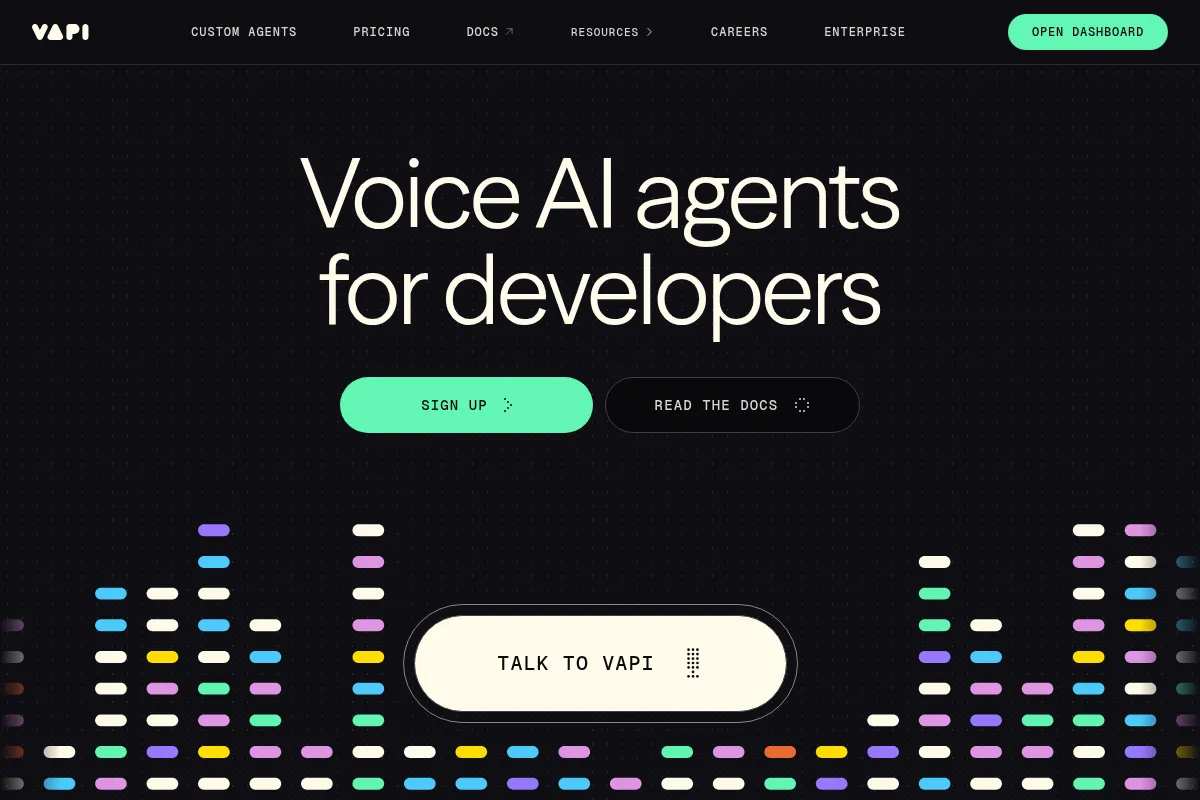
Who Should Use Vapi?
Typical users
Software developers, AI engineers, and technical product managers who need to embed sophisticated voice AI capabilities into applications or build custom voice-based products.
Maturity fit
scaling to advanced
Choose this if…
- You need to integrate custom LLM, STT, and TTS providers.
- Your product's core functionality relies on highly specific voice interactions.
- You have a development team capable of managing complex API integrations and infrastructure.
- You require fine-grained control over latency and conversational flow.
Skip this if…
- You need a no-code or low-code solution for quick deployment.
- Your budget requires predictable, all-inclusive per-minute pricing.
- You lack dedicated engineering resources for setup and maintenance.
- Your primary need is for simple IVR or basic conversational agents.
About Vapi
Vapi is a developer platform that provides APIs and tools to build, test, and deploy voice AI agents. It acts as an orchestration layer, allowing developers to select and integrate their preferred speech-to-text (STT), large language model (LLM), and text-to-speech (TTS) providers. The platform aims to abstract away infrastructure complexity, enabling developers to focus on creating custom voice experiences for various applications.
Official profiles
What it actually does
Vapi allows developers to construct voice AI agents that can engage in natural conversations, make and receive phone calls, and integrate with external systems via APIs. It handles the real-time audio processing, model orchestration, and telephony, enabling the creation of custom voice assistants for tasks like customer support, sales, and appointment scheduling.
What makes it different
Vapi differentiates itself by offering a highly modular and developer-centric approach, providing extensive control over the choice of underlying AI models (LLM, STT, TTS) and telephony providers. This 'bring-your-own-stack' philosophy contrasts with more opinionated, all-in-one platforms, appealing to developers who prioritize flexibility and deep customization over ease of use.
Ratings across the web

Ratings aggregated from independent review platforms.
Key Features
Modular Provider Integration
Allows developers to select and integrate their preferred LLM, STT, and TTS services, offering maximum flexibility.
Voice API
Provides the core functionality to build, deploy, and manage voice AI agents programmatically.
Assistants and Squads
Enables the creation of single-purpose agents (Assistants) or complex, multi-agent workflows (Squads) for specialized tasks.
Real-time Conversations
Aims for sub-500ms response times for natural, human-like interactions.
Developer Tools (SDKs, CLI)
Offers tools for easier integration and management of voice agents within existing codebases.
Webhooks
Facilitates real-time data exchange and event handling between Vapi and external systems.
Customizable Flows
Allows for the creation of dynamic conversational logic beyond basic branching.
Pricing
Ad-Hoc
- Platform and orchestration fee
- Pay-as-you-go for STT, LLM, TTS, and telephony
Startup
- Includes 7,500 minutes
- API access
- Web interface for testing
- Basic hosting credit
Agency
- Includes 6,000 minutes
- API access
- Web interface for testing
- Basic hosting credit
Enterprise
- Custom pricing based on usage, concurrent calls, integrations, and support needs
- Unlimited concurrent calls
- HIPAA compliance infrastructure
- 24/7 technical support
Pricing checked 6 months ago
Pricing guidance
- When you exceed the included minutes for your plan.
- When you need more than 10 concurrent calls (default limit).
- When you require HIPAA compliance or other advanced security features.
- When you need dedicated support or custom integrations.
- The base per-minute rate ($0.05) only covers Vapi's orchestration; STT, LLM, TTS, and telephony costs are additional and can significantly increase the total cost per minute (often $0.07-$0.25+).
- Default concurrency limit of 10 calls per account, which can be increased via custom plans or add-ons.
- HIPAA compliance is an additional $1,000/month add-on.
- Support is primarily via email or Discord, with limited direct human support for basic plans.
Modular and usage-based, with a low entry point for the orchestration layer but significant additional costs for core AI services and telephony, making it potentially expensive and complex at scale.
Pros & Cons
Strengths
-
High degree of customization
Vapi allows developers to choose and integrate their preferred LLM, STT, and TTS providers, offering unparalleled flexibility in tailoring voice AI agents to specific needs.
-
Developer-focused platform
With robust APIs, SDKs, and clear documentation, Vapi is built for engineers who need deep control and integration capabilities.
-
Real-time performance
The platform is optimized for low latency, aiming for sub-500ms response times to ensure natural and engaging voice interactions.
-
Scalable infrastructure
Vapi handles the complex infrastructure, allowing developers to scale their voice AI applications without managing underlying hardware or services.
Weaknesses
-
Complex and variable pricing
The pricing model is layered, with separate charges for Vapi's orchestration, STT, LLM, TTS, and telephony. This can lead to unpredictable costs that are significantly higher than the base per-minute rate.
-
Requires significant technical expertise
Vapi is designed for developers and requires a strong understanding of APIs, LLMs, and system integration. Non-technical users will find it difficult to move beyond basic configurations.
-
No built-in advanced features
Features like retries, rate limit handling, and long-running operations are not managed by Vapi, requiring developers to implement them.
-
Limited native integrations
While Vapi integrates with many tools via webhooks and APIs, it doesn't offer many out-of-the-box, no-code integrations compared to some competitors.
-
Voice-only focus
Vapi is primarily for voice channels and does not natively support SMS or chat, requiring additional tools for omnichannel communication.
Real User Sentiment
Users generally praise Vapi's flexibility and developer-friendliness, but express concerns about pricing complexity and the need for technical expertise.
Users tend to like
- Flexibility in choosing STT, LLM, and TTS providers.
- Developer-friendly API and SDKs.
- Natural-sounding voices and good voice quality.
- Real-time performance and low latency.
- Responsive and helpful support team.
Users commonly complain about
- Complex and often unpredictable pricing structure.
- Steep learning curve and requirement for technical skills.
- Lack of out-of-the-box, no-code features.
- Concurrency limits can be an issue for high-volume outbound campaigns.
- Support can be slow for non-critical issues.
Recurring tradeoffs
- Flexibility vs. complexity.
- Developer control vs. ease of use.
- Low base rate vs. high total cost per minute.
Happiest users
Developers and engineering teams who value granular control over their voice AI stack and have the resources to manage complex integrations and variable costs.
Often frustrated
Non-technical users or teams seeking a simple, all-in-one, or predictably priced solution for voice AI applications.
Use Cases
Building custom customer support chatbots with voice capabilities.
Developing automated sales outreach and lead qualification systems.
Creating appointment scheduling agents for businesses.
Integrating voice interfaces into existing web or mobile applications.
Automating complex multi-step workflows with voice interaction.
Developing specialized voice agents for logistics or inventory management.
Creating personalized virtual assistants for specific industries like healthcare or finance.
Frequently Asked Questions
What is Vapi's pricing structure?
Vapi uses a usage-based pricing model. The base orchestration fee starts at $0.05 per minute. However, this does not include costs for Speech-to-Text (STT), Large Language Models (LLMs), Text-to-Speech (TTS), and telephony, which are billed separately by third-party providers. This layered approach means the total cost per minute can range from $0.07 to $0.25 or more, depending on the chosen services.
Is Vapi suitable for non-technical users?
Vapi is primarily a developer-focused platform. While it offers a basic no-code builder for simple flows, advanced configuration, integration, and troubleshooting require significant technical expertise. Teams without dedicated developers will likely find it challenging to implement and manage effectively.
What are Vapi's concurrency limits?
By default, Vapi accounts have a concurrency limit of 10 active calls at any given time. This limit is more likely to be reached with high-volume outbound campaigns. For higher concurrency needs, custom plans or add-on lines (at $10 per line per month) are available.
What integrations does Vapi offer?
Vapi integrates with various tools and services through APIs and webhooks, allowing connections to CRMs, databases, and other business systems. Popular integration partners include Zapier, Twilio, HubSpot, and Google Sheets. However, many integrations require custom development or configuration.
How does Vapi compare to Retell AI?
Retell AI is often positioned as a more user-friendly and transparent alternative to Vapi. Retell AI offers a simpler, all-inclusive per-minute pricing model ($0.07+/min) and includes features like STT at no extra charge, unlike Vapi's separate charges. Retell AI also emphasizes a no-code/low-code approach and features like verified phone numbers, making it more accessible for teams without extensive development resources.
What are the main components of a Vapi voice agent?
A Vapi voice agent is built around three core components: Speech-to-Text (STT) to convert spoken audio into text, a Large Language Model (LLM) to process the text and generate responses, and Text-to-Speech (TTS) to convert the LLM's output back into spoken audio. Vapi acts as an orchestration layer, allowing developers to choose their preferred providers for each component.
Does Vapi offer HIPAA compliance?
Yes, Vapi offers HIPAA compliance as an add-on, typically costing an additional $1,000 per month. This is crucial for businesses handling sensitive health information.
What is the typical effective cost per minute for Vapi?
While Vapi's base orchestration fee is $0.05 per minute, the effective cost per minute for a fully functional voice agent typically falls between $0.07 and $0.25 or more. This is due to the combined costs of STT, LLM, TTS, and telephony services from various providers.
Why trust this page?
This evaluation combines product positioning, pricing analysis, traffic and market signals, and public user sentiment into a single decision-support page. Content is generated editorially — not copied from the vendor's website.
Funding & Company
Founded
2020
Stage
Series b
Total Raised
$72.1M
Latest Round
Series B (May 2026)
Notable Investors
Vapi has raised a total of $72.1 million, culminating in a $50 million Series B in May 2026. This significant and recent funding from top-tier investors like Peak XV and Bessemer Venture Partners provides substantial runway and signals strong market confidence in its developer-focused voice AI platform.
Market Signals & Traffic
Estimated visits, global rank, geography, traffic sources, monthly visit trends, and organic search keywords (Similarweb)—on a dedicated page built for depth and search.
- Estimated visits
- 1,198,004
- Global rank
- #28,106
- Snapshot
- Apr 2026
- Traffic trend
- Steady
Estimated monthly visits
Alternatives to Vapi
View all alternativesRetell AI
Communication, Automation & Agents, AI Assistant

Build and deploy human-like conversational voice agents for business.
Bland AI
AI Assistant, Automation

AI platform for automating inbound and outbound phone calls.
GitHub Copilot
Developer Tools, AI Assistant

AI-powered coding assistant that suggests and generates code.
Similar Tools
adaptAI
AI Assistant, Automation & Agents, Developer Tools
Consulting and development platform for mid-sized business automation solutions.
Tofu
Marketing Automation, Content Creation

Create hyper-personalized B2B marketing content for account-based marketing campaigns.
Clipdrop
Content Creation, Design, Productivity

AI-powered suite for creating and editing stunning visuals in seconds.
Podcastle
Content Creation, Video Creation, Communication

All-in-one platform for broadcast-quality audio and video production
Kenect
Communication, Marketing Automation, E-commerce

Business texting platform for lead generation, reviews, and payments.
Supercut
Video Creation, AI Assistant, Content Creation

AI-powered video messaging and screen recording for fast-moving teams.