

Cookiebot is a set-it-and-forget-it compliance tool that automates the core tasks of cookie consent management effectively. It excels at scanning, blocking, and logging, but its rigid design and pricing model can be frustrating for users needing more control or managing multiple sites.
Excellent for small to medium-sized businesses prioritizing automated compliance over deep customization, weaker for users who need advanced design control or predictable, multi-domain pricing.
Analysis based on product data, pricing structure, traffic signals, and public user sentiment.
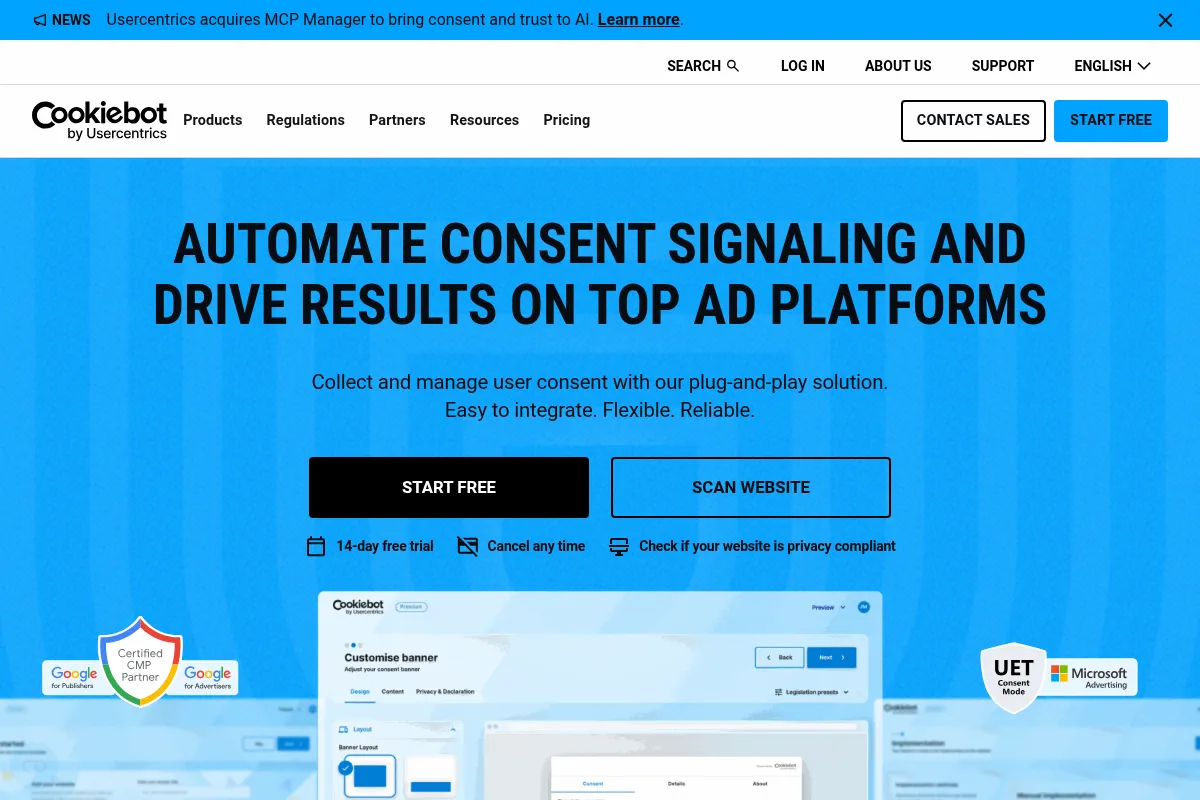
Who Should Use Cookiebot?
Typical users
Small to mid-sized business owners, website administrators, and marketing teams who need a straightforward way to comply with GDPR and CCPA without requiring deep technical knowledge.
Maturity fit
beginner to scaling
Choose this if…
- Your primary goal is automated, reliable cookie scanning and blocking.
- You need a solution that integrates well with Google Consent Mode v2.
- You manage a single domain or a small number of websites with a low page count.
- You prefer a simple setup process that doesn't require manual coding for basic compliance.
Skip this if…
- You require highly customized, on-brand consent banner designs without using custom CSS.
- Your website is highly dynamic, requiring more frequent than monthly cookie scans.
- You manage multiple domains, as the per-domain pricing model can become expensive.
- You need detailed consent analytics and A/B testing capabilities.
About Cookiebot
Cookiebot is a consent management platform (CMP) by Usercentrics designed to automate website compliance with global privacy laws like GDPR and CCPA. It scans a website to find all cookies and trackers, then blocks them until user consent is obtained through a customizable banner. It is primarily for small and mid-sized businesses looking for a reliable, automated solution to a complex legal requirement.
Official profiles
What it actually does
Cookiebot automatically scans your website to detect and categorize all cookies and trackers. It then displays a consent banner to visitors, allowing them to provide granular consent before any non-essential scripts are executed. The platform logs user consents for audit purposes and generates a public cookie declaration.
What makes it different
Cookiebot's main differentiator is its focus on automation and simplicity. Its core strength lies in its powerful scanner that accurately identifies and automatically blocks trackers before consent is given, which is a critical compliance feature that works out-of-the-box. While some competitors offer broader privacy management suites, Cookiebot specializes in being a straightforward, if sometimes rigid, consent management tool.
Ratings across the web

Ratings aggregated from independent review platforms.
Key Features
Automated Cookie Scanning
The platform regularly scans your site to find and categorize all tracking technologies, reducing the manual effort needed to maintain compliance.
Automatic Cookie Blocking
It prevents cookies and trackers from running before a user gives explicit consent, which is a fundamental requirement of GDPR.
Geo-Targeted Consent Banners
The system can automatically display different banner types and legal frameworks (GDPR, CCPA, etc.) based on the visitor's location.
Google Consent Mode v2 Integration
Ensures that consent signals are correctly passed to Google services, allowing for compliant use of Google Analytics and Ads.
Consent Log
Securely stores a record of all user consents, providing a necessary audit trail to demonstrate compliance to authorities.
Customizable Banners
Allows for adjustments to the text, colors, and buttons of the consent banner to align with a site's branding, though advanced customization requires coding.
Multi-language Support
Banners can be displayed in over 40 languages, often detected automatically based on the user's browser settings.
Pricing
Free
- 1 domain
- Up to 50 subpages
- Basic banner customization
- Google Consent Mode v2 support
Lite
- 1 domain
- Up to 50 subpages
- Full banner customization
- Consent log
- Geo-targeting
Small
- Up to 350 subpages per domain
- Full banner customization
- Consent log
- Geo-targeting
- Multi-domain support (billed per domain)
Medium
- Up to 3,500 subpages per domain
- Full banner customization
- Consent log
- Geo-targeting
- Multi-domain support (billed per domain)
Large
- Up to 7,000 subpages per domain
- Full banner customization
- Consent log
- Geo-targeting
- Multi-domain support (billed per domain)
Extra Large
- Over 7,000 subpages per domain
- Full banner customization
- Consent log
- Geo-targeting
- Multi-domain support (billed per domain)
Pricing checked 6 months ago
Pricing guidance
- Your website grows beyond 50 pages.
- You need to customize the consent banner beyond basic templates.
- You require an audit trail with a detailed consent log.
- You need to manage compliance across multiple geographic regions with different rules.
- Pricing is per-domain, with no multi-site discounts.
- Subdomains are treated as separate domains and require their own subscription.
- Plans automatically upgrade if your page count exceeds the tier limit, which can lead to unexpected charges.
- Removing the 'Powered by Cookiebot' logo requires custom CSS, even on paid plans.
Affordable for a single small site, but becomes progressively expensive for businesses with multiple domains or a large number of pages.
Pros & Cons
Strengths
-
Reliable automated scanning and blocking
The core function of detecting and blocking trackers before consent works flawlessly out of the box. This provides a high degree of confidence in achieving baseline compliance with privacy laws like GDPR.
-
Easy initial setup
Implementation is straightforward for most users, typically involving adding a JavaScript snippet to the website's header. It integrates well with major CMS platforms, making it accessible for non-developers.
-
Strong Google Consent Mode integration
As a Google-certified CMP, it ensures seamless communication of consent signals to Google Analytics and Ads, which is critical for marketers in the EU/EEA.
-
Genuinely useful free plan
The free plan is sufficient for small, single-domain websites with under 50 pages, offering full compliance features like automatic scanning and blocking.
Weaknesses
-
Pricing model is expensive at scale
The per-domain, per-page pricing structure becomes costly for businesses with multiple websites or large sites. Recent price increases have also caused significant customer backlash.
Affects: Agencies, multi-site businesses, and sites with high page counts
-
Limited banner customization without code
While basic color and text changes are possible, the layout options are rigid. Achieving a unique or seamlessly integrated design often requires custom CSS, which is a hurdle for non-technical users.
Affects: Marketers and designers who prioritize brand consistency
-
Basic analytics and reporting
The dashboard provides only surface-level metrics on consent numbers. It lacks deeper insights, such as A/B testing or detailed analysis of consent rates by region or banner design.
Affects: Data-driven marketers and product teams
-
Monthly scans may be insufficient
The default monthly scan frequency may not be adequate for dynamic websites that frequently add new scripts or third-party tools, potentially leaving new trackers unblocked between scans.
Affects: E-commerce stores and sites with active development cycles
-
Customer support is limited
Support is restricted to email, and some users report slow response times and inadequate solutions to their issues.
Affects: Users who need immediate or complex technical assistance
Real User Sentiment
Users generally agree that Cookiebot is effective and easy to implement for its core purpose of cookie compliance. However, sentiment is frequently soured by its pricing model, a clunky user interface, and limited customer support.
Users tend to like
- The 'set-it-and-forget-it' nature of the automated scanning and blocking.
- Ease of initial setup and implementation.
- Reliable compliance with major regulations like GDPR.
- Effective integration with Google Consent Mode.
Users commonly complain about
- Sudden and significant price increases.
- The per-domain pricing model is expensive for multiple sites.
- The admin interface is considered unintuitive and outdated.
- Poor customer support with slow response times.
- Limited design flexibility for the consent banner without coding.
Recurring tradeoffs
- Users trade deep customization and advanced analytics for automated, reliable compliance.
- The tool offers simplicity and ease of setup at the cost of a potentially expensive and rigid pricing structure.
Happiest users
Owners of single, small-to-medium sized websites who prioritize automated compliance and are less concerned with advanced customization or multi-domain management.
Often frustrated
Agencies, developers managing multiple client sites, and marketing teams who find the pricing model punitive and the UI/customization options restrictive.
Use Cases
Small Business Website
A local business owner uses the Free or Small plan to make their WordPress site GDPR compliant quickly.
E-commerce Store
A Shopify store owner uses Cookiebot to manage consent for marketing and analytics trackers, ensuring compliance with GDPR and CCPA.
Digital Marketing Agency
An agency implements Cookiebot across client websites but struggles with the per-domain pricing model.
Corporate Website
A medium-sized company uses the Medium plan to ensure its corporate site complies with international privacy laws and maintains a consent log for audits.
Publisher/Blog
A content creator with a growing blog uses Cookiebot to manage consent for advertising cookies and comply with Google's publisher policies.
Frequently Asked Questions
Is Cookiebot's free plan sufficient for compliance?
The free plan is sufficient for basic compliance on a single website with fewer than 50 pages. It includes automatic scanning, cookie blocking, and support for Google Consent Mode v2. However, it lacks features of the paid plans like full banner customization, geo-targeting, and a consent log for audits, which may be required for demonstrating compliance.
How does Cookiebot's pricing work?
Cookiebot's pricing is based on the number of subpages on your website and is billed per domain. Each subdomain is considered a separate domain. Plans automatically upgrade if a scan detects that your page count has exceeded your current tier's limit, which can result in unexpected cost increases.
What are the main alternatives to Cookiebot?
Common alternatives include OneTrust, TrustArc, CookieYes, and Complianz. OneTrust and TrustArc are more comprehensive (and complex) enterprise-level platforms. CookieYes and Complianz are often cited by former Cookiebot users as having more straightforward and affordable pricing models, especially for WordPress sites.
What are Cookiebot's biggest limitations?
The main limitations are its rigid pricing model that penalizes multi-domain users, limited banner customization options without coding, basic analytics, and a monthly default scan frequency that may be too slow for dynamic websites.
How does Cookiebot integrate with other platforms?
Cookiebot integrates with most major CMS platforms like WordPress, Shopify, Wix, and Squarespace, typically by adding a script to the site's header. It also has specific plugins and apps for platforms like WordPress to simplify installation. It integrates directly with Google Tag Manager to manage Google Consent Mode v2.
Does Cookiebot slow down my website?
Yes, like many client-side consent management platforms, Cookiebot can have a negative impact on page speed. Because it runs as an external script and must block other scripts from loading until consent is given, it can affect Core Web Vitals. The impact is more noticeable on sites with many third-party scripts.
Can I customize the look of the Cookiebot banner?
Yes, you can customize colors, text, and button styles through the dashboard. However, the overall layout and structural options are limited. To achieve a fully custom design or to remove the Cookiebot branding (even on paid plans), you will need to apply custom CSS.
Why trust this page?
This evaluation combines product positioning, pricing analysis, traffic and market signals, and public user sentiment into a single decision-support page. Content is generated editorially — not copied from the vendor's website.
Funding & Company
Founded
2017
Stage
Series b
Total Raised
$21M
Latest Round
Series B (Dec 2020)
Notable Investors
Cookiebot is a product of Usercentrics, which merged with Cybot (the original parent of Cookiebot) in 2021. Usercentrics has raised at least €21 million (~$21M USD) through a Series B round in late 2020. This funding, led by growth equity firm Full In Partners, positions the combined entity as a major, well-capitalized player in the consent management market.
Market Signals & Traffic
Estimated visits, global rank, geography, traffic sources, monthly visit trends, and organic search keywords (Similarweb)—on a dedicated page built for depth and search.
- Estimated visits
- 1,412,588
- Global rank
- #38,526
- Snapshot
- Apr 2026
- Traffic trend
- Surging
Estimated monthly visits
Similar Tools
Outrank
Content Creation

An AI-powered platform that automates SEO analysis and content creation to grow organic traffic.
Robin AI
AI Assistant, Privacy & Compliance, Workflow

Legal assistant for contract drafting, review, and management.
Plan0
Productivity, Automation & Agents, Workflow

Autonomous project manager for engineering and product teams
Sweep
Developer Tools, Automation & Agents

Junior developer assistant that handles bug fixes and feature requests
Make AI
Automation & Agents, Developer Tools

Visual platform to connect apps and automate workflows without code.
Kick
Productivity, Automation

Automated bookkeeping and financial management for startups and small businesses.