

Hippocratic AI
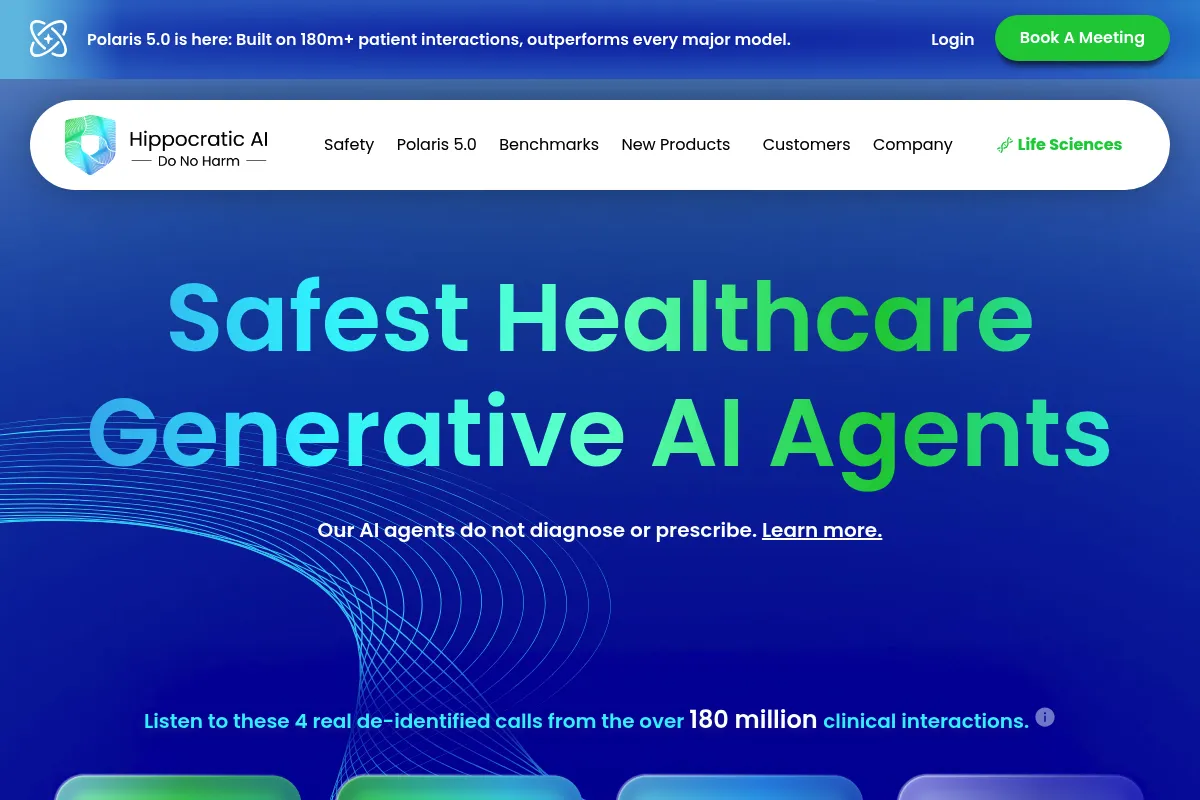
A specialized healthcare LLM provider focused on non-diagnostic patient interactions, prioritizing medical accuracy and bedside manner over general-purpose utility.
Best for health systems automating patient follow-ups and administrative workflows, weaker for high-stakes clinical diagnostic support.
Analysis based on product data, pricing structure, traffic signals, and public user sentiment.
Who Should Use Hippocratic AI?
Typical users
Enterprise health systems, payors, and digital health providers with the technical infrastructure to integrate AI into clinical workflows.
Maturity fit
advanced
Choose this if…
- Your priority is medical safety and HIPAA compliance over general-purpose flexibility.
- You need low-latency voice agents for patient outreach and chronic care management.
- You want an AI trained specifically on clinical data and reinforced by medical professionals.
Skip this if…
- You are a solo practitioner looking for a simple, out-of-the-box administrative tool.
- Your primary need is clinical diagnostic decision support rather than patient interaction.
- You require a low-cost, self-serve platform with transparent public pricing.
About Hippocratic AI
Hippocratic AI is a safety-focused Large Language Model (LLM) designed exclusively for the healthcare industry. It aims to address the global healthcare worker shortage by providing automated, empathetic voice agents for non-diagnostic tasks like post-discharge follow-up and chronic care management.
Official profiles
What it actually does
The platform provides a suite of generative AI agents that interact with patients via voice to handle administrative and low-stakes clinical tasks. It uses a specialized architecture to ensure medical accuracy and maintains a 'bedside manner' designed to improve patient adherence and satisfaction.
What makes it different
Unlike general LLMs, this model is trained on healthcare-specific data and fine-tuned using Reinforcement Learning from Human Feedback (RLHF) provided by thousands of licensed nurses and doctors. Its partnership with NVIDIA enables sub-second voice latency, making automated phone interactions feel more natural than standard text-to-speech systems.
Key Features
Medical RLHF
Fine-tuned by licensed clinicians to ensure responses align with medical standards.
Low-Latency Voice
Sub-second response times via NVIDIA's inference stack to prevent awkward conversational pauses.
Constellation of Agents
A multi-agent architecture where specialized models handle specific medical domains.
Empathy Scoring
Specifically optimized to outperform general models on patient-perceived bedside manner.
Safety Guardrails
Built-in restrictions that prevent the model from providing unauthorized medical diagnoses.
HIPAA Compliance
Designed from the ground up to meet healthcare data privacy and security requirements.
Pricing
Enterprise
- Full access to healthcare LLM
- Custom agent development
- Dedicated integration support
- HIPAA-compliant hosting
- NVIDIA-powered voice latency
Pricing checked 4 months ago
Pricing guidance
- When moving from pilot to full-scale health system deployment
- When requiring custom agent workflows for specific patient populations
- Usage-based costs for voice minutes
- Minimum contract values typical of enterprise healthcare software
Premium enterprise positioning with pricing likely based on patient volume or interaction count.
Pros & Cons
Strengths
-
Superior medical grounding
Outperforms GPT-4 on various medical exams and safety benchmarks due to its domain-specific training set.
-
High patient engagement
The focus on empathy and natural voice cadence leads to higher completion rates for follow-up calls compared to automated IVR systems.
-
Reduced clinician burnout
Automates repetitive outreach tasks, allowing human nurses to focus on high-acuity patients who require manual intervention.
Weaknesses
-
Non-diagnostic limitation
The tool is strictly prohibited from making diagnoses, which may frustrate users looking for a more comprehensive clinical assistant.
Affects: Clinical teams seeking diagnostic support
-
High barrier to entry
As an enterprise-first B2B solution, it requires significant integration effort and lacks a self-serve tier for smaller clinics.
Affects: Small practices and startups
-
Opaque pricing
Lack of public pricing makes it difficult for operators to assess ROI without entering a lengthy sales cycle.
Affects: Procurement and finance teams
Real User Sentiment
Generally positive within the healthcare tech community, though some clinicians remain skeptical of AI's role in patient empathy.
Users tend to like
- Focus on safety over speed
- Clinician-led training approach
- Natural-sounding voice interactions
Users commonly complain about
- Lack of transparency for small developers
- Potential for 'hallucinations' in complex medical scenarios
- High cost of enterprise implementation
Recurring tradeoffs
- Safety guardrails mean the AI often defers to a human, which can limit its immediate utility in complex cases.
Happiest users
Innovation officers at large health systems looking to reduce administrative overhead.
Often frustrated
Independent developers or small clinics who cannot access the technology due to its enterprise focus.
Use Cases
Post-Surgery Follow-up
Calling patients to check for signs of infection or complications after discharge.
Chronic Disease Management
Weekly check-ins with diabetic patients to monitor glucose levels and diet adherence.
Appointment Preparation
Providing pre-colonoscopy instructions to ensure patients follow necessary dietary restrictions.
Health Risk Assessment
Conducting initial screenings to identify patients who may need social determinants of health (SDOH) support.
Billing Support
Explaining complex medical bills to patients in a clear, empathetic manner.
Frequently Asked Questions
How much does Hippocratic AI cost?
Pricing is not public. As an enterprise B2B solution, costs are determined by the scale of the health system, the number of agents deployed, and interaction volume. You must contact their sales team for a quote.
Is Hippocratic AI HIPAA compliant?
Yes, the platform is built specifically for healthcare and adheres to HIPAA regulations regarding the privacy and security of protected health information (PHI).
Can Hippocratic AI diagnose patients?
No. The company explicitly states that its agents are for non-diagnostic tasks. If a patient asks for a diagnosis, the AI is programmed to refer them to a licensed human professional.
How does it compare to GPT-4?
While GPT-4 is a generalist, Hippocratic AI is fine-tuned on medical data and reinforced by clinicians. In internal benchmarks, it outperforms GPT-4 on safety and medical accuracy tests like the USMLE.
Does it support languages other than English?
The primary focus has been English, but the company is expanding its capabilities to support multilingual patient populations common in large health systems.
What integrations are supported?
Hippocratic AI is designed to integrate with major Electronic Health Record (EHR) systems like Epic and Cerner, though specific implementation details depend on the enterprise agreement.
Why trust this page?
This evaluation combines product positioning, pricing analysis, traffic and market signals, and public user sentiment into a single decision-support page. Content is generated editorially — not copied from the vendor's website.
Funding & Company
Founded
2023
Stage
Series c
Total Raised
$404M
Latest Round
Series C (Nov 2025)
Notable Investors
Hippocratic AI has raised a total of $404 million across four major rounds, including a recent $126 million Series C in late 2025. [3, 5, 15] This rapid and substantial funding from elite investors like Andreessen Horowitz, Kleiner Perkins, and General Catalyst signals strong market confidence and provides a long runway for product development and scaling within the healthcare sector. [3]
Market Signals & Traffic
Estimated visits, global rank, geography, traffic sources, monthly visit trends, and organic search keywords (Similarweb)—on a dedicated page built for depth and search.
- Estimated visits
- 61,829
- Global rank
- #508,113
- Snapshot
- Apr 2026
- Traffic trend
- Surging
Estimated monthly visits
Alternatives to Hippocratic AI
View all alternatives
Similar Tools
Chroma
Developer Tools, Search

Open-source embedding database for building applications with long-term memory.
Alhena AI
E-commerce, AI Assistant, Automation & Agents

Concierge for e-commerce discovery, shopping, and automated support
AI21 Labs
Developer Tools, AI Assistant, Content Creation

Foundation models and developer tools for building language-based applications.
Koyeb
Developer Tools, Automation

Serverless platform for deploying high-performance applications and AI models
Dot
AI Assistant, Health & Wellness, Productivity

Personal assistant and companion that builds long-term memory.
Ollama
Developer Tools, Privacy & Compliance

Run large language models locally on your machine.