
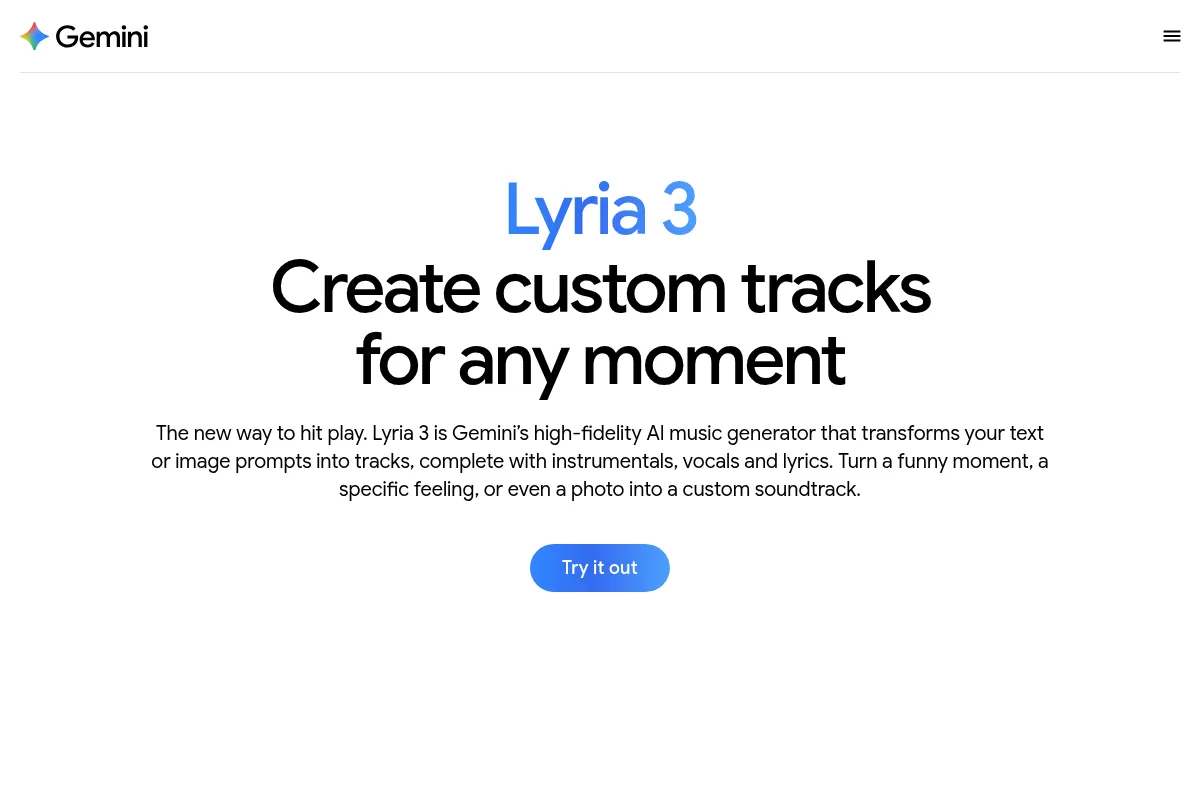
Lyria is a text-to-music AI model that generates high-fidelity audio, offering developers and creators a new way to produce soundtracks and musical pieces.
Best for content creators needing quick, integrated music generation; weaker for professional musicians requiring deep control.
Analysis based on product data, pricing structure, traffic signals, and public user sentiment.
Who Should Use Lyria?
Typical users
Content creators, social media managers, developers, and hobbyists looking to quickly generate music for videos, podcasts, or personal projects.
Maturity fit
beginner to scaling
Choose this if…
- You need to quickly generate background music or soundtracks for videos and social media content.
- You want to experiment with AI-generated music without a steep learning curve.
- You are already integrated into the Google ecosystem (Gemini, Vertex AI).
- You need to create custom music with specific moods or themes from text or image prompts.
Skip this if…
- You are a professional musician seeking granular control over every aspect of music production.
- You require multi-track editing, stem export, or advanced mixing capabilities.
- You need to generate music longer than 3 minutes.
- You are looking for AI that can perfectly replicate specific artist vocal styles.
About Lyria
Lyria is Google's AI music generation model, designed to create high-fidelity audio from text or image prompts. It aims to democratize music creation by offering a user-friendly interface integrated into Google products, allowing for quick generation of soundtracks and musical pieces.
What it actually does
Lyria generates music based on text descriptions or images. It can produce instrumental tracks, songs with vocals and lyrics, and even custom cover art. The model offers different variants for short clips or longer compositions, with features like tempo control and time-aligned lyrics.
What makes it different
Lyria's integration into existing Google products like Gemini and Vertex AI offers a unique convenience for users already within that ecosystem. Its focus on high-fidelity 48kHz stereo output and SynthID watermarking for transparency also sets it apart.
Ratings across the web

Ratings aggregated from independent review platforms.
Key Features
Lyria 3 Pro for full-length songs (up to 3 minutes)
Enables more complex musical structures and longer compositions.
Lyria 3 Clip for short clips (30 seconds)
Optimized for rapid prototyping and social media assets.
Multimodal input (text and images)
Allows for creative prompting using visual cues.
Time-aligned lyrics
Provides control over when lyrics appear within the track.
SynthID watermarking
Ensures transparency by identifying AI-generated audio.
Integration with Gemini and Vertex AI
Offers a seamless workflow for existing Google users.
Pricing
Lyria 3 (via Gemini)
- 30-second music clip generation
- Text and image prompts
- Vocals and lyrics
- Custom cover art
- SynthID watermarking
Lyria 3 Pro (via Vertex AI)
- Full-length song generation (up to 3 minutes)
- Advanced composition control
- Multimodal inputs
- High-fidelity audio
- API access for developers
Pricing checked 6 months ago
Pricing guidance
- When you need to generate music longer than 30 seconds.
- When you require more control over song structure (intros, verses, choruses).
- When integrating music generation into applications or workflows via API.
- Maximum song length of 3 minutes.
- Lack of multi-stem export for professional mixing.
- Vocal generation is generic and cannot mimic specific artists.
Lyria is positioned as an accessible AI music tool integrated into Google's ecosystem, with tiered capabilities for casual users and developers.
Pros & Cons
Strengths
-
Ease of Use
Lyria is integrated into familiar Google products like Gemini, making it accessible to a wide audience without a steep learning curve.
-
High-Fidelity Audio
The model generates 48kHz stereo audio, which is suitable for video production and offers a professional sound quality.
-
Creative Control
Features like tempo conditioning, time-aligned lyrics, and multimodal input offer significant creative direction for users.
-
Integrated Ecosystem
Being part of Google's suite of tools (Gemini, Vertex AI, AI Studio) streamlines workflows for users already invested in these platforms.
Weaknesses
-
Limited Song Length
While Lyria 3 Pro supports up to 3 minutes, this is still restrictive for professional music production compared to competitors offering longer outputs or multi-stem exports.
Affects: Musicians and producers needing full-length tracks or stems for further editing.
-
Lack of Stem Export
Lyria does not offer multi-stem export, which is crucial for professional mixing and mastering.
Affects: Professional musicians and producers who need to manipulate individual instrument tracks.
-
Vocal Mimicry Limitations
Lyria cannot replicate specific artist vocal styles, focusing instead on generic vocal timbres.
Affects: Users seeking to create music in the style of a particular artist.
-
Pricing for Longer Tracks
While basic generation might be accessible, longer tracks (up to 3 minutes) are often tied to paid Gemini subscriptions.
Affects: Casual users or those on free Gemini tiers who want to explore longer song creation.
Real User Sentiment
Early sentiment suggests Lyria is praised for its ease of use and integration within the Google ecosystem, making AI music creation more accessible. However, limitations in track length and control are noted by more advanced users.
Users tend to like
- Ease of use and integration with Gemini.
- High-quality audio output (48kHz stereo).
- Ability to generate music from text and images.
- SynthID watermarking for transparency.
Users commonly complain about
- Limited track length (max 3 minutes).
- Lack of stem export for professional editing.
- Generic vocal styles, no artist mimicry.
- Advanced features often tied to paid subscriptions.
Recurring tradeoffs
- Convenience and accessibility vs. professional-level control and output length.
- High-fidelity short clips vs. longer, more complex compositions.
Happiest users
Content creators and casual users who value quick, integrated music generation for social media and personal projects.
Often frustrated
Professional musicians and producers who require granular control, stem exports, and longer track durations for their work.
Use Cases
Generating background music for YouTube videos or social media clips.
Creating custom soundtracks for vlogs or podcasts.
Experimenting with AI for musical ideation and inspiration.
Developing interactive music experiences through APIs.
Producing personalized jingles or short musical pieces for marketing.
Frequently Asked Questions
What is Lyria 3 and Lyria 3 Pro?
Lyria 3 is Google's family of AI music generation models. Lyria 3 generates 30-second music clips from text or image prompts, while Lyria 3 Pro can create full-length songs up to three minutes long with enhanced structural control. Both models offer high-fidelity audio and can generate vocals and lyrics.
How does Lyria compare to Suno or Udio?
Lyria excels in its integration with the Google ecosystem (Gemini, Vertex AI) and offers 48kHz stereo output. Compared to Suno and Udio, Lyria's current limitations include a maximum track length of 3 minutes and a lack of stem export, making it more suited for quick content creation than professional music production. Suno and Udio are often cited for longer track outputs and more advanced editing features.
What are the limitations of Lyria?
The primary limitations of Lyria include a maximum song length of 3 minutes, the absence of multi-stem export for individual instrument tracks, and generic vocal styles that cannot mimic specific artists. While Lyria 3 Pro offers more structural control, it still falls short of the granular editing capabilities found in professional Digital Audio Workstations (DAWs) or some competing AI music tools.
Does Lyria offer API access?
Yes, Lyria is available through the Gemini API and Google AI Studio, allowing developers to integrate its music generation capabilities into their own applications. Lyria 3 Pro is also accessible via Vertex AI for enterprise-level use cases.
Is there a free version of Lyria?
Lyria 3 is integrated into the Gemini app, and its capabilities may be accessible to free Gemini users for generating short clips. However, generating longer tracks (up to 3 minutes) or accessing advanced features like Lyria 3 Pro typically requires a paid subscription to Gemini Advanced or usage through Vertex AI, which has its own pricing structure.
Can Lyria generate music in different languages and genres?
Yes, Lyria supports generating music in multiple languages and across various genres, including pop, funk, and Motown. Developers can explore global languages and genres through its API.
What is SynthID watermarking?
SynthID is a Google technology that embeds an imperceptible digital watermark into AI-generated audio. This watermark allows for the identification and verification of content created or edited by Google AI, promoting transparency and trust in AI-generated media.
Why trust this page?
This evaluation combines product positioning, pricing analysis, traffic and market signals, and public user sentiment into a single decision-support page. Content is generated editorially — not copied from the vendor's website.
Company
Founded
1998
Stage
Public
HQ
Mountain View, California, U.S.
Lyria is an AI model developed by Google DeepMind, a subsidiary of the publicly traded technology conglomerate Alphabet Inc. As an internal project, it does not have traditional funding rounds (e.g., Seed, Series A). Its financial stability is directly tied to its parent company, Alphabet, one of the world's most valuable corporations.
Market Signals & Traffic
Estimated visits, global rank, geography, traffic sources, monthly visit trends, and organic search keywords (Similarweb)—on a dedicated page built for depth and search.
- Estimated visits
- 34,370,963
- Global rank
- #1,407
- Snapshot
- Apr 2026
- Traffic trend
- Steady
Estimated monthly visits
Alternatives to Lyria
View all alternativesSuno
Music Generation

An AI music and song generator that creates original music from text prompts.
Udio
Music Generation, Content Creation

AI-powered music generator that creates original songs from text prompts.
Mubert
Music Generation, Content Creation

AI-powered platform for generating royalty-free music.
Similar Tools
Mubert
Music Generation, Content Creation
AI-powered platform for generating royalty-free music.
Suno
Music Generation, Content Creation

AI-powered music generator that creates songs from text prompts.
ACE Studio
Music Generation, Content Creation

Professional singing voice generator and vocal synthesis platform.
Soundraw
Music Generation, Content Creation

AI-powered music generator for unique, royalty-free tracks.
Udio
Music Generation, Content Creation
AI-powered music generator that creates original songs from text prompts.
AIVA
Music Generation, Content Creation

AI music composition assistant for creating original songs in various styles.