

Suno generates complete, vocal-led songs from text prompts with surprising speed and coherence, making it an exceptional tool for rapid idea generation and content creation, but it falls short for musicians who need granular control over production.
Excellent for content creators and hobbyists needing quick, original music; weaker for producers requiring professional-grade stems and detailed editing capabilities.
Analysis based on product data, pricing structure, traffic signals, and public user sentiment.
Who Should Use Suno?
Typical users
Social media content creators, marketers, hobbyists, and songwriters looking for a tool to quickly prototype musical ideas and generate background music.
Maturity fit
beginner to scaling
Choose this if…
- You need to create full songs with vocals, not just instrumental loops.
- Your priority is speed and ease of use over fine-tuned musical control.
- You want to quickly generate royalty-free music for videos, podcasts, or social media.
- You're a songwriter who wants to overcome writer's block by exploring different styles and melodies for your lyrics.
Skip this if…
- You're a music producer who needs clean, isolated instrument stems for mixing and mastering.
- You require precise control over melody, harmony, rhythm, and song structure.
- Your workflow involves detailed audio editing, which Suno's web-based studio doesn't fully support.
- You are concerned about the legal ambiguity of AI-generated music and potential copyright infringement claims.
About Suno
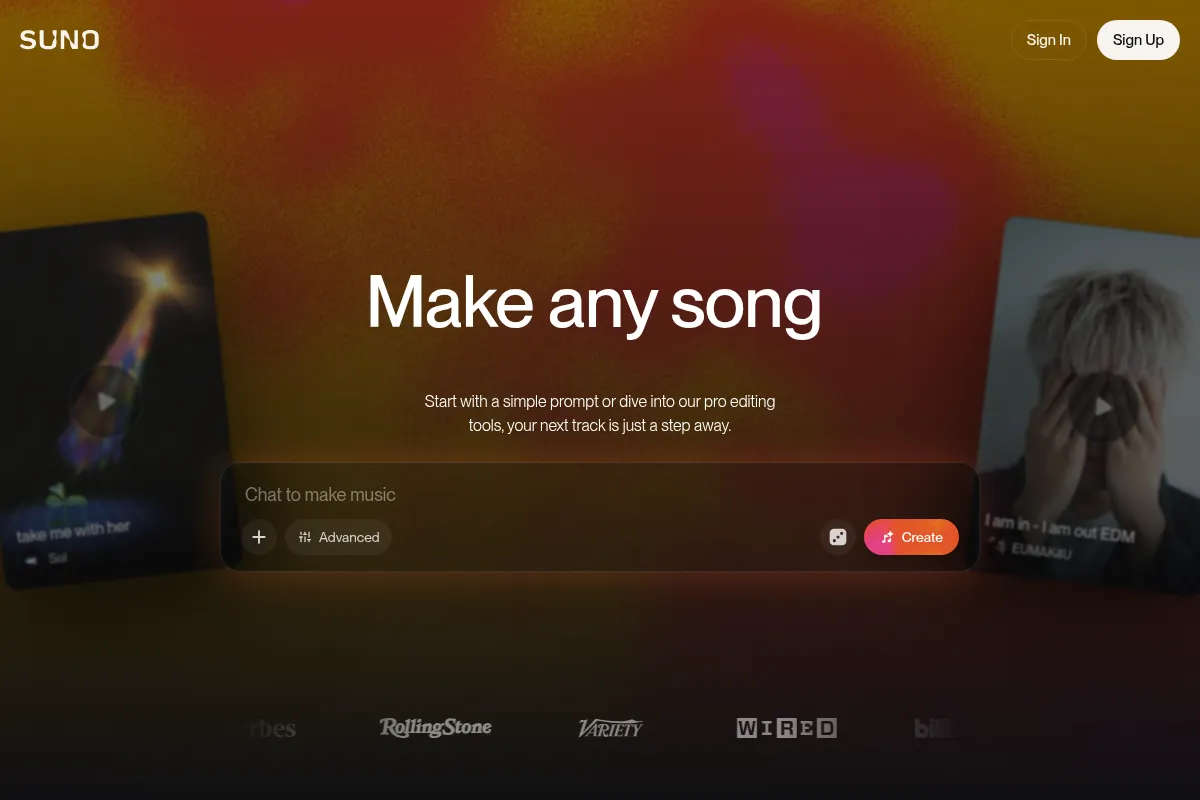
Suno is an AI music generator that creates full songs, including vocals and instrumentals, from text prompts. It is designed for users without technical music skills to produce original music across a wide range of genres. The core value is making music creation accessible to anyone, instantly turning ideas into listenable tracks.
Official profiles
What it actually does
Users input a text description of a song, including genre, mood, and theme, or provide their own lyrics. Suno's AI then generates two unique song clips, typically up to two minutes long, complete with vocals, instrumentation, and cover art. Paid users can then extend these clips to create longer, more structured songs and download them for commercial use.
What makes it different
Suno's primary differentiator is its ability to generate coherent, often emotionally resonant vocals, which sets it apart from many AI music tools that focus solely on instrumentals. Unlike competitors that may offer more granular editing, Suno prioritizes a simple, prompt-to-song workflow that produces a complete piece with a recognizable verse-chorus structure in a single step.
Ratings across the web
Ratings aggregated from independent review platforms.
Key Features
Full Song Generation
Creates complete tracks with vocals and a logical song structure, not just short loops.
Custom Mode
Allows users to input their own lyrics and specify the style and tempo for more directed output.
Instrumental Mode
Generates tracks without vocals, suitable for background music or karaoke.
Song Extension
Users can continue a generated track, building out a full song structure (verse, chorus, bridge) up to four minutes.
Style & Genre Versatility
Capable of producing music across a vast range of styles, from pop and rock to niche and fusion genres.
Commercial Use Rights
Paid plans grant users ownership and commercial rights to the songs they create, allowing for monetization.
Stem Separation
Premier plan users can download separated vocal and instrumental stems, though quality is a point of user contention.
API Access
An unofficial API is available for developers to integrate Suno's music generation into their own applications.
Pricing
Basic Plan
- 50 credits per day (approx. 10 songs)
- Non-commercial use only
- Shared generation queue
- Cannot purchase additional credits
Pro Plan
- 2,500 credits per month (approx. 500 songs)
- General commercial terms
- Priority generation queue
- 10 concurrent jobs
Premier Plan
- 10,000 credits per month (approx. 2,000 songs)
- General commercial terms
- Priority generation queue
- Early access to new features
Pricing checked 6 months ago
Pricing guidance
- You need to use the music you create in a monetized YouTube video, podcast, or other commercial project.
- You run out of daily free credits and want to continue generating songs.
- You want faster generation times by accessing the priority queue.
- You need to run more than two song generations at the same time.
- Commercial use rights on paid plans do not equal guaranteed copyright ownership; legal risk is on the user.
- Credits are consumed for every generation attempt, even if the output is poor or ignores your prompt.
- Suno retains ownership of all songs created on the free plan.
- Your inputs (lyrics, prompts) may be used to train Suno's models.
Affordable for individuals and content creators, with a credit system that can become costly for users who require many iterations to achieve a desired result.
Pros & Cons
Strengths
-
Impressive Vocal Quality
The AI-generated vocals are often surprisingly human-like, carrying emotion and nuance that surpasses many competitors. This makes the generated songs feel more complete and listenable out of the box.
-
Ease of Use and Speed
The interface is intuitive, allowing users to go from a simple text prompt to a full song in under a minute. This is ideal for rapid brainstorming and content creation.
-
Generous Free Tier
The free plan offers 50 credits per day (enough for 10 songs), which is substantial for casual experimentation and personal projects.
-
Strong Song Structure
Suno is proficient at creating logical song structures with distinct verses, choruses, and bridges, making the output feel more like a finished piece of music.
Weaknesses
-
Lack of Fine-Grained Control
Users cannot directly edit notes, change instruments, or fine-tune the mix within the tool. You are largely dependent on re-rolling generations until you get a desirable result, which consumes credits.
Affects: Musicians and producers
-
Inconsistent Stem Quality
Audio professionals report that the separated instrument stems often have significant bleed-over, making them unusable for professional mixing and mastering.
Affects: Audio engineers and professional producers
-
Prompt Adherence Can Be Unpredictable
The AI can sometimes ignore specific instructions in a prompt, mispronounce words, or get stuck repeating lyrics, leading to wasted credits and frustration.
Affects: Users with very specific requirements
-
Legal and Copyright Ambiguity
Suno faces lawsuits from major record labels over its training data. While paid plans grant commercial use, the terms state Suno cannot guarantee the output is non-infringing, placing the legal risk on the user.
Affects: Commercial users and artists
Real User Sentiment
Users are generally impressed, often describing the quality of vocal generation as 'jaw-dropping' and 'incredible'. However, this initial excitement is often tempered by frustration with the lack of editing controls and the unpredictability of the AI.
Users tend to like
- The quality and emotional range of the AI vocals.
- The speed of generation from prompt to song.
- The ability to create music in a vast array of genres.
- Its value as a tool for overcoming songwriter's block and brainstorming ideas.
Users commonly complain about
- Inability to edit or correct specific parts of a song without re-generating.
- Messy instrument stems that are unsuitable for professional mixing.
- AI ignoring prompts, mispronouncing words, or producing repetitive/generic output.
- The credit system penalizes users for the AI's failed attempts.
- Songs can have a 'clinical' or overly clean sound in the latest versions.
Recurring tradeoffs
- Users trade granular control for speed and ease of use.
- Achieving a high-quality, specific result often requires burning through credits on multiple generation attempts.
- Using the tool for commercial purposes involves accepting a degree of legal risk due to unresolved copyright issues.
Happiest users
Hobbyists, content creators, and marketers who need good-enough custom music quickly without needing production-level quality.
Often frustrated
Professional musicians, producers, and audio engineers who find the lack of control and poor stem quality a barrier to serious work.
Use Cases
Social Media Content
Generating unique background music or jingles for TikToks, Instagram Reels, and YouTube Shorts.
Podcast Production
Creating custom intro, outro, and transition music that is royalty-free.
Songwriting and Brainstorming
Musicians and lyricists can input lyrics to quickly hear them performed in various styles, helping to break writer's block.
Marketing and Advertising
Businesses can create custom jingles or soundtracks for ad campaigns without hiring a composer.
Personalized Gifts
Creating unique songs for birthdays, anniversaries, or special events.
Game Development
Indie developers can generate thematic background music for their games.
Educational Content
Teachers can create songs to help students learn and remember information.
Frequently Asked Questions
Can I use music from Suno's free plan on YouTube?
No, you cannot use music created with the free plan for any commercial purpose, which includes monetized YouTube videos. The free plan grants a non-commercial license only, and Suno retains ownership of the songs. To use the music commercially, you must subscribe to a paid plan like the Pro or Premier plan.
How does Suno compare to Udio?
Suno is often seen as faster and more focused on generating complete songs with strong vocals from a simple prompt, making it great for quick ideas and content creation. Udio is often praised for slightly higher audio fidelity and is preferred by some for more complex instrumental production. The choice depends on your priority: Suno for rapid, vocal-led song creation, and Udio for potentially higher-quality instrumentals and structure.
What are the biggest limitations of Suno?
The main limitations are the lack of direct editing capabilities, the inconsistent quality of instrument stems, and the AI's occasional failure to follow prompts accurately. Users cannot tweak individual notes or adjust the mix, making it a poor fit for professional music production. Additionally, there are significant legal uncertainties regarding the copyright of the output and the training data used by the model.
Do I own the music I make with a paid Suno plan?
According to Suno's terms, if you create a song while on a paid Pro or Premier plan, you are granted ownership and commercial use rights. However, this is a complex issue. Suno's terms also state they cannot guarantee the output doesn't infringe on existing copyrights, and U.S. copyright law has not fully settled on ownership for purely AI-generated works. You take on the legal risk of any potential infringement.
Can I upload my own audio to Suno?
Yes, Suno has a feature that allows you to upload a short audio clip to influence the style of the generated music. This is often used to transfer a melody or a specific vibe into a new creation. For example, you could hum a tune, and the AI will attempt to build a full song around it.
Does Suno have an API?
Suno does not currently offer an official public API. However, several third-party developers have created unofficial APIs that allow for integration into other applications. These are not supported by Suno and may be less stable than an official offering.
What happens to my songs if I cancel my subscription?
If you created songs while on a paid subscription, you retain the commercial rights to those specific songs even after you cancel your plan. However, any new songs you create after reverting to the free plan will be subject to non-commercial use terms.
Why trust this page?
This evaluation combines product positioning, pricing analysis, traffic and market signals, and public user sentiment into a single decision-support page. Content is generated editorially — not copied from the vendor's website.
Funding & Company
Founded
2022
Stage
—
Total Raised
$775M
Latest Round
Series D (Jun 2026)
Notable Investors
Suno has raised a total of $775 million across four funding rounds, with its most recent being a $400 million Series D in June 2026. This significant and rapid fundraising demonstrates strong investor confidence in its position within the AI music generation market.
Market Signals & Traffic
Estimated visits, global rank, geography, traffic sources, monthly visit trends, and organic search keywords (Similarweb)—on a dedicated page built for depth and search.
- Estimated visits
- 369,158
- Global rank
- #152,100
- Snapshot
- Apr 2026
- Traffic trend
- Rising
Estimated monthly visits
Alternatives to Suno
View all alternativesUdio
Music Generation, Content Creation

AI-powered music generator that creates original songs from text prompts.
Soundraw
Music Generation, Content Creation

AI-powered music generator for unique, royalty-free tracks.
Boomy
Music Generation, Content Creation, AI Assistant

AI-powered platform for creating and monetizing original songs.
Similar Tools
vLLM
Developer Tools, Workflow

High-throughput serving engine for large language model inference
Tolstoy
Video Creation, Marketing Automation, AI Assistant

Interactive video platform for shoppable content and personalized shopping journeys.
Vidu AI
Content Creation, Video Creation

AI-powered tool to generate cinematic videos from text and images.
WitnessAI
Privacy & Compliance, Security, Developer Tools

Governance and security platform for enterprise generative model usage
Artisan
Automation & Agents, Email Marketing, Productivity

Digital workers for automating end-to-end sales prospecting and outreach.
Magnific AI
Content Creation, Design

AI-powered tool to upscale and enhance images with incredible detail.