

An AI workspace that centralizes and queries your research library across multiple file types, best for synthesizing existing documents rather than discovering new ones.
Excellent for students and scientists organizing a known set of PDFs, videos, and audio files; weaker for new literature discovery, where tools like Elicit have an edge.
Analysis based on product data, pricing structure, traffic signals, and public user sentiment.
Who Should Use Anara?
Typical users
Graduate students, PhD candidates, and research scientists working on literature reviews or analyzing a collected library of documents, audio lectures, and video presentations.
Maturity fit
beginner to scaling
Choose this if…
- You need to analyze and cross-reference a mix of PDFs, audio, and video files in one place.
- Your priority is getting answers with clickable, passage-level citations from your own uploaded documents.
- You want an integrated workspace for your library, notes, and drafts, reducing the need to switch between tools.
- You value the flexibility of choosing from multiple AI models (like GPT, Claude, Gemini) for different tasks.
Skip this if…
- Your primary need is discovering new academic papers; Elicit or Scite.ai are built for that.
- You require a tool with a polished, native mobile application.
- You need deep, real-time collaboration features beyond folder sharing and basic editing.
- You are looking for a free tool with generous limits; Anara's free tier has daily usage caps.
About Anara
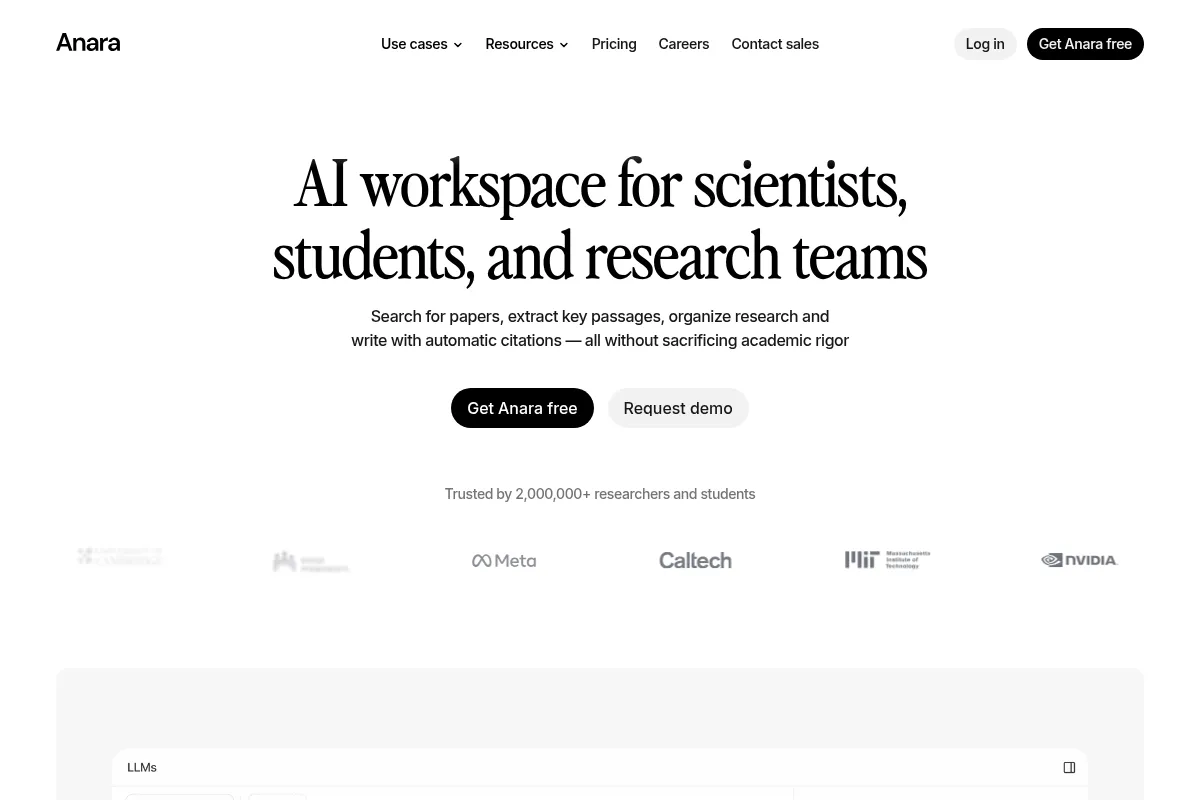
Anara (formerly Unriddle AI) is an AI-powered workspace designed for academic and scientific research. It helps users build a searchable library from various file types—including PDFs, audio, and video—to extract information, synthesize findings, and draft written work with source-linked citations. The tool focuses on analyzing a user's existing collection of materials rather than discovering new literature.
Official profiles
What it actually does
Anara allows users to upload documents, videos, audio files, and web pages to create a personal research library. Its AI can then chat with individual files or entire folders, answering questions, summarizing content, and comparing arguments across multiple sources. Every AI-generated claim is linked back to the precise passage in the source document, aiming to prevent hallucinations and ensure academic integrity.
What makes it different
Anara's primary differentiator is its multimodal support, handling PDFs, audio, video, and images within a single workspace, which is less common than PDF-only tools. It also offers flexibility by allowing users on paid plans to switch between different large language models (from OpenAI, Anthropic, and Google) for their queries. Unlike discovery-focused tools, Anara positions itself as an integrated environment for working with materials you have already collected.
Ratings across the web


Ratings aggregated from independent review platforms.
Key Features
Passage-Level Citations
Every AI-generated statement links directly to the specific sentence in the source document, allowing for immediate verification and building trust.
Multimodal Workspace
Upload and analyze PDFs, lecture recordings (audio/video), and images with OCR in one unified library, which is ideal for researchers with diverse source materials.
Cross-Document Chat
Ask questions across an entire folder of documents to synthesize information, compare methodologies, or find contradictions without reading each file individually.
AI Model Selection
Paid users can choose the best AI model (e.g., GPT-4, Claude 3.5) for a specific task, offering more control over the output's quality and style.
Specialized AI Agents
Use commands like '@SearchPapers' to query academic databases or '@CompleteForm' to automate data extraction for systematic reviews.
Reference Manager Integrations
Connect directly to Zotero and Mendeley libraries, allowing users to import and analyze their existing collections without manual uploads.
Pricing
Free
- 1000 AI words per day
- 5 file uploads per day
- 20 MB or 120 pages per file
- Access to basic AI models
Plus
- 4,000 AI words per day
- 10 file uploads per day
- 100MB or 600 pages per import
- Zotero & Mendeley connectors
Pro
- Unlimited AI words and imports
- Access to premium models (GPT-4.1, Claude 3.5, Gemini 2.5)
- 300MB or 10,000 pages per import
- Google Drive, Notion, OneDrive connectors
- Priority support
Max
- Everything in Pro
- Access to advanced models (Gemini 3 Pro, Claude Opus 4.5)
- Deep Search agent
- Early access to new features
Pricing checked 6 months ago
Pricing guidance
- You hit the daily upload or query limit on the Free or Plus plan.
- You need to analyze large files (over 100MB or 600 pages).
- You require higher-quality analysis from premium AI models like GPT-4 or Claude 3.5.
- You need to connect your Google Drive or Notion workspace.
- The quality of AI analysis is tied to your plan; the best models are reserved for Pro and Max tiers.
- Key integrations like Zotero and Mendeley are only available on paid plans.
- Collaboration features are basic on lower tiers, with more robust team controls on enterprise plans.
Competitively priced for individual academic users, with clear value progression across tiers based on usage limits and access to premium AI models.
Pros & Cons
Strengths
-
Verifiable, trustworthy answers
Every claim made by the AI includes a clickable citation that points to the exact passage in the source document. This focus on traceability is critical for maintaining academic integrity and avoiding hallucinations.
-
Supports diverse file types
Anara handles PDFs, audio, video, and images, making it a versatile hub for researchers who work with more than just text-based papers, such as lecture recordings or interviews.
-
Integrates with existing workflows
Direct integrations with Zotero, Mendeley, and Google Drive mean researchers can easily import their existing libraries instead of starting from scratch.
-
Flexible AI model choice
Unlike competitors that lock you into a single provider, Anara's paid plans let you switch between models from OpenAI, Anthropic, and Google to suit different research tasks.
Weaknesses
-
Not a literature discovery tool
Anara is designed to analyze documents you already have. For finding new papers based on a research question, tools like Elicit or Consensus are more effective.
Affects: Researchers in the early stages of a project
-
Limited free plan
The free tier has strict daily limits on uploads and AI queries, making it more of a trial than a functional tool for any significant research project.
Affects: Users on a tight budget
-
No native mobile app
The platform is optimized for desktop use and lacks a dedicated mobile application, which limits on-the-go access and review.
Affects: Users who work across multiple devices
-
AI can still lack nuance
While citations add trust, some users find the AI's summaries and analysis can be generic or miss the subtle arguments in complex, theoretical papers. Human oversight remains essential.
Affects: Researchers working with highly theoretical or nuanced texts
Real User Sentiment
User sentiment is generally positive but limited, with most feedback coming from early adopters. Users praise the concept of a unified, multimodal research workspace and the tool's time-saving potential, but some express skepticism about its aggressive marketing and the ultimate quality of AI-driven analysis.
Users tend to like
- The ability to get quick summaries and find specific information in dense PDFs.
- Passage-level citations that allow for easy verification of AI claims.
- Consolidating different file types (PDFs, videos) into one searchable library.
- Saving significant time on literature reviews and organizing notes.
Users commonly complain about
- Aggressive and sometimes misleading social media advertising.
- The AI can still be superficial and require manual double-checking for nuanced topics.
- The free plan is too limited to be useful for actual academic work.
- Some users feel using such a tool might undermine the development of critical research skills.
Recurring tradeoffs
- It streamlines analysis of existing documents but doesn't help you discover new ones.
- It saves time on initial information extraction, but critical analysis and synthesis still require significant human effort.
Happiest users
Students and individual researchers who are organizing a defined set of source materials for a literature review or dissertation and value speed and efficiency.
Often frustrated
Researchers who expect the AI to perform deep critical analysis or those who tried the tool based on social media hype and found it didn't replace the need for careful reading.
Use Cases
PhD Candidate Writing a Literature Review
Upload dozens of papers to a folder and ask the AI to identify key themes, compare methodologies, and find contradicting findings.
Student Studying for an Exam
Upload lecture slides, video recordings, and textbook PDFs to generate flashcards and practice quizzes on key concepts.
Research Lab Collaborating on a Project
Use a shared team library to give all members access to the same set of papers and notes, ensuring everyone is working from the same information.
Scientist Analyzing Clinical Studies
Quickly extract data points like sample sizes, interventions, and outcomes from multiple study PDFs to populate a comparison table.
Undergraduate Researching a Term Paper
Use the AI chat to quickly understand dense academic articles and pull key quotes with accurate citations for their bibliography.
Frequently Asked Questions
What is the pricing for Anara?
Anara offers four main tiers. The Free plan has daily limits. The Plus plan ($10/month) increases those limits and adds Zotero/Mendeley integration. The Pro plan ($20/month) offers unlimited use and access to premium AI models like GPT-4. The Max plan ($30/month) provides access to the most advanced models and new features.
How does Anara compare to Elicit?
Anara and Elicit serve different purposes. Anara is a workspace for analyzing and synthesizing a library of documents you have already collected. Elicit, in contrast, is primarily a discovery tool that helps you find new, relevant papers from a massive academic database based on a research question. Choose Anara to work with your existing library; choose Elicit to find new literature.
What are the main limitations of Anara's AI?
While Anara's AI provides citations to build trust, its analysis can sometimes be superficial, especially with complex or theoretical texts. It excels at information extraction but is not a substitute for human critical thinking and nuanced interpretation. The quality of the output also depends heavily on the AI model selected, with the best models restricted to higher-priced plans.
Does Anara integrate with other tools like Zotero or Notion?
Yes, Anara offers several key integrations on its paid plans. It can connect to reference managers like Zotero and Mendeley, as well as cloud storage services like Google Drive and OneDrive. It also has an integration for importing content from Notion workspaces.
Can Anara handle files other than PDFs?
Yes, this is one of its key strengths. Anara supports a wide range of file types, including Word documents, PowerPoint presentations, audio files (MP3, WAV), video files (MP4, YouTube links), and images, which it can process with Optical Character Recognition (OCR).
Is Anara trustworthy for academic work?
Anara is designed to be more trustworthy than general-purpose chatbots. By restricting its answers to the documents you provide and linking every claim to the specific source passage, it significantly reduces the risk of AI 'hallucinations' or fabricated information. However, users are still responsible for critically evaluating the AI's synthesis and ensuring its interpretation is accurate.
Why trust this page?
This evaluation combines product positioning, pricing analysis, traffic and market signals, and public user sentiment into a single decision-support page. Content is generated editorially — not copied from the vendor's website.
Funding & Company
Founded
2023
Stage
Seed
Total Raised
$3M
Latest Round
Seed (Oct 2024)
Notable Investors
Anara, formerly Unriddle AI, has raised a $3 million Seed round from investors including Y Combinator and the founders of GitHub and Reddit. This funding supports the company's focus on providing a citation-verified AI research assistant for academic and scientific communities.
Market Signals & Traffic
Estimated visits, global rank, geography, traffic sources, monthly visit trends, and organic search keywords (Similarweb)—on a dedicated page built for depth and search.
- Estimated visits
- 2,152,446
- Global rank
- #23,655
- Snapshot
- Apr 2026
- Traffic trend
- Surging
Estimated monthly visits
Alternatives to Anara
View all alternatives
Similar Tools
Auctor
Marketing Automation, Automation & Agents, Sales
Automated lead generation and personalized outreach for sales teams
iLovePDF
Productivity, Documentation, Data Extraction

Comprehensive suite of tools for editing, converting, and managing PDF files.
Listen Labs
Research, Productivity, Communication

Extract actionable insights from user interviews and feedback recordings.
Casap
Automation & Agents, Communication, Workflow

Operations platform for automating property management workflows and resident communications.
TextQL
AI Assistant, Automation, Developer Tools

Query data warehouses and documentation using natural language.
Browzwear
Design, Workflow, E-commerce

3D fashion design and digital apparel development platform