

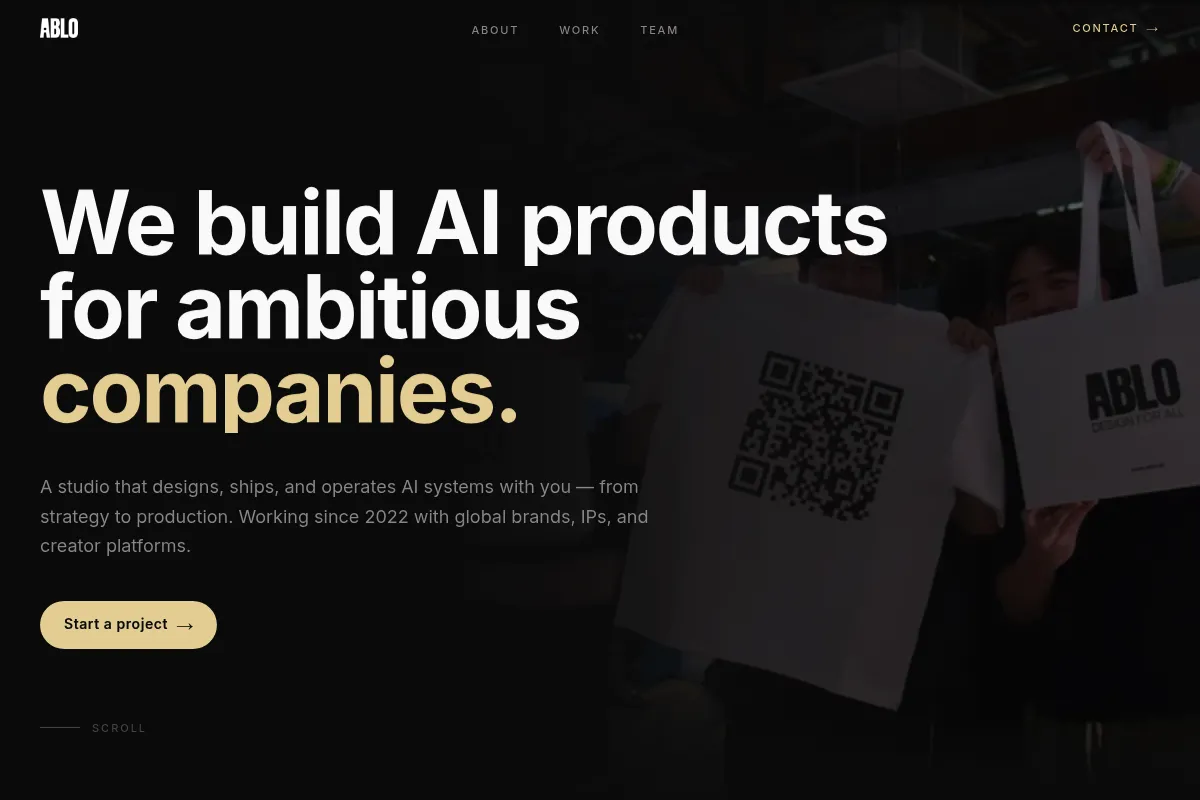
A design-to-fulfillment platform that uses generative AI to turn text and photos into physical apparel, best for creators who want to launch a brand without managing complex supply chains.
Excellent for influencers and small creators launching graphic-heavy merch, weaker for professional designers requiring custom pattern-making or high-fashion construction.
Analysis based on product data, pricing structure, traffic signals, and public user sentiment.
Who Should Use Ablo?
Typical users
Social media influencers, indie musicians, and digital artists with an audience but no manufacturing experience.
Maturity fit
beginner to scaling
Choose this if…
- Your priority is speed to market over custom garment construction.
- You want to launch a merch line without upfront inventory costs.
- You lack professional design skills but have a clear visual brand identity.
Skip this if…
- You need to create complex, non-standard silhouettes or high-fashion couture.
- Your workflow requires using your own existing manufacturing partners.
- You require precise control over fabric sourcing and technical pattern grading.
About Ablo
Ablo is an AI-driven operating system for fashion brands, developed by the studio Space Runners. It exists to bridge the gap between digital design and physical production by providing generative tools that output production-ready graphics. The platform focuses on 'co-creation,' allowing brands and creators to collaborate on apparel designs using shared IP.
Official profiles
What it actually does
Users generate apparel graphics using text-to-image or photo-to-image AI tools, apply them to pre-set garment templates, and launch a storefront. Ablo handles the backend manufacturing, logistics, and fulfillment, typically through a print-on-demand or small-batch model.
What makes it different
Unlike general AI art generators, Ablo is built specifically for fashion production, ensuring designs are formatted for printing and embroidery. It also integrates with Story Protocol to track IP ownership and royalties, which is unique for creators who remix brand assets or collaborate with other artists.
Ratings across the web
Ratings aggregated from independent review platforms.
Key Features
Image Maker
Generates apparel-ready graphics from text prompts in under 30 seconds.
Photo Transformer
Converts uploaded images into stylized, printable art for garments.
Font Maker
Creates custom typography specifically designed for brand logos and apparel prints.
Shopify Integration
Syncs designs directly to an e-commerce store for immediate sale.
Story Protocol Integration
Registers designs on a blockchain to manage IP rights and co-creation royalties.
Studio Services
Provides high-end strategy and custom AI model training for established brands.
Pricing
Creator
- Access to AI design tools
- Unlimited design generations
- Shopify store integration
- On-demand fulfillment
- No upfront costs
Studio / Enterprise
- 1:1 launch strategy sessions
- Custom AI model training
- Brand-aligned style systems
- Full-scale production management
- Quarterly engagements
Pricing checked 4 months ago
Pricing guidance
- When you need a custom AI model trained on your specific brand archive
- When you require high-level strategy for a major collection launch
- When you need deep integration into enterprise-level systems
- Revenue is likely shared or built into a markup on the physical product cost.
- Advanced features like custom AI model training are gated behind the Studio tier.
Highly accessible for individuals with a premium service layer for enterprise brands.
Pros & Cons
Strengths
-
Zero upfront inventory risk
The platform's focus on on-demand production means creators don't have to buy bulk stock before testing a design's popularity.
-
Low barrier to entry
Non-designers can produce professional-looking graphics without learning Adobe Illustrator or CLO3D.
-
High-profile brand ecosystem
Partnerships with brands like Balmain and Crocs allow creators to participate in officially sanctioned co-creation drops.
Weaknesses
-
Limited product catalog
The platform is mostly restricted to standard 'blank' silhouettes like t-shirts, hoodies, and totes.
Affects: Fashion designers wanting to innovate on garment shape and fit.
-
Closed manufacturing loop
You are tied to Ablo's production network and cannot easily export technical packs to external factories.
Affects: Scaling brands that want to optimize margins by sourcing their own manufacturers.
-
AI design genericism
Without significant prompt engineering or manual editing, AI-generated designs can look similar to other 'AI-merch' on the market.
Affects: Brands trying to establish a highly unique or avant-garde visual identity.
Real User Sentiment
Users generally appreciate the speed and ease of turning an idea into a live product, though some professional designers find the creative constraints limiting.
Users tend to like
- Intuitive interface for non-designers
- Fast generation of printable graphics
- No upfront financial risk for launching a store
- Access to high-end brand collaborations
Users commonly complain about
- Limited selection of garment types
- Lack of control over the physical manufacturing details
- Occasional generic output from AI models
Recurring tradeoffs
- You trade design control and manufacturing flexibility for speed and zero upfront cost.
Happiest users
Influencers and artists who want to monetize their brand quickly without learning the fashion industry's technical side.
Often frustrated
Professional fashion designers who want to control every stitch, fabric weight, and pattern measurement.
Use Cases
Influencer Merch
A YouTuber launching a limited-edition hoodie line for their followers.
Band Merchandise
An indie band creating unique tour t-shirts from fan-submitted photos.
Brand Prototyping
A startup testing graphic concepts before committing to a large production run.
Community Co-creation
A brand allowing its Discord community to design and buy their own versions of a sneaker.
Event Apparel
Creating custom, high-quality totes or tees for a specific conference or pop-up shop.
Frequently Asked Questions
Is Ablo really free to use?
Yes, the Creator plan has no upfront costs or monthly subscription fees. Ablo makes money by taking a portion of the sale price or through the markup on the physical products manufactured and fulfilled through their network.
How does Ablo compare to CALA or Pietra?
CALA and Pietra are more traditional supply chain platforms that help you source factories and manage production for custom designs. Ablo is more focused on using AI to generate the designs themselves and offers a more automated, print-on-demand style experience for graphics.
Can I use my own manufacturer with Ablo?
No, Ablo is designed as an end-to-end system where they handle the manufacturing through their own vetted network. If you already have a factory, you would likely use a tool like Techpacker or CALA instead.
Who owns the rights to the designs I create?
According to Ablo, you retain full rights and ownership of the original designs you create on the platform. However, if you are 'remixing' a partner brand's IP (like Balmain), the ownership and royalty structure are governed by specific co-creation agreements tracked via Story Protocol.
Does Ablo integrate with Shopify?
Yes, Ablo features a one-click launch capability that syncs your AI-generated designs directly to a Shopify store, allowing you to start selling immediately.
What kind of clothes can I make on Ablo?
The platform currently focuses on 'streetwear' basics including t-shirts, hoodies, sweatshirts, and accessories like tote bags. It is not currently suitable for complex tailored items like suits or technical outerwear.
Why trust this page?
This evaluation combines product positioning, pricing analysis, traffic and market signals, and public user sentiment into a single decision-support page. Content is generated editorially — not copied from the vendor's website.
Funding & Company
Founded
2021
Stage
Seed
Total Raised
$10M
Latest Round
Seed (Mar 2022)
Notable Investors
Ablo's parent company, Space Runners, secured a $10 million Seed round in early 2022, co-led by prominent crypto and venture funds Pantera Capital and Polychain Capital. This funding provides a solid foundation for the company to develop its AI-powered fashion design platform and establish partnerships with major brands, suggesting a good degree of operational stability for the near future.
Market Signals & Traffic
Estimated visits, global rank, geography, traffic sources, monthly visit trends, and organic search keywords (Similarweb)—on a dedicated page built for depth and search.
- Estimated visits
- 6,412
- Global rank
- #3,220,349
- Snapshot
- Apr 2026
- Traffic trend
- Falling
Estimated monthly visits
Alternatives to Ablo
View all alternativesBrowzwear
Design, Workflow, E-commerce

3D fashion design and digital apparel development platform
The New Black
Design, E-commerce, Content Creation

Generate unique fashion designs and clothing concepts instantly
yoona.ai
Design, Automation, E-commerce

Design platform for fashion brands and creative teams
Similar Tools
Enter Pro
Developer Tools, Website Builder, Automation & Agents

Build full-stack apps, websites, and agents through conversational chat.
MultiOn
AI Assistant, Automation, Productivity

AI agents that autonomously perform tasks and workflows on the web.
TextQL
AI Assistant, Automation, Developer Tools

Query data warehouses and documentation using natural language.
Superhuman
Communication, Productivity, AI Assistant

High-speed email client designed for professional productivity and focus.
AgentOpus
Automation & Agents, Workflow, Developer Tools

Visual builder for creating and deploying autonomous agent workflows
MuleSoft Anypoint Platform
Automation & Agents, Developer Tools

Connect applications, data, and devices through APIs and automated workflows.