

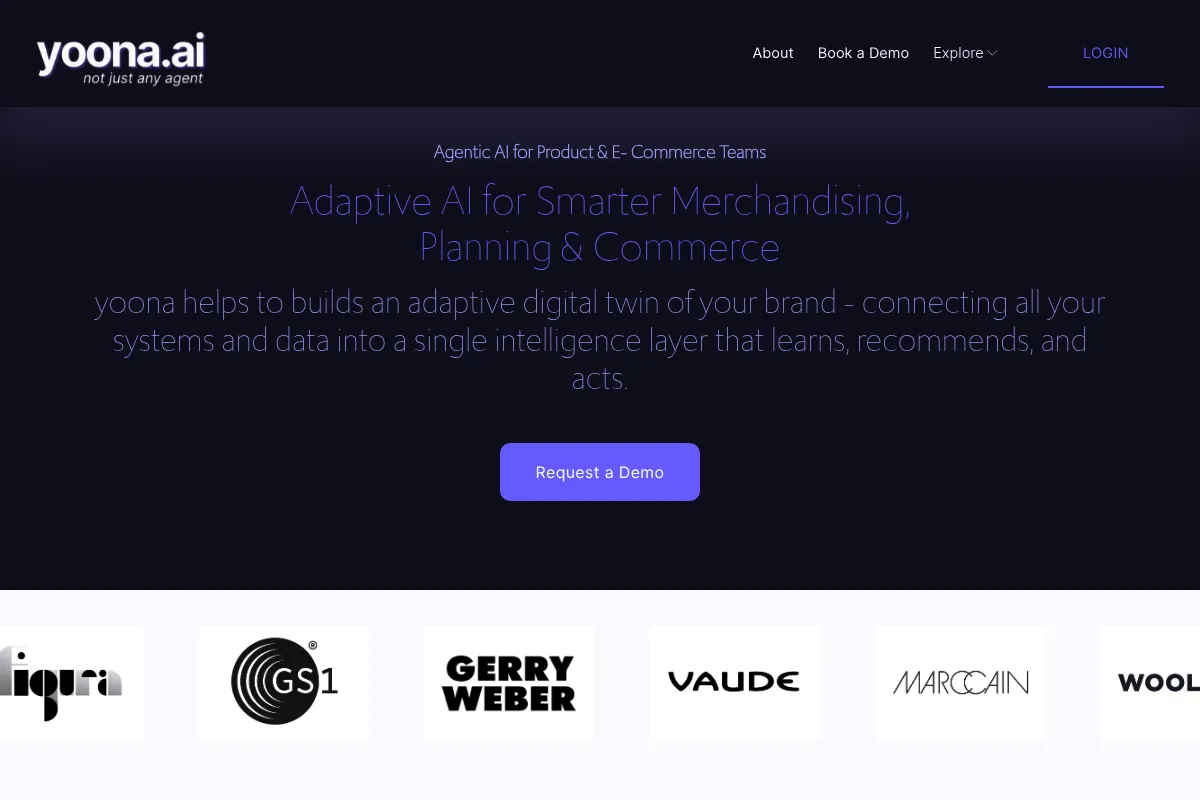
yoona.ai
A specialized generative AI platform for fashion that bridges the gap between conceptual mood boards and production-ready technical designs, though it requires a high-volume workflow to justify the enterprise-leaning cost.
Excellent for fashion brands needing to accelerate collection planning and trend-aligned prototyping, weaker for individual creators looking for a simple image generator.
Analysis based on product data, pricing structure, traffic signals, and public user sentiment.
Who Should Use yoona.ai?
Typical users
Mid-to-large fashion brands, design agencies, and apparel manufacturers with established production pipelines.
Maturity fit
scaling to advanced
Choose this if…
- Your priority is reducing the time between trend research and technical sketch creation.
- You want to generate designs based on specific brand DNA and historical data.
- You need to visualize 2D sketches as 3D-ready concepts for faster internal approval.
Skip this if…
- You are a solo designer needing a general-purpose AI art tool like Midjourney.
- Your workflow is purely artisanal and doesn't benefit from high-volume collection generation.
- You require deep, native 3D pattern-making software like CLO 3D for final manufacturing files.
About yoona.ai
yoona.ai is a vertical-specific design platform built for the fashion industry to automate the transition from concept to collection. It combines generative AI with trend analysis to help brands create market-aligned designs while reducing physical sampling waste.
What it actually does
The platform converts text prompts, hand-drawn sketches, or mood boards into detailed fashion designs and technical visualizations. It integrates real-time market data to suggest colors, fabrics, and silhouettes that align with current consumer trends.
What makes it different
Unlike general AI image generators, yoona.ai is built on fashion-specific datasets, meaning it understands garment construction, draping, and industry-standard terminology. It focuses on 'production-readiness' rather than just aesthetic imagery, aiming to fit directly into a brand's PLM (Product Lifecycle Management) workflow.
Key Features
Brand DNA Training
Allows teams to upload past collections so the AI generates designs consistent with the brand's specific aesthetic.
Trend-to-Design Mapping
Connects real-time market data directly to the generative engine to ensure new designs are commercially viable.
Technical Sketch Refinement
Converts rough hand-drawn ideas into clean, professional visualizations suitable for design meetings.
Fabric and Texture Overlay
Applies realistic textile patterns and textures to generated silhouettes to test material looks.
Collection Planning Dashboard
Organizes generated designs into cohesive seasonal lines rather than isolated images.
Sustainability Analytics
Tracks the reduction in physical prototypes and CO2 emissions saved by using digital iterations.
Pricing
Contact Sales
- Full access to generative design tools
- Trend analysis integration
- Brand DNA training
- Dedicated account management
- Enterprise-grade security
Pricing checked 4 months ago
Pricing guidance
- When moving from pilot testing to full collection planning
- When requiring custom AI training on brand-specific archives
- When needing multi-user collaboration for large design teams
- Generation credits may be capped based on the specific contract
- Custom model training requires a significant initial dataset of brand images
- API access for PLM integration may be an additional cost
Premium B2B positioning with a focus on ROI through efficiency and waste reduction.
Pros & Cons
Strengths
-
Industry-specific logic
The AI understands fashion-specific constraints like seams, necklines, and fabric behavior better than general-purpose models like DALL-E.
-
Significant lead-time reduction
By automating the initial visualization phase, brands can move from a mood board to a finalized design concept in hours instead of weeks.
-
Data-driven creativity
The integration of trend analysis helps creative directors back up their design choices with market data, reducing the risk of commercial failure.
Weaknesses
-
High barrier to entry
The platform is positioned for enterprise clients, making it inaccessible for independent designers or small startups.
Affects: Freelance designers and small boutique brands
-
Not a full CAD replacement
While it generates visualizations, it does not yet produce the technical tech packs or 2D patterns required for actual sewing and manufacturing.
Affects: Production and technical design teams
-
Learning curve for prompting
To get the most out of the fashion-specific engine, users must learn how to describe garments using precise industry terminology.
Affects: Creative teams transitioning from traditional sketching
Real User Sentiment
Generally positive among innovation leads at fashion brands who value the speed of iteration, though technical designers remain cautious about its manufacturing utility.
Users tend to like
- Speed of generating seasonal variations
- Ability to visualize ideas without physical samples
- Alignment with sustainability goals
- Ease of creating marketing-ready visuals early in the process
Users commonly complain about
- Lack of direct export to pattern-making software
- Opaque pricing structure
- Occasional 'hallucinations' in garment construction details
Recurring tradeoffs
- Users trade the precision of manual CAD work for the speed and volume of AI generation.
Happiest users
Creative directors at fast-fashion or mid-market brands who need to produce high volumes of trend-aligned designs quickly.
Often frustrated
Technical designers who expect the tool to generate ready-to-sew patterns or tech packs.
Use Cases
Creative Director
Rapidly iterating on a new seasonal theme based on a specific mood board.
Merchandiser
Testing how a specific trend (e.g., 'utility wear') fits into the current brand aesthetic before committing to production.
Sustainability Officer
Reducing the number of physical samples shipped globally by using digital-first approvals.
Marketing Team
Generating high-fidelity garment images for early consumer testing or social media teasers.
Design Agency
Presenting multiple collection directions to a client in a fraction of the usual time.
Frequently Asked Questions
How much does yoona.ai cost?
Yoona.ai does not publish public pricing. It is an enterprise-focused tool where costs are determined by the size of the brand, the number of users, and whether custom AI model training is required. Expect a B2B sales process.
Can yoona.ai replace CLO 3D or Browzwear?
No. Yoona.ai is a generative design tool for ideation and visualization. CLO 3D and Browzwear are technical CAD tools used for creating 2D patterns and 3D simulations for manufacturing. They are complementary, not competitors.
Does it create tech packs?
Currently, yoona.ai focuses on the visual design and conceptual stage. While it provides high-fidelity images that can be used in a tech pack, it does not automatically generate the technical measurements or grading sheets required for production.
How does it handle brand consistency?
The platform allows brands to 'train' the AI on their own data. By uploading images of previous successful collections, the AI learns the brand's specific style, ensuring that new generations feel like a natural evolution of the brand.
Is there a free trial available?
There is no self-service free trial. Interested users must book a demo through their website, after which a limited pilot or trial period may be negotiated as part of the sales process.
What integrations does it support?
Yoona.ai is designed to fit into the digital fashion workflow, often connecting with PLM (Product Lifecycle Management) systems and 3D design software, though specific API availability depends on the enterprise agreement.
Why trust this page?
This evaluation combines product positioning, pricing analysis, traffic and market signals, and public user sentiment into a single decision-support page. Content is generated editorially — not copied from the vendor's website.
Funding & Company
Founded
2020
Stage
Seed
Total Raised
$1.1M
Latest Round
Accelerator (May 2021)
Notable Investors
yoona.ai has raised an estimated $1.1 million in a pre-seed round, supplemented by participation in several accelerator programs including Techstars and Google for Startups. This funding from a mix of venture capital and strategic accelerators provides the company with a foundational runway to develop its AI-powered design platform for the fashion industry.
Market Signals & Traffic
Estimated visits, global rank, geography, traffic sources, monthly visit trends, and organic search keywords (Similarweb)—on a dedicated page built for depth and search.
- Estimated visits
- 11,267
- Global rank
- #1,995,645
- Snapshot
- Apr 2026
- Traffic trend
- Falling
Estimated monthly visits
Alternatives to yoona.ai
View all alternatives

Similar Tools
Extropic
Developer Tools, Research

Thermodynamic computing platform for high-performance and energy-efficient generative models.
Lovo AI
Content Creation, AI Assistant

AI voice generator and text-to-speech platform with video editing.
Encord
Developer Tools, Workflow, Research

Data development platform for labeling, managing, and evaluating multimodal datasets.
Marblism
AI Assistant, Content Creation, Email Marketing

An AI employee platform with digital workers for various business roles.
World Labs
Content Creation, Developer Tools, Gaming

Spatial intelligence models for understanding and interacting with 3D environments.
Lyria
Music Generation, Content Creation

AI-powered model for generating high-fidelity music from text and images.