

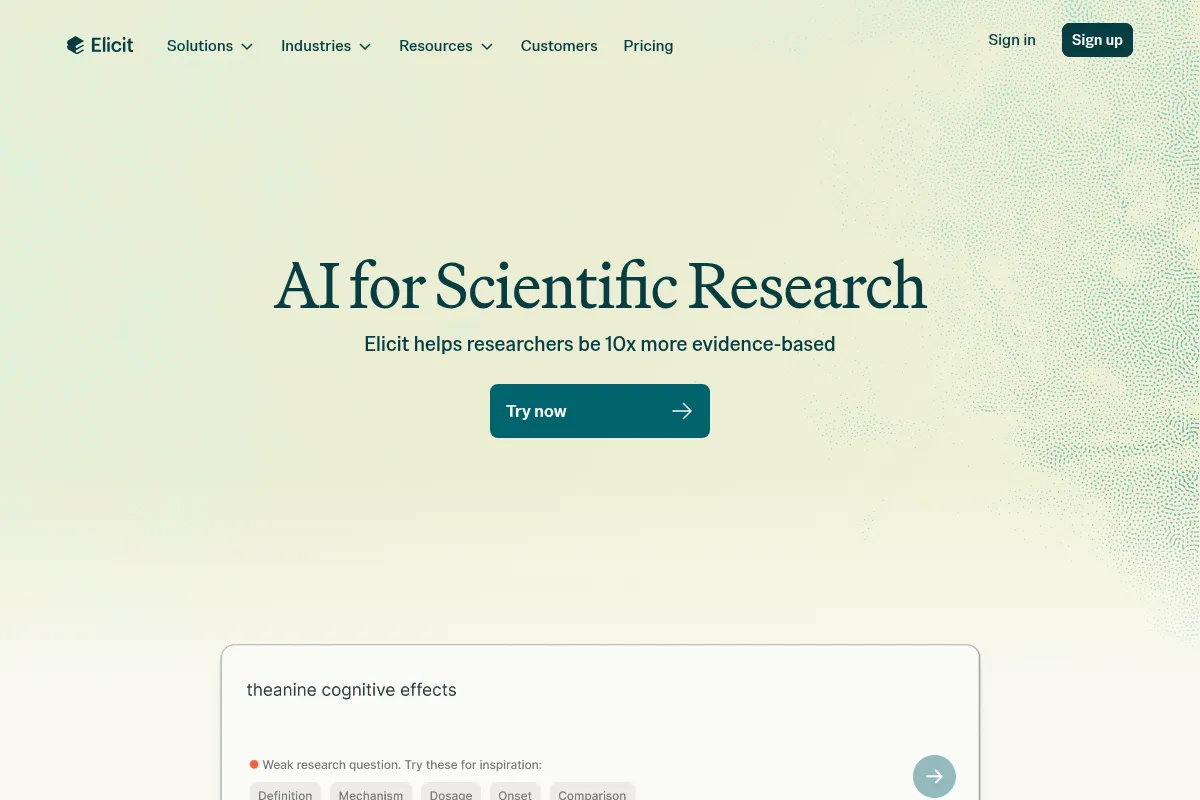
Elicit is an AI research assistant that automates literature review and data extraction for academic and professional researchers, streamlining the process of finding, synthesizing, and analyzing scholarly information.
Best for academic literature review and data extraction, weaker for general writing assistance.
Analysis based on product data, pricing structure, traffic signals, and public user sentiment.
Who Should Use Elicit?
Typical users
Academic researchers, graduate students, scientists, and professionals in fields requiring extensive literature review and data synthesis. It's also beneficial for industry analysts and policy makers needing to quickly access and understand research findings.
Maturity fit
beginner to advanced
Choose this if…
- You need to conduct systematic literature reviews or meta-analyses.
- You want to automate the extraction of specific data points from research papers.
- You need to quickly find relevant academic papers using natural language queries.
- Your workflow involves synthesizing information from multiple sources for reports or proposals.
Skip this if…
- You require a comprehensive writing assistant or citation manager.
- Your primary need is for general conversational AI or creative content generation.
- You need to analyze non-academic content or a very broad range of web articles.
- You require deep qualitative analysis or interpretation beyond data extraction.
About Elicit
Elicit is an AI-powered research assistant designed to automate and streamline academic workflows. It helps researchers find relevant papers using natural language questions, extract key data into customizable tables, and synthesize findings. Elicit is particularly useful for literature reviews and systematic reviews, significantly reducing the time and effort required for these tasks.
Official profiles
What it actually does
Elicit automates key aspects of the research process, including finding relevant academic papers through semantic search, summarizing their content, and extracting specific data points into organized tables. It supports systematic review workflows by guiding users through search, screening, and data extraction.
What makes it different
Elicit differentiates itself through its specialized focus on academic literature and its structured workflow, which goes beyond simple Q&A to offer systematic review capabilities and detailed data extraction. Its semantic search understands the meaning of queries, not just keywords, and it provides sentence-level citations for all generated information, enhancing transparency and verifiability.
Ratings across the web

Ratings aggregated from independent review platforms.
Key Features
Semantic Search
Finds relevant papers based on the meaning of your query, not just keywords, improving discovery of related research.
Automated Data Extraction
Pulls specific data points (e.g., sample size, outcomes) from papers into organized tables, saving manual effort.
Systematic Review Workflow
Guides users through search, screening, and data extraction for comprehensive evidence synthesis.
Sentence-Level Citations
Links every AI-generated claim directly to the source sentence in the paper, allowing for easy verification.
Research Reports
Generates customizable research briefs summarizing findings from multiple papers.
Unlimited Chat with Papers
Allows users to ask questions and get answers directly from the full text of research papers.
Paper Upload and Analysis
Enables users to upload their own documents for analysis and data extraction.
Concepts Tool
Breaks down complex ideas and shows connections between them.
Pricing
Basic
- Unlimited search across 138M+ papers
- Unlimited chat with papers (4 at once)
- 20 data extractions/month
- 2 custom columns per table
Plus
- Unlimited search
- Unlimited chat/summaries (8 papers at once)
- 600 data extractions/year
- Export to CSV/BIB/RIS
- 5 custom columns per table
- High-accuracy mode
Pro
- Everything in Plus
- 2,400 data extractions/year
- Dedicated systematic review workflows
- 20 custom columns per table
- Research alerts
Enterprise
- Everything in Pro
- Volume discounts
- Custom workflows
- Co-branding
- Dedicated support
- Screen 40,000 papers
Pricing checked 6 months ago
Pricing guidance
- Needing to extract data from more than 20 PDFs per month.
- Requiring export options (CSV, BIB, RIS).
- Conducting systematic reviews that benefit from dedicated workflows.
- Needing to analyze more than 8 full-text papers at once.
- The free plan's 20 data extractions per month can be a quick limit for intensive use.
- While the Pro plan allows screening 5,000 papers, the Enterprise plan screens 40,000, indicating a significant jump in scale for the highest tier.
- API access is limited to Pro and Enterprise users.
Elicit offers a tiered pricing structure, with a generous free plan for basic use and progressively more powerful features and higher limits for paid tiers, positioning itself as accessible for students and professionals alike.
Pros & Cons
Strengths
-
Efficient Literature Discovery
Elicit's semantic search finds relevant papers even without exact keyword matches, significantly speeding up the initial research phase. This is particularly valuable for exploring new or complex topics.
-
Streamlined Data Extraction
The ability to extract specific data points from multiple papers into a structured table automates a tedious process, making it easier to compare findings and conduct meta-analyses.
-
Focus on Academic Rigor
With sentence-level citations and a workflow inspired by systematic reviews, Elicit promotes accuracy and transparency, helping researchers verify information and build trust in the findings.
-
Generous Free Tier for Exploration
The free Basic plan offers unlimited search and chat capabilities, allowing users to thoroughly test the tool's core functionalities before committing to a paid plan.
-
Dedicated Systematic Review Tools
The Pro and Enterprise plans offer specialized workflows for systematic reviews, automating screening and data extraction, which can save significant time and resources for large-scale research projects.
Weaknesses
-
Limited Scope Beyond Academic Literature
Elicit is primarily designed for academic papers and may not be suitable for analyzing general web content, news articles, or other non-scholarly sources.
Affects: Users needing to research topics outside of academic journals.
-
Potential for Hallucinations and Inaccuracies
Like all AI tools, Elicit can sometimes misinterpret nuances or generate inaccurate information, requiring users to critically evaluate and verify its outputs.
Affects: All users, especially those relying solely on Elicit without cross-referencing.
-
Sensitivity Issues in Systematic Searches
Some studies indicate that Elicit's sensitivity in comprehensive systematic searches can be lower than traditional methods, potentially missing relevant papers.
Affects: Researchers conducting highly sensitive systematic reviews where missing even a few key papers is critical.
-
No Built-in Writing or Citation Management
While Elicit excels at finding and extracting information, it does not offer integrated writing assistance or full citation management features, requiring users to use separate tools for these tasks.
Affects: Users seeking an all-in-one research and writing solution.
Real User Sentiment
Users generally find Elicit to be a highly effective tool for speeding up research, particularly for literature reviews and data extraction, though some note limitations and the need for verification.
Users tend to like
- Speed and efficiency in finding relevant papers.
- Automated data extraction into organized tables.
- Semantic search that uncovers relevant studies beyond keywords.
- Sentence-level citations for verification.
- Useful for systematic reviews and evidence synthesis.
Users commonly complain about
- Occasional inaccuracies or 'hallucinations' requiring verification.
- Limited scope beyond academic literature.
- Free credits can be used up quickly.
- Lack of integrated writing or full citation management features.
Recurring tradeoffs
- Speed and automation vs. the need for human verification.
- Specialized academic focus vs. broader content analysis.
- Structured data extraction vs. general conversational AI.
Happiest users
Academic researchers, graduate students, and professionals who regularly conduct literature reviews and need to extract and synthesize data from scholarly papers.
Often frustrated
Users who expect a general-purpose AI assistant for creative writing or broad web content analysis, or those who are not diligent in verifying AI-generated outputs.
Use Cases
Conducting systematic literature reviews for academic publications.
Extracting key data points (e.g., methodology, outcomes) from multiple studies for meta-analysis.
Quickly finding 'seed' articles or foundational research in a new field.
Generating research reports for grant proposals or policy briefs.
Summarizing complex academic papers for easier understanding.
Identifying research gaps by synthesizing existing literature.
Brainstorming research questions and refining search strategies.
Frequently Asked Questions
What is Elicit AI and what does it do?
Elicit AI is an AI-powered research assistant designed to automate and streamline academic workflows. It helps researchers find relevant papers using natural language questions, extract key data into customizable tables, and synthesize findings. Its core functions include semantic search across millions of academic papers, automated data extraction, paper summarization, and support for systematic review processes. It aims to significantly reduce the time and effort required for literature reviews and evidence synthesis.
How much does Elicit AI cost? Is there a free plan?
Elicit offers a tiered pricing structure. The Basic plan is free and provides unlimited search and chat capabilities, along with limited data extractions per month. Paid plans, such as Plus (starting around $12/month annually) and Pro (starting around $49/month annually), offer increased data extraction limits, advanced features like systematic review workflows, export options, and higher usage caps. Custom Enterprise plans are also available.
How does Elicit AI compare to Google Scholar or PubMed?
Elicit goes beyond traditional search engines like Google Scholar and PubMed by not only finding papers but also actively summarizing them, extracting key data into tables, and facilitating systematic review workflows. While Google Scholar and PubMed are excellent for broad discovery and citation tracking, Elicit provides AI-driven analysis and synthesis, acting as a research assistant rather than just a search portal. Elicit uses Semantic Scholar as a data source, which is also used by Google Scholar.
What are the limitations of Elicit AI?
Elicit's primary limitations include its focus on academic literature, meaning it's not ideal for general web content. Like all AI, it can sometimes 'hallucinate' or produce inaccuracies, requiring users to verify its outputs. Some studies suggest its sensitivity for comprehensive systematic searches may be lower than traditional methods. Additionally, it lacks integrated writing assistance and full citation management features, necessitating the use of separate tools for those tasks.
Can Elicit AI be used for systematic reviews?
Yes, Elicit offers dedicated workflows for systematic reviews, particularly in its Pro and Enterprise plans. It automates key steps such as screening titles and abstracts, extracting data from included papers, and generating research reports. While it can significantly speed up the process, it's often recommended as a complementary tool to traditional methods, with human oversight still crucial for methodological rigor.
Does Elicit AI integrate with other tools like Zotero?
Elicit allows users to export research data in formats like CSV, BIB, and RIS, which can then be imported into reference managers like Zotero. While direct, real-time integration might vary, the export functionality facilitates its use within existing research workflows. Elicit also offers an API for integration with other tools and scripts for Pro and Teams users.
How accurate is Elicit AI's data extraction?
Elicit claims high accuracy in data extraction, with some reports indicating rates of 99.4% in specific use cases and near-zero false negatives. It can distinguish detailed quantitative and qualitative information, including data presented in tables. However, users are still advised to verify critical information, as AI can sometimes miss nuances or misinterpret data, especially if the source paper is unclear.
Can Elicit AI analyze full-text papers, or just abstracts?
Elicit can analyze both abstracts and full-text papers. The Plus plan allows summarization of up to 8 full-text papers at once, and users can upload their own PDFs for analysis. The ability to access full-text papers may depend on the availability of open-access versions or integrated subscriptions.
Why trust this page?
This evaluation combines product positioning, pricing analysis, traffic and market signals, and public user sentiment into a single decision-support page. Content is generated editorially — not copied from the vendor's website.
Funding & Company
Founded
2021
Stage
Series a
Total Raised
$31M
Latest Round
Series A (Feb 2025)
Notable Investors
Elicit has raised a total of $31 million over two rounds, including a $22 million Series A in February 2025. [2, 3] This funding provides a solid operational runway to expand its AI research assistant beyond academia into enterprise markets.
Market Signals & Traffic
Estimated visits, global rank, geography, traffic sources, monthly visit trends, and organic search keywords (Similarweb)—on a dedicated page built for depth and search.
- Estimated visits
- 2,259,712
- Global rank
- #22,216
- Snapshot
- Apr 2026
- Traffic trend
- Surging
Estimated monthly visits
Alternatives to Elicit
View all alternativesConsensus
Productivity, Data Extraction

AI-powered academic search engine for peer-reviewed research papers.
scite
AI Assistant, Productivity

Discover and evaluate scientific research through smart citation context.
Semantic Scholar
Productivity, Data Extraction, Developer Tools

AI-powered research tool for scientific literature discovery and analysis.
Similar Tools
Hebbia
AI Assistant, Data Extraction, Productivity

Knowledge discovery platform for complex document analysis and research
Tavily
Developer Tools, Data Extraction, Automation & Agents

Search engine for AI agents and RAG workflows
The New Black
Design, E-commerce, Content Creation

Generate unique fashion designs and clothing concepts instantly
Viggle AI
Video Creation, Content Creation

AI tool to animate static images and create videos from motion.
Attest
Developer Tools, Privacy & Compliance

Evaluation and testing platform for large language model applications
Virtue
Privacy & Compliance, Workflow, Automation

Governance and risk management platform for enterprise compliance