

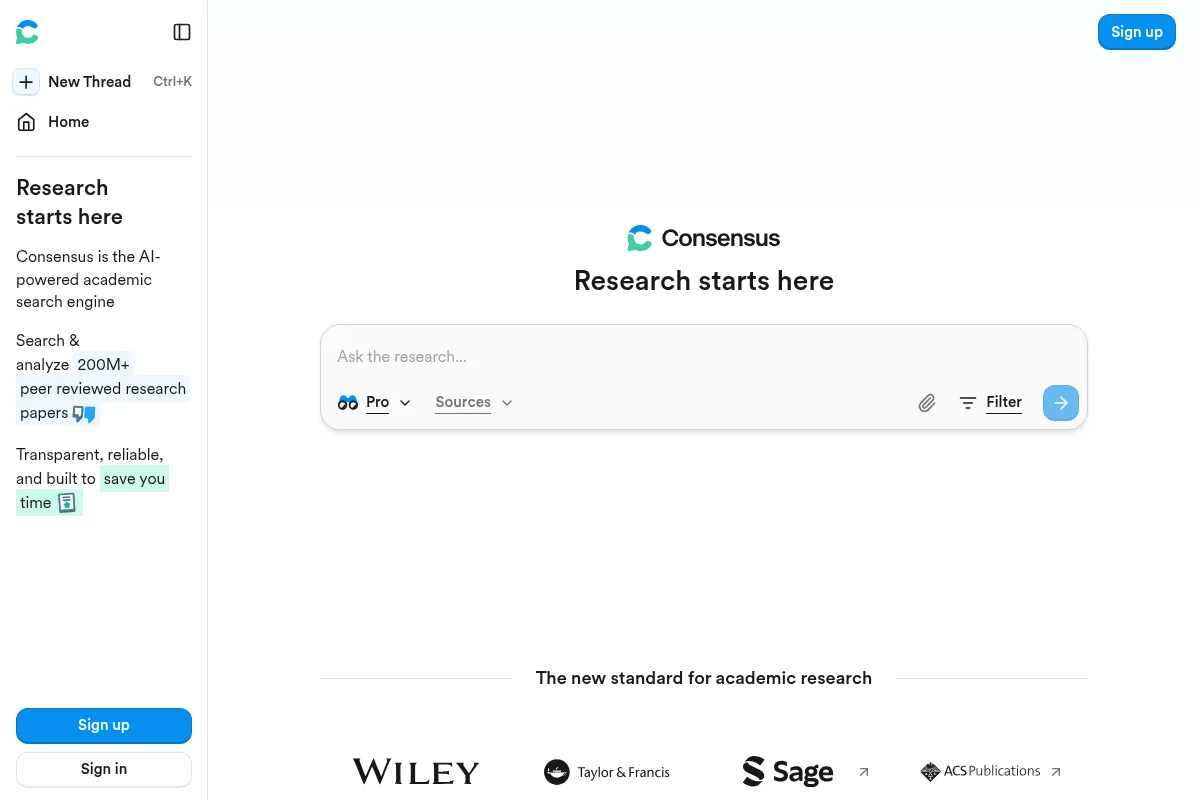
Consensus is an AI-powered academic search engine that synthesizes information from peer-reviewed research papers, offering quick answers and literature review assistance.
Best for researchers needing rapid, evidence-based answers to specific questions, weaker for broad literature exploration.
Analysis based on product data, pricing structure, traffic signals, and public user sentiment.
Who Should Use Consensus?
Typical users
Researchers, students, academics, and professionals who need to quickly find and understand information from peer-reviewed studies. This includes individuals working on literature reviews, dissertations, or seeking evidence-based answers for their work.
Maturity fit
beginner to advanced
Choose this if…
- You need to quickly find and synthesize information from academic research.
- You want to understand the general scientific consensus on a specific question.
- You need to quickly identify relevant papers for a literature review.
- You prefer answers grounded in peer-reviewed research over general AI models.
Skip this if…
- You require comprehensive literature discovery and exploration of broad topics.
- You need to perform systematic reviews with advanced data extraction.
- You are looking for a tool that provides full-text access to paywalled articles.
- You prefer to rely solely on human-curated literature reviews.
About Consensus
Consensus is an AI-powered academic search engine that indexes over 200 million peer-reviewed research papers. It aims to accelerate the research process by providing quick, synthesized answers and insights directly from scientific literature, complete with citations. It's designed to help users orient themselves in new research areas and understand the prevailing scientific consensus on specific questions.
What it actually does
Consensus searches a vast database of academic papers to answer user queries. It provides AI-generated summaries of research findings, highlights areas of agreement or disagreement using its 'Consensus Meter,' and allows users to 'Ask Paper' for in-depth analysis of specific studies. It also offers features for organizing and saving research.
What makes it different
Unlike general AI chatbots, Consensus is specifically trained on academic literature and grounds all its responses in peer-reviewed research, providing direct citations. Its 'Consensus Meter' offers a unique visualization of agreement across studies for yes/no questions, and its 'Ask Paper' feature allows direct interaction with the content of individual papers.
Ratings across the web

Ratings aggregated from independent review platforms.
Key Features
Consensus Meter
Visualizes the level of agreement or disagreement in research literature for yes/no questions, helping users quickly gauge scientific consensus.
AI-Powered Summaries
Provides concise summaries of key findings from research papers, saving users time on initial reading.
Ask Paper
Allows users to ask specific questions directly to the full text of a research paper for detailed insights.
My Library
Enables users to organize and save papers into custom collections for easy retrieval and management.
Advanced Search Filters
Offers precise filtering options (e.g., publication year, study design, methodology) to refine search results.
Pro Analysis
Offers a more thorough synthesis of key findings from top papers with citations.
Medical Mode
Narrows search results to high-quality medical sources, including clinical guidelines and top medical journals.
Pricing
Free
- Basic Quick Search (Abstracts only, up to 10 papers)
- Limited Pro Search (Full Texts and Abstracts, up to 20 papers)
- 3 Deep Searches per month
- 10 paper Snapshots per month
Pro
- Unlimited Pro Search
- 15 Deep Searches per month
- Unlimited paper Snapshots
- Unlimited Ask Paper messages
- Unlimited bookmarks and custom lists
Deep
- Everything in Pro
- 200 Deep Searches per month
- Unlimited Pro Analyses
- Unlimited paper Snapshots
- Unlimited Ask Paper messages
Pricing checked 6 months ago
Pricing guidance
- When you frequently need to perform in-depth analyses of multiple papers (Deep Searches).
- When you require unlimited access to advanced AI features like Pro Analysis and Ask Paper.
- When you need to save and organize a large number of papers and searches.
- The 'Free' tier has limitations on the number of deep searches and paper snapshots.
- While Pro and Deep plans offer 'unlimited' Pro Analyses and Ask Paper messages, there might be unstated usage caps or rate limits.
- Access to full-text articles is limited to Open Access papers; paywalled articles require separate access.
Affordable for individual researchers and students, with tiered pricing that scales with usage intensity.
Pros & Cons
Strengths
-
Evidence-based answers
All responses are directly tied to peer-reviewed research papers, providing a higher degree of trust and accuracy compared to general AI models.
-
Time-saving literature review
Significantly speeds up the process of finding and understanding relevant research, particularly for initial literature exploration and identifying key papers.
-
Unique 'Consensus Meter'
Provides a clear, visual representation of scientific agreement on specific questions, which is highly valuable for quickly assessing the state of research.
-
Focused on academic research
Its specialized nature means it's optimized for academic content, offering features tailored to researchers' needs.
Weaknesses
-
Limited for broad literature discovery
While excellent for specific questions, it may not be the best tool for broad, exploratory literature searches or for discovering tangential research areas.
Affects: Researchers needing to explore a wide, undefined research space.
-
Potential for AI misinterpretation
Although grounded in research, AI summaries can sometimes miss nuances or misinterpret findings, requiring users to verify critical information.
Affects: Users who rely solely on AI summaries without cross-referencing original papers.
-
Paywall limitations
Consensus does not provide access to paywalled articles; users must use library resources or interlibrary loans to access them.
Affects: Users without institutional access to paywalled research papers.
-
Limited in-depth analysis of complex topics
While it synthesizes findings, it may not replace the deep critical analysis required for systematic reviews or highly complex research questions.
Affects: Researchers conducting systematic reviews or requiring deep qualitative analysis.
Real User Sentiment
Generally positive, with users appreciating its speed, evidence-based approach, and unique features like the Consensus Meter.
Users tend to like
- Evidence-based answers grounded in research papers.
- Speed and efficiency in finding relevant literature.
- The 'Consensus Meter' for visualizing agreement.
- Helpful AI summaries and 'Ask Paper' feature.
- User-friendly interface.
Users commonly complain about
- Occasional inaccuracies or misinterpretations in AI summaries.
- Limited access to full-text articles behind paywalls.
- Free tier limitations can be restrictive for frequent users.
- Some users desire more advanced features for systematic reviews.
Recurring tradeoffs
- Speed and convenience vs. the need for manual verification of critical findings.
- Focused, evidence-based answers vs. broad, exploratory literature discovery.
Happiest users
Researchers and students who need quick, reliable answers to specific scientific questions and value evidence-based insights.
Often frustrated
Users who require comprehensive literature discovery, advanced systematic review tools, or immediate access to paywalled content.
Use Cases
Quickly assessing the scientific consensus on a specific medical treatment.
Identifying key papers for a literature review in social sciences.
Verifying claims made in a news article with peer-reviewed research.
Getting a rapid overview of research on a new topic before diving deeper.
Finding evidence to support or refute a hypothesis for a research project.
Frequently Asked Questions
What is Consensus?
Consensus is an AI-powered academic search engine that searches over 200 million peer-reviewed research papers. It uses AI to help users find, understand, and synthesize scientific literature faster. Every response is grounded in real, citable research and includes citations to the original sources. It's designed to provide evidence-based answers and assist with literature reviews.
How does Consensus compare to ChatGPT?
Consensus is fundamentally different from general-purpose chatbots like ChatGPT. While ChatGPT is trained on a broad range of internet data, Consensus is specifically trained on academic texts and peer-reviewed research papers. This means Consensus provides answers grounded in scientific literature with direct citations, making it more reliable for academic research. ChatGPT may generate more creative or conversational text but lacks the same level of academic rigor and source verification.
What are the limitations of Consensus?
Consensus does not provide direct access to paywalled articles; users will need separate institutional access or interlibrary loans for those. While its AI summaries are helpful, they may occasionally miss nuances or require verification against the original papers. The 'Consensus Meter' is powered by a limited number of top results (5-20), so it may not reflect the entirety of research on a topic. It is also not a substitute for deep critical analysis or systematic review methodologies.
Does Consensus integrate with citation managers?
Yes, Consensus integrates with popular citation managers such as Zotero, Mendeley, and EndNote. Users can export paper details directly from Consensus search results and saved lists into CSV or RIS file formats, allowing for seamless integration into their preferred reference management tools for academic projects.
Is there a free version of Consensus?
Yes, Consensus offers a Free tier that allows users to get started with basic search functionalities. This tier includes limited Pro Searches, a small number of Deep Searches per month, and paper snapshots. It's suitable for users who need occasional access or are just exploring the platform. For more extensive use, paid plans offer greater capabilities.
How does the 'Consensus Meter' work?
The 'Consensus Meter' is a feature designed for yes/no questions. It visually represents the level of agreement or disagreement across the top 5-20 relevant research papers found for your query. It categorizes findings into 'Yes,' 'No,' 'Possibly,' or 'Mixed,' providing a quick overview of the prevailing scientific perspective on a topic. Each classification is based on extracted information from the papers, and the contributing papers are visible.
Can Consensus access full-text articles?
Consensus can directly provide full-text PDFs for Open Access articles. For articles behind paywalls, it provides a direct link to the publisher's page along with metadata and abstracts, enabling users to determine relevance. Users would then need to access these paywalled articles through their institutional subscriptions or other means.
What kind of questions should I ask Consensus?
Consensus works best with specific research questions or topics that are likely to be covered in academic literature. While it can handle various query types, yes/no questions are particularly effective for the 'Consensus Meter.' Avoid overly broad questions like 'tell me about climate change'; instead, try more focused queries such as 'Does X improve Y?' or 'What is the impact of Z on A?'
Why trust this page?
This evaluation combines product positioning, pricing analysis, traffic and market signals, and public user sentiment into a single decision-support page. Content is generated editorially — not copied from the vendor's website.
Funding & Company
Founded
2021
Stage
Series b
Total Raised
$45.75M
Latest Round
Series B (May 2026)
Notable Investors
Consensus has raised a total of $45.75 million across four funding rounds, including a recent $30 million Series B in May 2026. This consistent access to capital from notable investors like Draper Associates and Union Square Ventures signals strong market confidence and provides a solid financial runway for product development and expansion.
Market Signals & Traffic
Estimated visits, global rank, geography, traffic sources, monthly visit trends, and organic search keywords (Similarweb)—on a dedicated page built for depth and search.
- Estimated visits
- 5,887,178
- Global rank
- #8,785
- Snapshot
- Apr 2026
- Traffic trend
- Surging
Estimated monthly visits
Alternatives to Consensus
View all alternativesElicit
AI Assistant, Data Extraction, Productivity

AI research assistant for literature review, data extraction, and synthesis.
scite
AI Assistant, Productivity

Discover and evaluate scientific research through smart citation context.
Semantic Scholar
Productivity, Data Extraction, Developer Tools

AI-powered research tool for scientific literature discovery and analysis.
Similar Tools
Zhipu AI
AI Assistant, Developer Tools, Content Creation

Advanced large language models for conversational and multimodal content generation.
Algolia
Developer Tools, Automation & Agents

API-first search and discovery platform for websites and apps.
Hostinger AI Builder
Productivity, Developer Tools, Content Creation

All-in-one web hosting and website building platform with AI tools.
Arahi AI
Privacy & Compliance, Workflow

Governance and risk management platform for enterprise deployments.
Akash Network
Developer Tools, Research

Decentralized cloud marketplace for high-performance GPU and compute resources.
AdCreative
Content Creation, Design, Marketing Automation

AI-powered platform for generating high-converting ad creatives, copy, and videos.