

Semantic Scholar
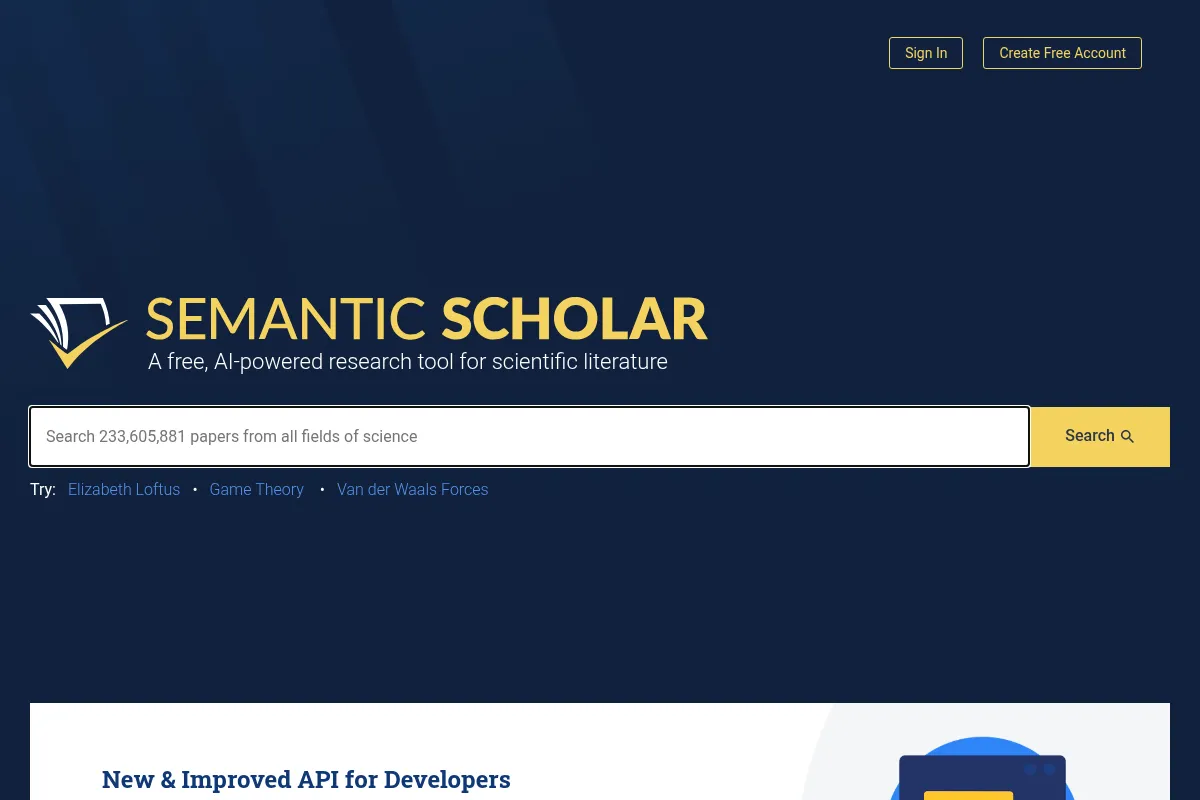
Semantic Scholar is a free, AI-powered academic search engine that excels at helping researchers discover and understand scientific literature, but it's not a comprehensive replacement for traditional databases or a tool for in-depth, multi-disciplinary bibliometrics.
Best for AI-driven literature discovery and quick paper summaries, weaker for exhaustive multi-disciplinary searches.
Analysis based on product data, pricing structure, traffic signals, and public user sentiment.
Who Should Use Semantic Scholar?
Typical users
Academic researchers, students, and knowledge workers who need to quickly find and understand scientific papers. It's particularly useful for those in computer science and biomedical fields.
Maturity fit
beginner to advanced
Choose this if…
- You need to quickly triage a large volume of scientific papers.
- You want AI-generated summaries (TLDRs) to assess relevance.
- You need to understand citation networks and influential papers.
- You are a developer looking for programmatic access to academic data via an API.
Skip this if…
- You require comprehensive coverage across all humanities and social sciences.
- Your primary need is formal bibliometric analysis for tenure or grant applications.
- You need to search behind paywalls for licensed content.
- You require deep integration with specific reference management software beyond basic export.
About Semantic Scholar
Semantic Scholar is a free, AI-powered search engine for scientific literature developed by the Allen Institute for AI. It aims to accelerate scientific breakthroughs by helping researchers overcome information overload through intelligent discovery and analysis of academic papers. It uses machine learning and NLP to provide features like AI-generated summaries and citation analysis.
What it actually does
Semantic Scholar indexes over 200 million academic papers, allowing users to search and discover relevant literature. It employs AI to provide features such as TLDR summaries for quick paper assessment, citation analysis to understand research impact, and personalized research recommendations.
What makes it different
Unlike traditional search engines, Semantic Scholar uses AI to understand the semantics of research topics, going beyond keyword matching. Its focus on providing AI-driven insights like TLDRs and identifying 'highly influential citations' differentiates it from broader academic search engines like Google Scholar.
Ratings across the web

Ratings aggregated from independent review platforms.
Key Features
TLDRs (Too Long; Didn't Read)
AI-generated, single-sentence summaries that help researchers quickly determine a paper's relevance without reading the abstract.
Citation Analysis
Identifies influential citations and provides citation graphs, helping users understand how papers relate to each other and their impact.
Research Feeds
Personalized recommendations of new papers based on a user's saved papers and reading history, helping researchers stay current.
Semantic Reader
An augmented reader that provides in-line citation cards with TLDRs and skimming highlights for a more contextual and efficient reading experience.
API Access
Offers programmatic access to its academic graph, enabling developers to build custom applications and perform large-scale data analysis.
Author and Paper Disambiguation
Uses AI to distinguish between authors with similar names and identify unique papers, improving search accuracy.
Pricing
Free
- AI-powered search
- TLDR summaries
- Citation analysis
- Research recommendations
- Semantic Reader
- API access (rate-limited)
Pricing checked 6 months ago
Pricing guidance
- When you require higher API rate limits for extensive data processing.
- When building applications that need to integrate Semantic Scholar data at scale.
- API rate limits for unauthenticated users (shared across all users).
- Authenticated API users have higher rate limits but still subject to throttling.
- TLDR coverage is not universal across all papers and disciplines.
Completely free, with a focus on open access and supporting the research community.
Pros & Cons
Strengths
-
AI-driven relevance ranking
Semantic Scholar uses AI to understand the meaning behind research topics, often providing more relevant results than keyword-based searches, which is especially useful for literature reviews and trend spotting.
-
TLDR summaries for quick triage
The AI-generated TLDRs offer a rapid way to assess paper relevance, saving researchers significant time by allowing them to quickly skip less pertinent articles.
-
Free and accessible
As a non-profit initiative, Semantic Scholar is completely free to use, including its API, promoting equal access to scientific knowledge for all researchers.
-
Strong API for developers
The Semantic Scholar Academic Graph (S2AG) API provides robust programmatic access to its data, supporting custom applications, large-scale analysis, and integration with other tools.
-
Focus on influential citations
Beyond raw citation counts, Semantic Scholar attempts to identify 'highly influential citations,' offering a more nuanced view of a paper's impact on the field.
Weaknesses
-
Limited coverage in some fields
While expanding, its coverage can be less comprehensive in certain humanities and social science disciplines compared to broader databases.
Affects: Researchers in non-STEM fields
-
Not a replacement for formal bibliometrics
For official metrics required for tenure or grant applications, specialized databases like Scopus or Web of Science are still considered the gold standard.
Affects: Academics seeking formal impact metrics
-
Does not search behind paywalls
Semantic Scholar prioritizes open access and does not index or provide access to content behind publisher paywalls, limiting its comprehensiveness for some searches.
Affects: Researchers needing access to paywalled content
-
TLDRs are summaries, not abstracts
While useful for quick triage, TLDRs are highly condensed and should not replace reading the abstract or full paper for critical understanding.
Affects: Users relying solely on TLDRs for comprehension
Real User Sentiment
Generally positive, with users appreciating its AI features and free access, though some note limitations in coverage and the need for supplementary tools.
Users tend to like
- AI-powered TLDR summaries for quick paper evaluation.
- Effective citation analysis and identification of influential papers.
- Free access to a vast academic corpus.
- Useful API for developers and data scientists.
- Personalized research recommendations.
Users commonly complain about
- Uneven coverage across all academic disciplines, particularly in humanities.
- TLDRs are not a substitute for abstracts or full papers.
- Inability to access content behind paywalls.
- Some users desire deeper integration with reference managers.
Recurring tradeoffs
- AI-driven relevance vs. comprehensive indexing.
- Speed and convenience of TLDRs vs. depth of abstracts.
- Free access vs. limitations in paywalled content.
Happiest users
Researchers in STEM fields, students, and developers who value AI-driven discovery and quick paper assessment.
Often frustrated
Researchers in niche humanities fields or those requiring exhaustive coverage of all literature, including paywalled content.
Use Cases
Discovering relevant research papers for a literature review
Semantic Scholar's AI helps surface key papers beyond simple keyword matches.
Quickly assessing the relevance of search results
TLDR summaries allow for rapid triage of papers.
Understanding the impact and connections of a specific paper
Citation analysis and influential citation identification provide context.
Staying updated with new research in a field
Personalized Research Feeds deliver tailored recommendations.
Developers building research tools
The Semantic Scholar API provides programmatic access to its vast academic graph.
Students needing to find credible sources for assignments
Semantic Scholar offers a reliable and free alternative to general search engines.
Frequently Asked Questions
Is Semantic Scholar free to use?
Yes, Semantic Scholar is completely free for all users. This includes access to its AI-powered search, TLDR summaries, citation analysis, research recommendations, and its API (though the API has rate limits). This aligns with its mission as a non-profit initiative to promote equal access to science.
How does Semantic Scholar compare to Google Scholar?
Semantic Scholar uses AI to understand the semantics of research topics, often providing more relevant results than Google Scholar's keyword-based approach. Semantic Scholar also offers unique features like TLDR summaries and influential citation identification. However, Google Scholar has broader coverage across disciplines and indexes content behind paywalls, which Semantic Scholar does not. For exhaustive searches, especially outside STEM, researchers often use both.
What are the limitations of Semantic Scholar?
Semantic Scholar's primary limitations include less comprehensive coverage in certain humanities and social science fields compared to specialized databases. It also does not index or provide access to content behind publisher paywalls. While TLDRs are useful for quick assessment, they are not a replacement for detailed abstracts or full papers, and formal bibliometric analysis for tenure may require tools like Scopus or Web of Science.
Does Semantic Scholar integrate with reference management tools like Zotero or EndNote?
Semantic Scholar allows users to export citations in various formats (BibTex, MLA, APA, Chicago) and can export to EndNote (.enw files). While it doesn't offer direct, real-time integration with tools like Zotero, the export functionality allows for easy transfer of citation data to manage research libraries.
What is a TLDR summary?
TLDR stands for 'Too Long; Didn't Read.' On Semantic Scholar, it's an AI-generated, single-sentence summary of a scientific paper. These summaries are designed to help researchers quickly grasp the main point of a paper and decide if it's relevant to their work, saving time by allowing them to bypass reading lengthy abstracts or full papers for initial triage.
Can I use Semantic Scholar for commercial purposes or build applications with its data?
Yes, Semantic Scholar provides a robust API (Semantic Scholar Academic Graph API) that developers and organizations can use to access its data programmatically. While there are rate limits, especially for unauthenticated requests, the API is free and designed to support the development of scholarly applications and large-scale data analysis. For high-volume data access, there may be partnered tiers available.
How does Semantic Scholar identify 'highly influential citations'?
Semantic Scholar uses a machine-learning model to analyze the context of citations. It identifies citations where the cited publication has a significant impact on the citing publication, going beyond simple citation counts to understand how a paper's methods or results were built upon. This identification relies on Semantic Scholar having access to the full text of the citing paper.
Why trust this page?
This evaluation combines product positioning, pricing analysis, traffic and market signals, and public user sentiment into a single decision-support page. Content is generated editorially — not copied from the vendor's website.
Company
Founded
2014
Stage
—
HQ
Seattle, Washington
Semantic Scholar is a free product from the Allen Institute for AI (AI2), a well-funded non-profit research institute. AI2 was established in 2014 through a major philanthropic commitment from Microsoft co-founder Paul G. Allen and is sustained by his estate and other grants. This non-profit structure ensures Semantic Scholar's stability and long-term operation without the typical pressures of a venture-backed company.
Market Signals & Traffic
Estimated visits, global rank, geography, traffic sources, monthly visit trends, and organic search keywords (Similarweb)—on a dedicated page built for depth and search.
- Estimated visits
- 8,737,239
- Global rank
- #6,855
- Snapshot
- Apr 2026
- Traffic trend
- Surging
Estimated monthly visits
Alternatives to Semantic Scholar
View all alternativesElicit
AI Assistant, Data Extraction, Productivity

AI research assistant for literature review, data extraction, and synthesis.
Consensus
Productivity, Data Extraction

AI-powered academic search engine for peer-reviewed research papers.
scite
AI Assistant, Productivity

Discover and evaluate scientific research through smart citation context.
Similar Tools
Predibase
Developer Tools

Fine-tune and serve custom large language models at scale.
Browzwear
Design, Workflow, E-commerce

3D fashion design and digital apparel development platform
beehiiv
Email Marketing, Content Creation

An all-in-one platform for creating, growing, and monetizing newsletters.
Rabbit
AI Assistant, Automation, Productivity

Pocket-sized hardware device that executes tasks across various mobile applications.
Browserbase
Automation, Automation & Agents, Developer Tools, Productivity

Cloud platform for running headless browsers at scale for AI agents and automation.
Malva AI
AI Assistant, Content Creation, Productivity

Curated directory and toolkit for free content creation tools.