

An AI coding assistant optimized for large-scale enterprise codebases, prioritizing low-latency autocomplete and deep repository context over general-purpose chat.
Excellent for engineering teams managing complex multi-repo architectures, weaker for solo developers who prefer the integrated UI of a standalone IDE like Cursor.
Analysis based on product data, pricing structure, traffic signals, and public user sentiment.
Who Should Use Augment Code?
Typical users
Mid-to-large engineering teams and enterprise developers working in massive, polyglot codebases.
Maturity fit
scaling to advanced
Choose this if…
- You need sub-100ms autocomplete latency to maintain flow
- Your project spans multiple repositories that need simultaneous indexing
- You want to keep your existing JetBrains or VS Code setup rather than switching IDEs
- IP protection and SOC 2/ISO 42001 compliance are non-negotiable
Skip this if…
- You are a solo developer on a small, single-repo project
- You prefer a standalone, AI-native IDE experience like Cursor or Windsurf
- Your budget is strictly capped at the $10-$20 range of basic assistants
About Augment Code
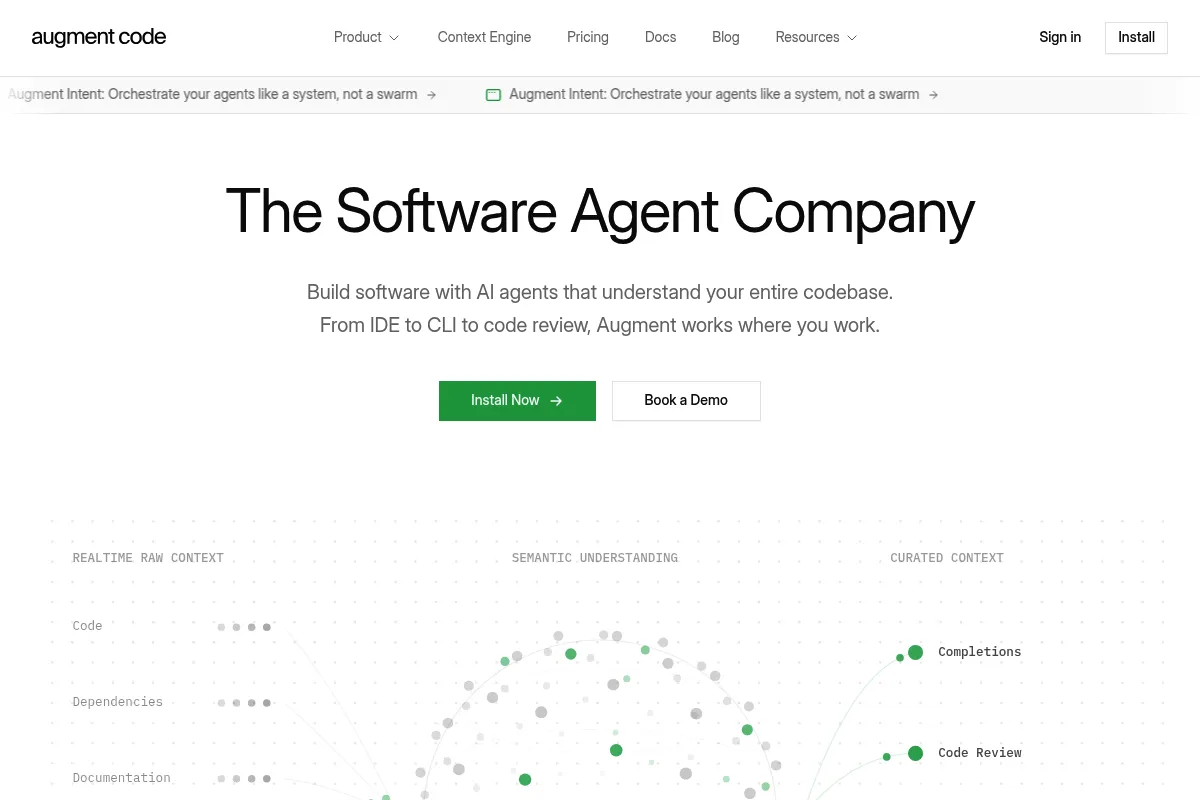
Augment is an AI-powered coding platform designed to handle the scale and complexity of professional software engineering. It focuses on providing context-aware suggestions by indexing entire portfolios of repositories rather than just open files or single projects.
Official profiles
What it actually does
It provides real-time code completion and an autonomous agent interface within existing IDEs. It indexes your team's entire codebase to answer architectural questions, perform multi-file refactors, and suggest code that adheres to internal patterns.
What makes it different
Unlike generic wrappers, Augment uses a custom inference stack to achieve near-instant latency. Its 'Context Engine' is built to reason across up to 500,000 files simultaneously, allowing it to understand cross-service contracts and dependencies that trip up tools with smaller context windows.
Ratings across the web

Ratings aggregated from independent review platforms.
Key Features
Context Engine
Indexes millions of lines of code to provide suggestions grounded in your specific architecture.
Augment Agent
Executes complex workflows like refactoring auth flows or migrating APIs across multiple files.
Slack Integration
Allows teams to query the codebase and documentation directly from communication channels.
Proof-of-Possession API
Ensures AI suggestions only use code the developer has local access to, preventing data leakage.
Intent Desktop Workspace
A standalone environment for high-level project planning and automation orchestration.
Smart Paste
Automatically refactors pasted code snippets to match the style and context of the destination file.
Model Picker
Allows switching between Claude 3.5 Sonnet, GPT-4o, and other models based on task complexity.
Pricing
Free Trial
- 30,000 credit pool
- Access to all core features
- Requires credit card
Indie
- 40,000 credits
- Autocomplete & Chat
- Slack integration
- Standard support
Standard
- 130,000 credits
- Team management tools
- Usage analytics
- Priority support
Max
- 450,000 credits
- Advanced admin controls
- Remote agent capabilities
- Highest priority support
Enterprise
- Custom credit limits
- VPC deployment
- Customer-managed encryption keys
- Dedicated account manager
Pricing checked 6 months ago
Pricing guidance
- When you need to manage more than one user
- When your credit usage exceeds 40k/month due to heavy agent tasks
- When you require enterprise security certifications for procurement.
- Credits do not roll over between billing cycles
- Auto top-ups cost $15 per 24,000 credits
- The Indie plan is restricted to a single user.
Premium enterprise positioning justified by superior context handling and security compliance.
Pros & Cons
Strengths
-
Superior multi-repo awareness
It understands dependencies across different services, making it highly effective for microservice architectures where other tools lose context.
-
Minimal latency
The autocomplete is fast enough to feel like local IntelliSense, reducing the cognitive friction common with slower cloud-based LLMs.
-
Deep IDE integration
By working as an extension for JetBrains and VS Code, it doesn't force developers to abandon their customized environments and plugins.
-
Enterprise-grade security
Features like customer-managed encryption keys and a strict no-training policy make it viable for highly regulated industries.
Weaknesses
-
Credit-based pricing complexity
The shift to a credit system can make monthly costs unpredictable for power users who rely heavily on autonomous agents.
Affects: Budget-conscious teams and heavy users
-
No standalone IDE
Lacks the deep UI-level AI integrations (like 'Composer' modes) found in dedicated AI editors like Cursor.
Affects: Developers seeking an AI-first interface
-
High entry cost for teams
At $60/user for the Standard tier, it is significantly more expensive than GitHub Copilot or basic Cursor plans.
Affects: Small startups and price-sensitive teams
Real User Sentiment
Users generally praise the tool's speed and its ability to 'actually know' the codebase, though some are frustrated by the recent move to credit-based pricing.
Users tend to like
- Sub-100ms autocomplete speed
- Accurate suggestions in large, complex repos
- Excellent JetBrains support
- Slack integration for codebase Q&A
Users commonly complain about
- High cost compared to GitHub Copilot
- Credit-based system feels restrictive
- Lack of a standalone IDE
Recurring tradeoffs
- You trade the AI-native UI of Cursor for the ability to stay in your preferred, established IDE.
Happiest users
Senior engineers in large companies who work across multiple repositories and value low-latency tools.
Often frustrated
Solo developers on tight budgets or those who want a fully automated 'AI-first' editor experience.
Use Cases
Large-scale refactoring
Using the agent to update API calls across dozens of microservices simultaneously.
Onboarding new hires
Letting developers ask the Slack bot questions about legacy logic and internal patterns.
Codebase migration
Automating the translation of patterns from one framework to another across a large repo.
Security-conscious development
Implementing AI assistance in environments where data training is strictly prohibited.
Cross-repo debugging
Finding the root cause of an issue that spans multiple service boundaries.
Frequently Asked Questions
How does Augment Code compare to Cursor?
Augment is an extension that works inside your existing IDE (VS Code, JetBrains), whereas Cursor is a standalone fork of VS Code. Augment is generally better at handling multi-repository context and enterprise security, while Cursor offers a more integrated 'AI-native' UI for single-repo projects.
Does Augment Code train on my data?
No. Augment has a strict policy against training its base models on customer proprietary code for all paid tiers. They offer SOC 2 Type II and ISO 42001 certifications to verify these data protection claims.
What are credits and how are they consumed?
Augment uses a credit-based system where different actions (autocomplete, chat, agent tasks) and different models (Claude 3.5, GPT-4o) consume credits at different rates. For example, using a 'Premium' model like Claude 3.5 Opus consumes more credits than a 'Standard' model like Sonnet.
Can I use Augment with JetBrains IDEs?
Yes. Unlike Cursor, which is VS Code-only, Augment provides full support for the JetBrains ecosystem, including IntelliJ IDEA, PyCharm, and WebStorm, making it a top choice for Java and Python enterprise teams.
Is there a free version of Augment Code?
There is no permanent free tier. Augment offers a trial with a 30,000 credit pool (requires a credit card) to let you test the features before committing to the $20/month Indie plan or higher tiers.
What is the 'Context Engine'?
The Context Engine is Augment's proprietary indexing technology that maps your entire codebase, including commit history and documentation. It allows the AI to understand architectural patterns and dependencies across up to 500,000 files, far exceeding the context window of standard LLMs.
Why trust this page?
This evaluation combines product positioning, pricing analysis, traffic and market signals, and public user sentiment into a single decision-support page. Content is generated editorially — not copied from the vendor's website.
Funding & Company
Founded
2022
Stage
Series b
Total Raised
$252M
Latest Round
Series B (Apr 2024)
Notable Investors
Augment Code has raised a significant $252 million across two rounds, culminating in a $227 million Series B in April 2024 that valued the company at $977 million. This substantial backing from top-tier investors like Sutter Hill Ventures and Index Ventures provides a long operational runway and signals strong market confidence in its AI-powered developer tools.
Market Signals & Traffic
Estimated visits, global rank, geography, traffic sources, monthly visit trends, and organic search keywords (Similarweb)—on a dedicated page built for depth and search.
- Estimated visits
- 0
- Global rank
- —
- Snapshot
- May 2026
- Traffic trend
- Steady
Estimated monthly visits
Alternatives to Augment Code
View all alternativesGitHub Copilot
Developer Tools, AI Assistant

AI-powered coding assistant that suggests and generates code.
Cursor
AI Assistant

An AI-powered code editor designed to help developers build software faster.
Sourcegraph
Developer Tools, AI Assistant

Code intelligence platform for searching, writing, and understanding codebases
Similar Tools
Devin
Developer Tools, AI Assistant, Automation & Agents

Autonomous AI software engineer for complex development tasks.
Cline
Developer Tools, AI Assistant, Automation & Agents

Autonomous coding agent for IDEs and terminal-based development workflows.
Greptile
Developer Tools, AI Assistant, Automation & Agents

Automated code review agent with complete codebase context.
Tessl
Developer Tools, Automation & Agents

Package manager for agent skills and development context
Snorkel AI
Developer Tools, Automation, Research

Programmatic data labeling and development platform for enterprise model building.
Martian
Developer Tools, Automation, Workflow

Dynamic router that automatically selects the best LLM for every prompt.