

Contextual AI
An enterprise-grade RAG platform that replaces generic LLM wrappers with end-to-end optimized models for high-stakes data retrieval and generation.
Excellent for enterprises requiring verifiable accuracy on private data, weaker for teams looking for a low-cost, plug-and-play chatbot.
Analysis based on product data, pricing structure, traffic signals, and public user sentiment.
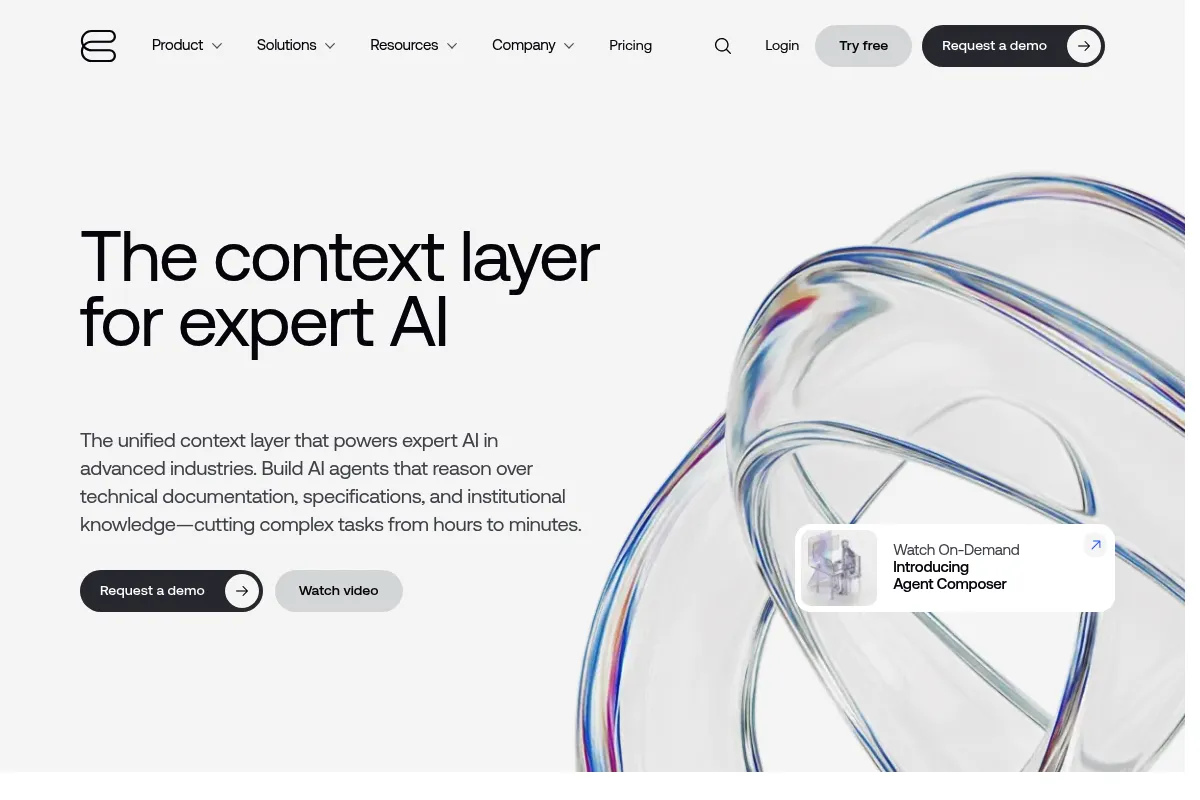
Who Should Use Contextual AI?
Typical users
Fortune 500 engineering teams, compliance-heavy industries like finance or legal, and product managers building high-stakes AI features.
Maturity fit
advanced
Choose this if…
- Your priority is 100% verifiable citations over creative writing
- You need to deploy AI within a private VPC or on-premises environment
- Standard RAG setups are producing too many hallucinations for your use case
- You want a system where the retriever and the model are co-trained for better alignment
Skip this if…
- You are a solo developer looking for a cheap, self-serve API
- Your data is public and doesn't require strict privacy guardrails
- You need a general-purpose creative assistant rather than a grounded knowledge tool
About Contextual AI
Contextual AI provides a platform for building RAG 2.0 systems, moving beyond simple vector search by co-training the retriever and the language model. Founded by the researchers who pioneered RAG at Meta and Hugging Face, it targets organizations that cannot tolerate the inaccuracies of off-the-shelf LLMs.
Official profiles
What it actually does
The platform ingests massive enterprise datasets and builds 'Contextual Foundation Models' (CFMs) that are specifically tuned to that data. It generates responses that include direct citations to source documents, ensuring every output can be audited for accuracy.
What makes it different
Unlike standard RAG which uses a frozen LLM and a separate vector database, Contextual AI uses an end-to-end optimized architecture. This 'RAG 2.0' approach allows the model to better understand the specific nuances of a company's internal language and data structure, significantly reducing the 'lost in the middle' problem common in basic retrieval systems.
Key Features
RAG 2.0 Architecture
Co-trains the retriever and generator as a single unit for higher precision.
Contextual Foundation Models (CFMs)
Specialized models that outperform general LLMs on private data tasks.
Verifiable Citations
Links every claim back to a specific source document for auditability.
Deployment Flexibility
Supports cloud, VPC, or on-premises setups to maintain data sovereignty.
Enterprise Connectors
Syncs with Slack, Google Drive, Confluence, and internal databases.
Hallucination Mitigation
Built-in guardrails that force the model to stay grounded in provided data.
Fine-tuning Pipeline
Allows teams to continuously improve model performance on specific domain jargon.
Pricing
Enterprise
- Full RAG 2.0 platform access
- Custom CFM training
- VPC or On-prem deployment options
- Dedicated support and integration assistance
- Unlimited data connectors
Pricing checked 5 months ago
Pricing guidance
- Moving from a pilot/POC to full production
- Requiring on-premises deployment for sensitive data
- Needing custom-trained models for specific industry jargon
- Pricing is likely based on data volume and compute requirements
- Requires a formal sales engagement for any level of access
- Implementation timelines can be weeks or months depending on data complexity
Premium enterprise positioning justified by technical depth and security features.
Pros & Cons
Strengths
-
Superior grounding and accuracy
By training the retriever and model together, the system avoids the common disconnect where a model fails to use the relevant data it was given.
-
Strict data privacy
The ability to deploy in a private VPC or on-prem is a requirement for financial and healthcare sectors that cannot send data to public LLM providers.
-
Audit-ready outputs
Citations are not just appended; the model is trained to generate them, making it much easier for human reviewers to verify facts.
Weaknesses
-
High barrier to entry
This is not a self-serve tool; it requires a significant investment in time and budget to set up a production-grade environment.
Affects: Small startups and individual developers
-
Opaque pricing and access
The lack of public pricing or a free tier makes it difficult to evaluate the tool without going through a formal sales process.
Affects: Procurement teams and technical evaluators
-
Implementation complexity
Maximizing the value of RAG 2.0 requires clean data and engineering resources to manage the integration.
Affects: Teams without dedicated AI or data engineering staff
Real User Sentiment
Highly respected by technical users for its research-backed approach to solving RAG limitations.
Users tend to like
- Technical pedigree of the founding team
- Focus on RAG 2.0 over simple vector search
- Commitment to data privacy and on-prem support
Users commonly complain about
- Lack of accessibility for smaller teams
- No public documentation for self-serve testing
- High perceived cost
Recurring tradeoffs
- Performance and accuracy vs. ease of setup
Happiest users
CTOs and AI Architects at large firms who have failed to get standard RAG to work at scale.
Often frustrated
Independent developers looking for a quick API to build a simple wrapper app.
Use Cases
Legal Discovery
Searching through millions of pages of case law and internal contracts with 100% citation accuracy.
Financial Reporting
Automating the synthesis of earnings calls and regulatory filings without risk of hallucinated numbers.
Technical Support
Powering internal help desks for complex hardware or software products using only official manuals.
Pharmaceutical Research
Grounding AI responses in proprietary clinical trial data and research papers.
Government Compliance
Managing policy queries across vast, sensitive internal databases in a secure environment.
Frequently Asked Questions
How much does Contextual AI cost?
Contextual AI does not publish pricing. It is an enterprise-only tool, and costs are determined based on deployment needs, data volume, and compute. Expect premium enterprise pricing comparable to other high-end AI infrastructure providers.
How is Contextual AI different from Glean?
Glean is primarily an enterprise search tool that helps employees find documents across apps. Contextual AI is a model-building platform that allows you to create custom, grounded LLMs (RAG 2.0) for specific generative tasks. Glean is for finding; Contextual is for building.
What is RAG 2.0?
RAG 2.0 is a methodology where the retriever (the part that finds data) and the generator (the LLM) are trained together as a single system. This differs from RAG 1.0, which simply plugs a pre-trained LLM into a separate search engine, often leading to lower accuracy.
Can I use Contextual AI without sending data to the cloud?
Yes. Contextual AI is designed for enterprise security and supports deployment within your own Virtual Private Cloud (VPC) or on-premises infrastructure, ensuring your data never leaves your control.
Does Contextual AI support multi-modal data?
Yes, the platform is designed to handle various data types beyond just text, allowing enterprises to ground their models in complex documents that may include tables, charts, and other non-textual information.
Is there a free trial for Contextual AI?
There is no self-serve free trial. Interested companies must contact their sales team to arrange a demo or a structured Proof of Concept (POC) to evaluate the platform's performance on their specific data.
Why trust this page?
This evaluation combines product positioning, pricing analysis, traffic and market signals, and public user sentiment into a single decision-support page. Content is generated editorially — not copied from the vendor's website.
Funding & Company
Founded
2023
Stage
Series a
Total Raised
$100M
Latest Round
Series A (Aug 2024)
Notable Investors
Contextual AI has raised a total of $100 million across two rounds, including a recent $80 million Series A in August 2024. This significant funding from top-tier VCs and strategic investors like Nvidia and Snowflake provides a strong capital base for product development and enterprise expansion.
Market Signals & Traffic
Estimated visits, global rank, geography, traffic sources, monthly visit trends, and organic search keywords (Similarweb)—on a dedicated page built for depth and search.
- Estimated visits
- 34,130
- Global rank
- #906,736
- Snapshot
- Apr 2026
- Traffic trend
- Falling
Estimated monthly visits
Alternatives to Contextual AI
View all alternativesCohere
Developer Tools, Automation & Agents

Enterprise large language models for search, discovery, and generation.
Glean
AI Assistant, Productivity, Documentation

Enterprise search and knowledge discovery platform for workplace teams.
Similar Tools
Inception
Developer Tools, Research

Specialized large language models and sovereign infrastructure for enterprises.
Udio
Music Generation, Content Creation

AI-powered music generator that creates original songs from text prompts.
Lyria
Music Generation, Content Creation

AI-powered model for generating high-fidelity music from text and images.
Tavily
Developer Tools, Data Extraction, Automation & Agents

Search engine for AI agents and RAG workflows
Mastra
Developer Tools, Automation & Agents, Workflow

TypeScript framework for building and deploying production-ready agents.
Beam AI
Automation & Agents, Productivity, Communication

Platform for deploying autonomous agents to automate complex business workflows.